The European Innovation Council is the largest single source of grant and equity money a Latvian deep tech startup can apply for, and among the hardest to win. This page sets out its instruments, how an application moves through them, what the equity means, how often applicants from countries like Latvia succeed, and when a cheaper route is the better bet.
EIC Accelerator and Horizon Europe for Latvian Startups
By Deepti Gupta · Reviewed by Vinayak Ravi · Riga Startups Editorial Team
Last verified · every figure links to its source, and the date each was checked is listed at the end · 8 min read
EU programmes change their rules and budgets every year. The figures here come from the EIC's 2026 pages and results announcements and are rechecked when those change, and the EIC's own guides always govern.
Can a Latvian Startup Get EIC Funding?
Yes, on the same terms as any EU company. The EIC Accelerator funds startups at TRL 6 to 8, the EIC Pre-Accelerator is reserved for companies in widening countries such as Latvia, and EIC Pathfinder and Transition fund earlier research and validation, usually through consortia and research organisations.
| Instrument | Stage | Up to | Who applies |
|---|---|---|---|
| EIC Pathfinder | Research, TRL 1 to 4 | EUR 4 million or more, where justified | Consortia of at least three independent organisations in different countries |
| EIC Transition | Validation towards TRL 6 | up to EUR 2.5 million | Single applicants or small consortia |
| EIC Pre-Accelerator | TRL 4 to TRL 6 | EUR 500,000 to 1 million in the 2027 call | Companies in widening countries |
| EIC Accelerator | TRL 6 to 8 | A grant below EUR 2.5 million, and equity | Startups and SMEs |
How Does the EIC Accelerator Application Process Work?
In three steps. A short proposal, a 12-page form with a pitch deck and a video, can be sent at any time and is batched on the first Tuesday of every month for four remote evaluators. A GO leads to a full proposal at a cut-off, and then an interview with the EIC jury.
Feedback on the short proposal normally arrives within four to six weeks. A company can have one application at a time, and a company from outside the EU must relocate before submitting the full application. The grant can be received only once during Horizon Europe, which runs from 2021 to 2027.
How Much Funding Does the EIC Accelerator Give?
A grant below EUR 2.5 million and equity of EUR 1 million to EUR 10 million from the EIC Fund, as a blend or on their own. The 2026 budget is EUR 414 million for the open call in any technology and EUR 220 million for challenges on set topics.
The EIC Fund's own guidelines put its Accelerator investments at EUR 0.5 million to EUR 10 million under the Accelerator, a lower floor than the Accelerator page gives, so confirm the current figure before planning a round around it. The funding guide sets the EIC beside Latvia's other sources of money.
How Hard Is It to Win EIC Accelerator Funding?
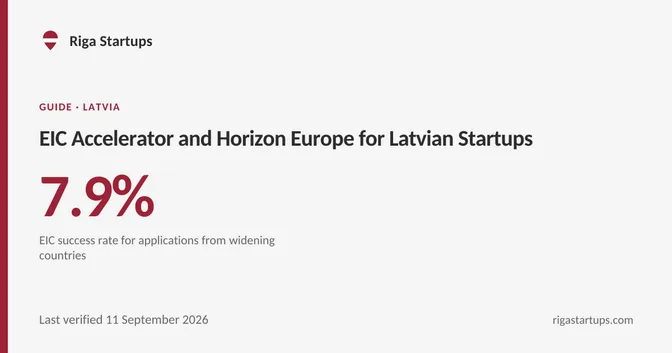
Very. Of the companies interviewed in the February 2026 round, the EIC funded 61 of the 121, and in June 38 of the 87, after the short and full proposal stages had already filtered applicants. Applications from widening countries such as Latvia succeed less often in the EIC, at 7.9% against 14.2%.
Widening countries also apply less: 16% of member state submissions to the EIC Accelerator came from them. A strong application that misses out can still win a Seal of Excellence, as 60 did in the February round, which helps it reach other EU and national funding.
It has been done from Latvia. Naco Technologies' 2023 round combined an EIC Accelerator grant with venture investment, and the funding round tracker records it.
What Does the EIC Fund's Equity Mean for Your Cap Table?
A long-term public shareholder. The EIC Fund invests through equity or convertible instruments, holds for 7 to 10 years, and at most 15, and in strategic areas may ask for the right to a blocking minority in strategic areas. It expects private co-investors, and the EIC says its equity multiplies private capital by a factor of three or more.
Before the money arrives, the company goes through due diligence by the European Investment Bank and the fund manager, and the fund looks for co-investors from its network. Treat it like any other investor: read the shareholder agreement, and model how its rights sit beside the ones your angels and funds already hold.
What Is the EIC Pre-Accelerator?
A grant for early deep tech companies in widening countries, Latvia among them, to reach the point where they can win the EIC Accelerator or raise private money. The 2027 call offers EUR 500,000 to 1 million in the 2027 call at 70% of eligible costs, for companies at TRL 4 to TRL 6.
It is open only to companies in Latvia, Estonia, Lithuania, and the other Horizon Europe widening countries. The call opens on 5 May 2027 and closes on 18 November 2027, and the last round, announced in April 2026, selected 70 companies. Winners get a fast track into the Accelerator.
How Do Horizon Europe Collaborative Calls Work for Startups?
Through consortia. EIC Pathfinder funds breakthrough research at TRL 1 to 4 with grants of EUR 4 million or more, where justified, usually to at least three independent organisations in different countries, and EIC Transition takes results towards market with grants up to EUR 2.5 million. A startup usually joins as the partner that will commercialise the technology.
The coordinator is typically a university or research institute. In Latvia, universities such as Riga Technical University and the University of Latvia are the natural first partners to approach, and Horizon Europe's national contact points advise on finding a consortium.
What Does an EIC Application Cost in Time and Money?
Mostly founder time. The short proposal is small, but the full proposal and the interview take weeks of work from the core team, and some companies pay a specialist writer. LIAA covers up to EUR 10,000 at 50% of the cost of preparing an application to an EU programme.
The bigger cost is attention. A company may have one application at a time, and months pass between a first short proposal and a decision. The public funding guide covers LIAA's application support in full.
What Are the Alternatives to EIC Funding for Latvian Deep Tech?
LIAA's science-intensive startup grant pays up to EUR 150,000 at 80% for research-based companies in a national rather than European competition, and the EIC Pre-Accelerator is a smaller EU step. Private investors move faster, and an EIC application reads stronger once they are in.
The investor directory lists the funds and angels backing Latvian startups, and the public funding guide sets out LIAA's grants.
Should Your Startup Apply for the EIC Accelerator?
Only if the technology is genuinely new, the market is large, the product is at TRL 6 or beyond, and the team can spare months of senior time. If any of those is missing, start with the Pre-Accelerator, a LIAA grant, or private investors, and come back to the EIC later.
- Is the innovation new to the market, not just to Latvia? The EIC funds products that could create or disrupt markets.
- Is the product at TRL 6 or later? At TRL 4 to 6, the Pre-Accelerator is the better fit.
- Do you want a long-term public shareholder? The equity comes with a patient investor and, in strategic areas, protective rights.
- Can the core team commit? The pitch, the full proposal, and the interview all need the people who run the company.
- Are private investors interested? The EIC Fund looks for co-investors, and their interest strengthens the case.
Frequently Asked Questions
Can Latvian Companies Apply for the EIC Accelerator?
Yes. Latvia is an EU member state, so Latvian startups and SMEs can apply, and as a widening country its companies can also apply for the EIC Pre-Accelerator.
How Much Is the EIC Accelerator Grant?
The grant is below EUR 2.5 million, as a lump sum for innovation work at TRL 6 to 8 completed within 24 months. Equity of EUR 1 million to EUR 10 million can come on top.
What Is the EIC Accelerator Success Rate?
In the February 2026 round, the EIC funded 61 of the 121 companies it interviewed, and applications from widening countries such as Latvia succeed in the EIC at 7.9% against 14.2% elsewhere.
When Is the Next EIC Pre-Accelerator Deadline?
The next call opens on 5 May 2027 and closes on 18 November 2027.
Does LIAA Help With EIC Applications?
Yes. LIAA covers up to EUR 10,000 at 50% of the cost of preparing an application to an EU programme.
Sources
- The European Innovation Council, on the EIC Accelerator, the EIC Pre-Accelerator, EIC Pathfinder, EIC Transition, and the EIC Fund's investment guidelines.
- EIC results announcements for February 2026, June 2026, and the Pre-Accelerator in April 2026.
- The Commission's data on widening participation in Horizon Europe, for success rates by group of countries.
- LIAA, on support for EU applications and the science-intensive startup grant.
- The funding round tracker, our own record of Latvian equity rounds.
This page explains what the EIC offers. Whether an application is worth the effort is a judgement about your company that only you can make.
Every Figure, and When It Was Checked
Each value links to the source it was taken from. The date is when that source was last read and matched. Where a source cannot be checked automatically, it says so.
| Figure | Value | Last checked |
|---|---|---|
| The EIC Accelerator grant component | below EUR 2.5 million, as a lump sum for innovation work at TRL 6 to 8 completed within 24 months | 11 September 2026 |
| The size of an EIC Accelerator grant | below EUR 2.5 million | 11 September 2026 |
| The EIC Accelerator investment component, as the Accelerator page states it | EUR 1 million to EUR 10 million | 11 September 2026 |
| How often a company may receive the EIC Accelerator grant | only once during Horizon Europe, which runs from 2021 to 2027 | 11 September 2026 |
| The 2026 budget for EIC Accelerator Challenges | EUR 220 million | 11 September 2026 |
| The 2026 budget for the EIC Accelerator Open | EUR 414 million | 11 September 2026 |
| When EIC Accelerator short proposals are batched for evaluation | on the first Tuesday of every month | 11 September 2026 |
| How many remote evaluators assess a short proposal | four | 11 September 2026 |
| The length of the short proposal form | 12-page | 11 September 2026 |
| How long feedback on a short proposal normally takes | four to six weeks | 11 September 2026 |
| How many EIC Accelerator applications a company may have open | one application at a time | 11 September 2026 |
| When a company from outside the EU must relocate to be eligible | before submitting the full application | 11 September 2026 |
| The size of an EIC Pathfinder grant | EUR 4 million or more, where justified | 11 September 2026 |
| Who applies to EIC Pathfinder Open | at least three independent organisations in different countries | 11 September 2026 |
| The size of an EIC Transition grant | up to EUR 2.5 million | 11 September 2026 |
| The size of an EIC Pre-Accelerator grant | EUR 500,000 to 1 million in the 2027 call | 11 September 2026 |
| The share of eligible costs the EIC Pre-Accelerator covers | 70% | 11 September 2026 |
| The readiness the EIC Pre-Accelerator is for | TRL 4 to TRL 6 | 11 September 2026 |
| Where a company must be registered to apply to the EIC Pre-Accelerator | Latvia, Estonia, Lithuania, and the other Horizon Europe widening countries | 11 September 2026 |
| When the next EIC Pre-Accelerator call opens | 5 May 2027 | 11 September 2026 |
| The deadline for the next EIC Pre-Accelerator call | 18 November 2027 | 11 September 2026 |
| The companies selected in the EIC Pre-Accelerator round announced in April 2026 | 70 | 11 September 2026 |
| How long the EIC Fund holds its investments | 7 to 10 years, and at most 15 | 11 September 2026 |
| What the EIC Fund may require to protect EU interests | the right to a blocking minority in strategic areas | 11 September 2026 |
| Who carries out the EIC Fund's due diligence | the European Investment Bank and the fund manager | 11 September 2026 |
| The EIC Fund's stated investment size for Accelerator companies | EUR 0.5 million to EUR 10 million under the Accelerator | 11 September 2026 |
| The companies funded out of those interviewed in the February 2026 EIC Accelerator round | 61 of the 121 | 11 September 2026 |
| The companies funded out of those interviewed in the June 2026 EIC Accelerator round | 38 of the 87 | 11 September 2026 |
| The applications awarded a Seal of Excellence in the February 2026 round | 60 | 11 September 2026 |
| How far the EIC says its equity draws in private capital | a factor of three or more | 11 September 2026 |
| The EIC success rate for applications from widening member states | 7.9% | 11 September 2026, by hand |
| The EIC success rate for applications from other member states | 14.2% | 11 September 2026, by hand |
| The share of member state EIC Accelerator submissions that came from widening countries | 16% | 11 September 2026, by hand |
| The most LIAA pays towards preparing an application to an EU programme | EUR 10,000 | 11 September 2026 |
| The share of EU application preparation costs LIAA covers | 50% | 11 September 2026 |
| The most the science-intensive startup grant pays one company | EUR 150,000 | 11 September 2026 |
| The highest share of costs the science-intensive startup grant covers | 80% | 11 September 2026 |