Reports
Recurring statistics computed from the Latvian Register of Enterprises and the job boards Latvian companies actually use. Every report names its population, states its dump date, and publishes the numbers behind each chart.
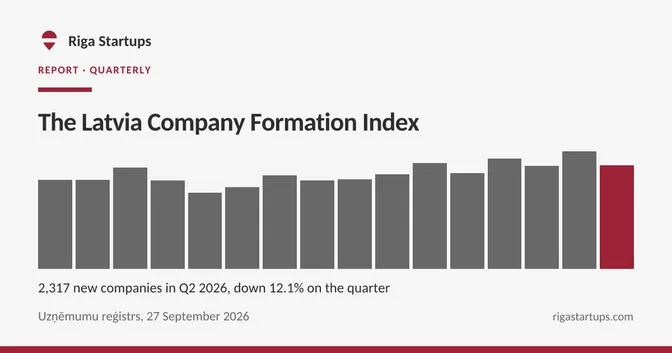
The Latvia Company Formation Index
How many limited companies were registered last quarter, where, and at what capitalisation. 46 quarters back to Q1 2015.
Quarterly · latest Q2 2026: 2,317 formations, +8.2% year on year · updated 27 September 2026
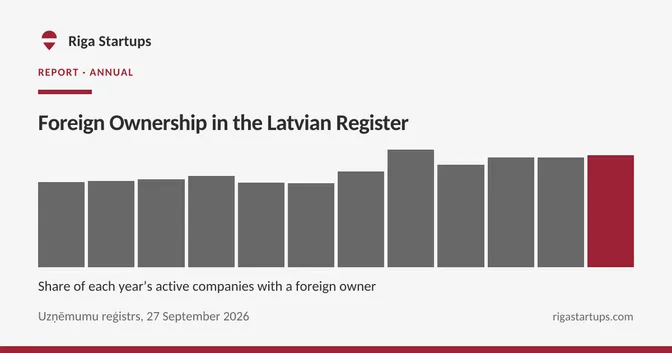
Foreign Ownership in the Latvian Register
How many Latvian companies have a non-Latvian beneficial owner, where those owners are from, whether they live here, and how the mix has shifted since 2015.
Annual · 12.3% of active companies, and 17.5% of those on this map · updated 27 September 2026
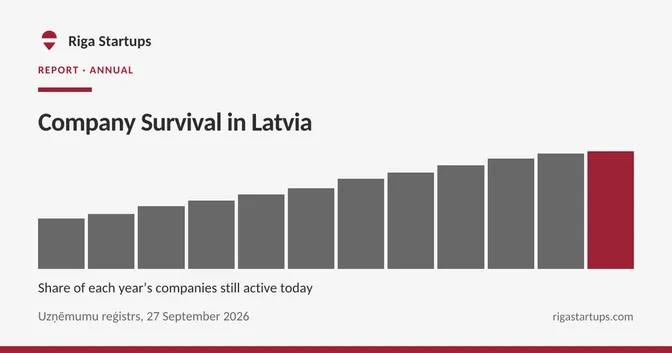
Company Survival in Latvia
What share of the companies registered in each year since 2015 were still on the register at 12, 24, 36, 48 and 60 months. Measured at matching ages, which is what makes the cohorts comparable.
Annual · 9 cohorts · 93.6% to 96.7% still registered after two years · updated 27 September 2026
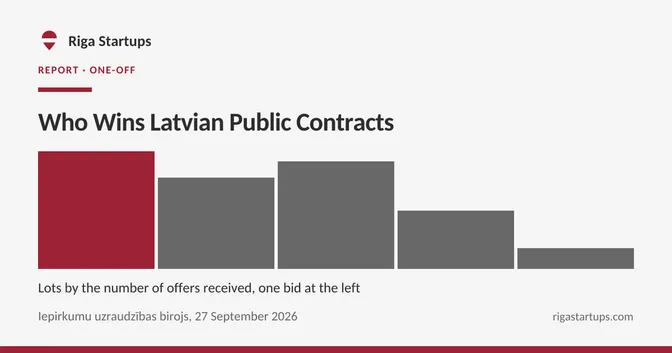
Who Wins Latvian Public Contracts
Every procurement notice Latvia has published since e-forms began: how big a typical contract is, how few people bid for one, what size of firm wins, and the companies on this map that have won something.
One-off · 29.7% of lots draw a single bid · updated 27 September 2026
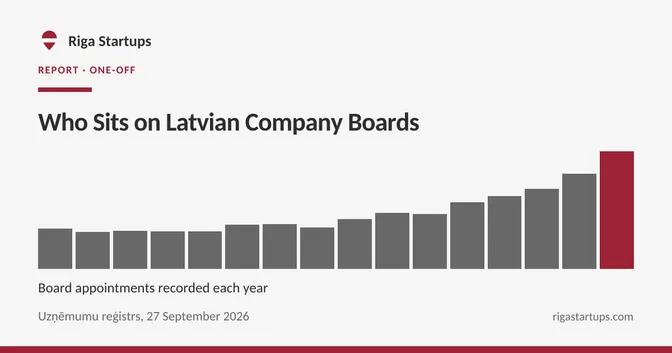
Who Sits on Latvian Company Boards
Board size, joint representation, how recently boards were appointed and how many boards one person sits on, across every active Latvian limited company, and why the register cannot show you a resignation.
One-off · 84.3% have a sole director · updated 27 September 2026
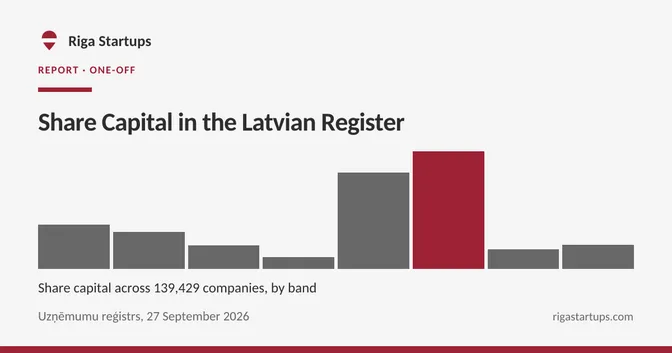
Share Capital in the Latvian Register
Whether founders really use the one-euro SIA, counted across every active company rather than guessed at, and why the question everyone asks next cannot be answered from this register at all.
One-off · 31.1% of active companies are below the EUR 2,800 minimum, and 16.1% of those on this map · updated 27 September 2026
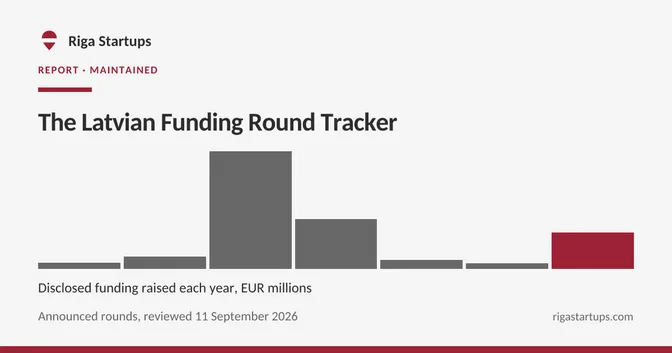
The Latvian Funding Round Tracker
Every publicly announced equity round into a Latvian startup since 2019, with its source: totals by year and quarter, round sizes by stage, the most active investors, and a check against filed accounts.
Maintained · 80 rounds, EUR 475.6M · reviewed 11 September 2026
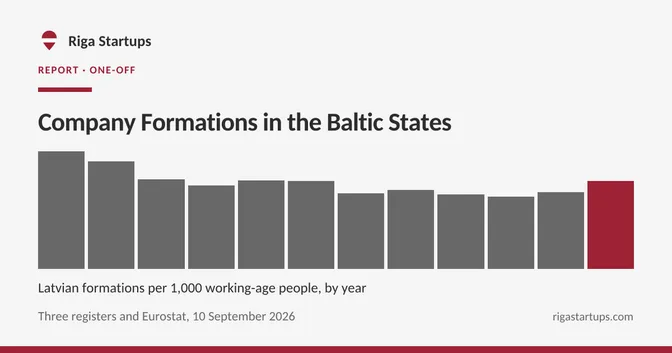
Company Formations in the Baltic States
How many limited-liability companies Latvia, Estonia and Lithuania register per working-age resident, how long businesses last, and why the figure usually quoted for Lithuania leaves most of its companies out.
One-off · Estonia 26.5, Lithuania 7.6 and Latvia 6.9 per 1,000 in 2024 · updated 10 September 2026
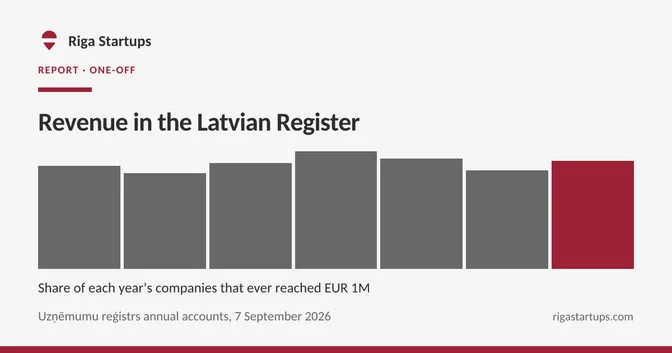
Revenue in the Latvian Register
What Latvian companies turn over and earn per employee, how many ever reach EUR 1M or EUR 10M and how fast, and five years of turnover in real terms, from filed annual accounts.
One-off · 7,977 companies over EUR 1M in 2025 · updated 7 September 2026
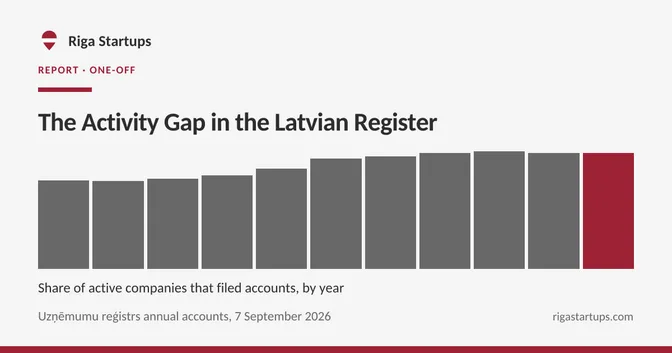
The Activity Gap in the Latvian Register
How many of the companies the register calls active show any sign of trading in the accounts they file, in four stated tiers, by company age and since 2014.
One-off · 84,973 of 123,862 companies reported turnover · updated 7 September 2026
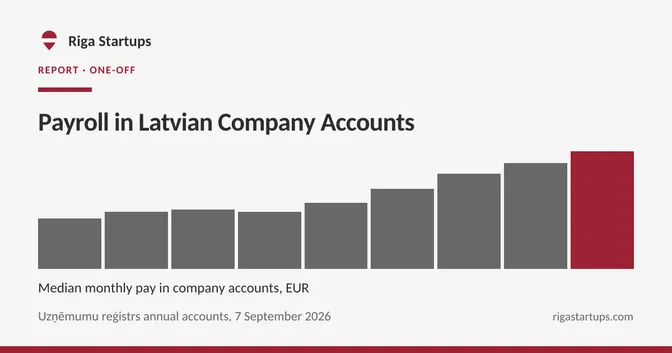
Payroll in Latvian Company Accounts
What Latvian companies spend on staff per employee, read from filed annual accounts rather than job adverts, by company size and against inflation, and why most accounts cannot say.
One-off · median EUR 771 a month per employee in 2025 · updated 7 September 2026
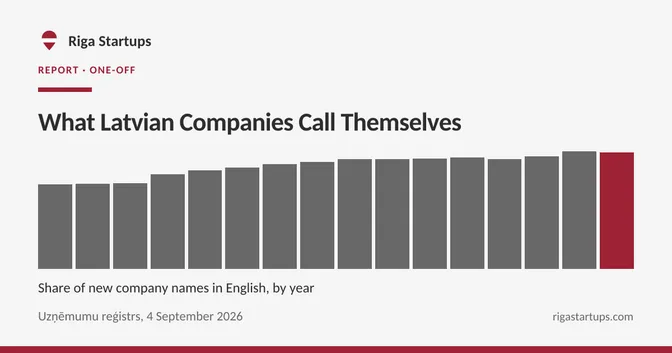
What Latvian Companies Call Themselves
The language of every limited company name since 1991, the year English overtook Latvian, the words everyone reaches for, who names in English, and whether a name has anything to do with survival.
One-off · 43% English in 2025 · updated 4 September 2026
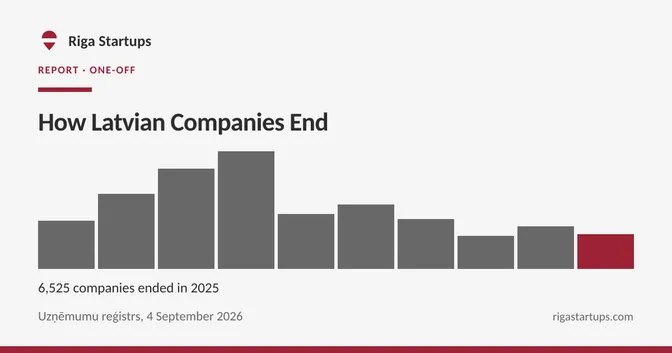
How Latvian Companies End
Every limited company the register ended since 2016, by whether it merged, went through insolvency, stopped filing first or was still trading, with the stated reasons, how long each takes, and what becomes of silent companies.
One-off · 6,525 endings in 2025 · updated 4 September 2026
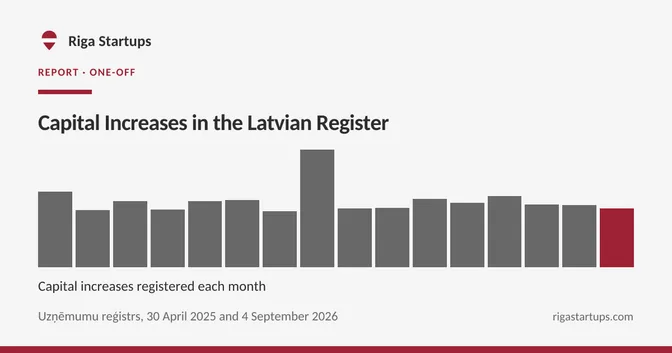
Capital Increases in the Latvian Register
Which Latvian companies raised their share capital, by how much, how many left the reduced-capital regime, and whether a new shareholder came with it, from an archived copy of the register set beside today’s.
One-off · 3,959 increases in 16.2 months · updated 4 September 2026
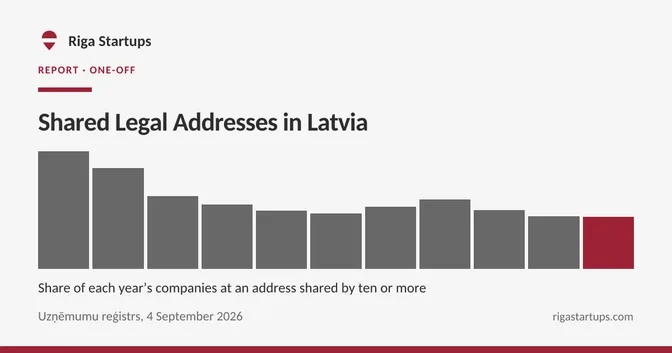
Shared Legal Addresses in Latvia
How many Latvian companies share a legal address, which addresses hold the most, and who registers there, grouped by the address register’s own codes and described rather than judged.
One-off · 9.1% of active companies share an address with nine or more others · updated 4 September 2026
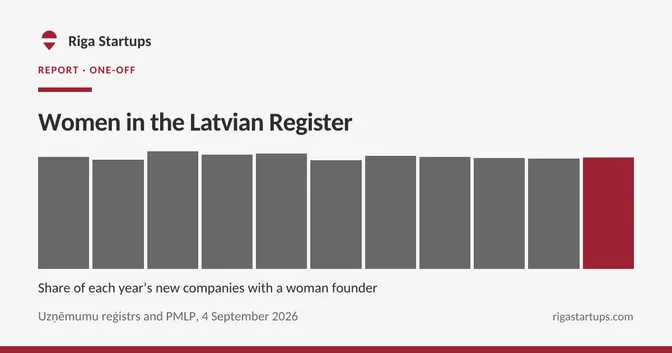
Women in the Latvian Register
How many Latvian companies have a woman among their founders and owners, in what kinds of team and where, with sex read from given names using the population register’s own counts.
One-off · 35.6% of new companies have a woman founder · updated 4 September 2026
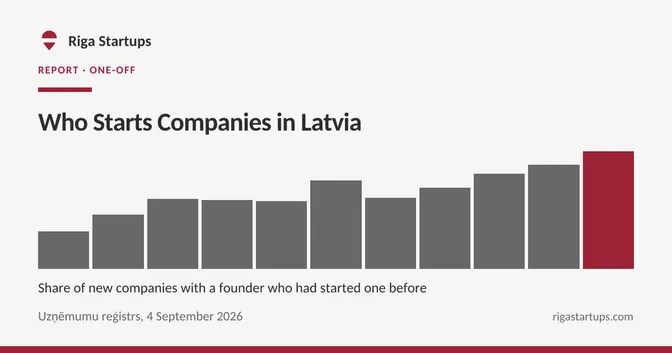
Who Starts Companies in Latvia
How old people are when they register a company, how many run more than one, and how far apart those companies come, from the register of who held the shares on day one.
One-off · median founder age 37 at registration · updated 4 September 2026
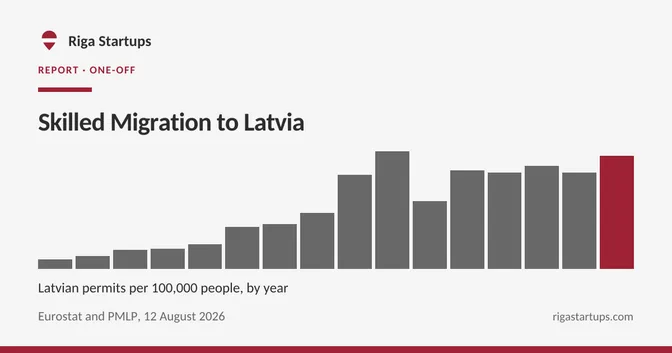
Skilled Migration to Latvia
How many Blue Cards and employment permits Latvia issues, who they go to and what the Blue Cards were for, measured against Estonia and Lithuania on one Eurostat definition.
One-off · Lithuania issued 26 times as many Blue Cards as Latvia in 2025 · updated 12 August 2026
Coming Soon
Dates are set by when the evidence arrives rather than by when it would be good to publish, so each one says what it is waiting for. A report goes out when it can be defended and not before.
The Hiring Report
November 2026Monthly
Roles opened and closed across Latvian company job boards, how long a role stays open, which functions are hiring, and the share of adverts that state a salary. Read nightly from each company’s own feed rather than from a jobs aggregator.
Waiting on: History. The nightly observation store began on 6 September 2026 and a role that was already open then has no observed opening date, so time-to-close reads low until those roles clear. The first honest edition covers October.
Pay Transparency Benchmark
May 2027Annual
Whether employers advertising in Latvia state pay as the law requires, how wide the stated ranges are, and how that differs by function and seniority. Framed against the EU pay transparency directive and where Latvian law actually stands at publication.
Waiting on: A reader that examines adverts, not database fields. Latvian law has required a job advertisement to state the pay since 22 October 2024, and employers satisfy that in prose: of nine Riga roles on one board that our reader records as stating nothing, five carry a gross euro range written into the description. So the share we can currently measure is a floor on disclosure and not a rate, and publishing it as a rate would accuse companies that are complying. A full year of adverts is the second thing it needs; a year-on-year comparison needs May 2028.
The Offshore Drift
June 2027Annual
How many Latvian companies wind up their Latvian entity while carrying on trading from a holding company abroad, where they go, and at what stage it happens. The gap between register survival and actual survival.
Waiting on: Human verification, not data. Detecting candidates is code: a company struck off the register whose website, job feed and social accounts are all still alive. Confirming one is editorial, needs a named public source per company, and every named company gets two weeks of right of reply first. One wrong entry here costs more than the report earns.
The Startup Survival Line
2028Added to the survival curve
The second line on the survival curve: how startups specifically fare against the register-wide baseline already published. The gap between the two is the point.
Waiting on: Witnessed closures. It cannot be back-filled, because the directory was built from sources that only ever listed companies which still existed, and it therefore shows almost no deaths at all. From 6 September 2026 every listed company is recorded nightly, so closures are observed rather than inferred. That needs roughly two years to say anything.
A share capital report was planned as a separate piece and will not appear. Most of it is already inside the formation index, and its most interesting question, whether minimum-capital companies survive differently, cannot be answered: the register publishes capital for companies that still exist and for no others, so there is no figure for any company that closed.