Survival Curve
Company Survival in Latvia
Of every limited company registered in Latvia since 2015, 93.6% to 96.7% were still on the register two years later, and 70.3% to 72.8% were still there after five. Those ranges cover 9 separate formation years, and they barely move. Company survival in Latvia is not getting better or worse: it is remarkably steady.
Source: Uzņēmumu reģistrs open data, dump of 27 September 2026, covering registrations through 25 September 2026. Population REGISTER_BASELINE (SIA and AS), 109,520 companies across 12 formation years. Definitions v4. Methodology.
What Is the Company Survival Rate in Latvia?
Between 70.3% and 72.8% of Latvian limited companies are still registered five years after formation, across the 6 formation years old enough to measure, and 93.6% to 96.7% after two. The range barely moves from one year to the next, so survival is neither improving nor worsening.
Survival by Age, Not by Date
Show the numbers
| Cohort | Formed | 12m | 24m | 36m | 48m | 60m | Today |
|---|---|---|---|---|---|---|---|
| 2,015 | 12,610 | 99.4% | 96% | 91% | 79.1% | 71.4% | 42.8% |
| 2,016 | 10,370 | 99.2% | 96.7% | 89.3% | 80.7% | 70.3% | 46.5% |
| 2,017 | 9,401 | 99.1% | 95.6% | 89.2% | 80.4% | 70.6% | 53% |
| 2,018 | 9,923 | 99% | 95.8% | 89.2% | 78.7% | 71.6% | 58.2% |
| 2,019 | 9,629 | 99% | 95% | 87.2% | 79.1% | 72.6% | 63.3% |
| 2,020 | 8,261 | 98.8% | 94.6% | 88% | 79.3% | 72.8% | 68.5% |
| 2,021 | 8,519 | 99% | 95% | 88.2% | 81.3% | - | 76.3% |
| 2,022 | 7,924 | 98.9% | 93.6% | 87.1% | - | - | 81.7% |
| 2,023 | 7,790 | 98.7% | 93.6% | - | - | - | 87.7% |
Why Is Company Survival Measured by Age Rather Than Date?
Because counting who is alive today mostly measures how long each cohort has had to fail. Measured at matching ages, two year survival across 9 cohorts spans 3.1 percentage points, so a company registered in 2015 and one registered in 2023 faced almost exactly the same odds.
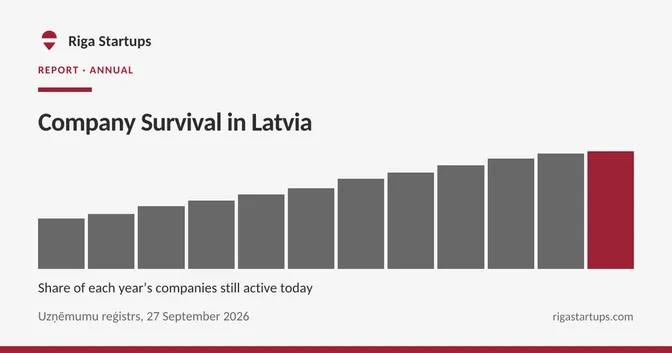
Ask how many companies from each year are alive today and the answer looks dramatic: 42.8% of the 2015 cohort against 99.8% of the 2026 one. It reads like a collapse in company longevity, and it is nothing of the sort. The 2015 cohort has had eleven years to fail and the newest has had months. That chart measures age.
Measured at matching ages the picture inverts. Two year survival across 9 cohorts spans 3.1 percentage points, and five year survival spans 2.5. A company registered in 2015 and one registered in 2023 faced almost exactly the same odds, through a pandemic and a war on the border.
This is the single most common error in company statistics, and it is why each line above stops where its cohort’s evidence stops rather than running to the edge.
Where in Latvia Do Companies Survive Longest?
Among municipalities with at least 200 formations, two year survival is highest in Dienvidkurzemes nov., at 98.1%, and lowest in Krāslavas nov., at 92.1%, pooled across the 9 cohorts old enough to have a figure. Each rate carries a margin of error, which the table under the chart gives for every municipality.
Survival by Municipality
- Dienvidkurzemes nov.98.1 per cent surviving
- Ropažu nov.97.7 per cent surviving
- Talsu nov.97.7 per cent surviving
- Jelgavas nov.97.7 per cent surviving
- Ķekavas nov.97.6 per cent surviving
- Valmieras nov.97.5 per cent surviving
- Saldus nov.97.4 per cent surviving
- Ludzas nov.97.4 per cent surviving
- Ventspils nov.97.3 per cent surviving
- Limbažu nov.97.2 per cent surviving
Show the numbers
| Municipality | Formed | 24m survival | Margin |
|---|---|---|---|
| Dienvidkurzemes nov. | 824 | 98.1% | +/- 0.9 pts |
| Ropažu nov. | 1,535 | 97.7% | +/- 0.7 pts |
| Talsu nov. | 954 | 97.7% | +/- 1 pts |
| Jelgavas nov. | 952 | 97.7% | +/- 1 pts |
| Ķekavas nov. | 1,471 | 97.6% | +/- 0.8 pts |
| Valmieras nov. | 1,412 | 97.5% | +/- 0.8 pts |
| Saldus nov. | 736 | 97.4% | +/- 1.1 pts |
| Ludzas nov. | 384 | 97.4% | +/- 1.6 pts |
| Ventspils nov. | 264 | 97.3% | +/- 2 pts |
| Limbažu nov. | 815 | 97.2% | +/- 1.1 pts |
| Tukuma nov. | 1,200 | 97.1% | +/- 0.9 pts |
| Siguldas nov. | 1,313 | 97% | +/- 0.9 pts |
| Jēkabpils nov. | 868 | 97% | +/- 1.1 pts |
| Salaspils nov. | 918 | 96.9% | +/- 1.1 pts |
| Mārupes nov. | 2,506 | 96.9% | +/- 0.7 pts |
| Ogres nov. | 2,144 | 96.8% | +/- 0.7 pts |
| Madonas nov. | 1,008 | 96.8% | +/- 1.1 pts |
| Kuldīgas nov. | 874 | 96.7% | +/- 1.2 pts |
| Alūksnes nov. | 322 | 96.6% | +/- 2 pts |
| Smiltenes nov. | 414 | 96.4% | +/- 1.8 pts |
| Aizkraukles nov. | 670 | 96.3% | +/- 1.4 pts |
| Cēsu nov. | 1,463 | 96.1% | +/- 1 pts |
| Jelgava | 1,972 | 95.9% | +/- 0.9 pts |
| Augšdaugavas nov. | 454 | 95.8% | +/- 1.8 pts |
| Dobeles nov. | 812 | 95.6% | +/- 1.4 pts |
| Saulkrastu nov. | 454 | 95.6% | +/- 1.9 pts |
| Bauskas nov. | 1,023 | 95.6% | +/- 1.3 pts |
| Rēzekne | 647 | 95.5% | +/- 1.6 pts |
| Ādažu nov. | 1,058 | 95.3% | +/- 1.3 pts |
| Liepāja | 2,000 | 95.3% | +/- 0.9 pts |
| Olaines nov. | 875 | 95.3% | +/- 1.4 pts |
| Balvu nov. | 449 | 95.3% | +/- 2 pts |
| Ventspils | 746 | 95.2% | +/- 1.5 pts |
| Preiļu nov. | 236 | 94.9% | +/- 2.8 pts |
| Rīga | 43,278 | 94.8% | +/- 0.2 pts |
| Gulbenes nov. | 494 | 94.7% | +/- 2 pts |
| Jūrmala | 2,433 | 94.6% | +/- 0.9 pts |
| Rēzeknes nov. | 455 | 94.5% | +/- 2.1 pts |
| Daugavpils | 1,819 | 94.3% | +/- 1.1 pts |
| Krāslavas nov. | 570 | 92.1% | +/- 2.2 pts |
What Does Latvian Company Survival Data Not Show?
Startup survival, for one: it counts every limited company, including holding vehicles and family firms. Struck off is not dead either, since a terminated entity may have moved abroad or merged, and registered is not trading, since a dormant company counts as surviving. Read these as register survival, not business survival.
This is not startup survival. It counts every limited company, including holding vehicles that never trade and family firms that never intended to grow. Latvia publishes no industry classification per company, and a technology filter cannot be built for companies that no longer exist, because every signal that marks a company as technology dies with it. The reasoning is on the methodology page.
A startup line is coming, and it is not here yet. Since 6 September 2026 every company we list is recorded nightly, so closures are witnessed rather than inferred. That series can carry an honest startup curve from around 2028. It cannot be back-filled from our directory, which was assembled from sources that only ever listed companies that still existed and therefore shows almost no deaths at all.
Struck off is not dead. A terminated Latvian entity may be a company that moved abroad, merged, or re-registered in another form. The plan for this report calls for a second line excluding companies known to have re-domiciled; that list does not exist yet, so 0 companies are excluded on those grounds and the raw register figure is all you see. Read these as register survival, not as business survival.
Registered is not trading. A dormant company that files nothing and employs nobody counts as surviving here, which is part of why five year survival looks generous next to the mortality founders describe.
Frequently Asked Questions
What Share of Latvian Companies Survive Two Years?
Between 93.6% and 96.7% of the limited companies registered in Latvia in each year from 2015 to 2023 were still on the register two years later, across 9 formation years.
What Share of Latvian Companies Survive Five Years?
Between 70.3% and 72.8% of Latvian limited companies were still registered five years after formation, across the 6 formation years old enough to have a five year figure.
Is Company Survival in Latvia Getting Worse?
No. Measured at the same ages, two year survival across 9 cohorts spans 3.1 percentage points and five year survival 2.5, through a pandemic and a war on the border.
Does Struck Off Mean a Latvian Company Failed?
Not always. A terminated Latvian entity may be a company that moved abroad, merged, or re-registered in another form, so these figures measure register survival rather than business survival.
Where Does the Latvian Company Survival Data Come From?
From the Uzņēmumu reģistrs open data, dump of 27 September 2026, covering 109,520 limited companies across 12 formation years, each measured at 12, 24, 36, 48 and 60 months of age.
Definitions Changelog
- v4, 9 September 2026. Added BambooHR to the machine readable boards. It is the ninth board we can read and the first found by crawling company careers pages rather than by guessing an account name. It carries no salary field, so it is deliberately absent from the boards that can state pay, and adding it lowers the share of roles on a pay capable board without any employer having changed what they disclose.
Cite This
Sageo SIA (2026). Company Survival in Latvia. Riga Startups. Computed from Uzņēmumu reģistrs open data, extract of 2026-09-27. https://rigastartups.com/reports/company-survival
Permalink: https://rigastartups.com/reports/company-survival · CSV for this edition
The numbers are free to reuse. The register data underneath is CC0 and this analysis of it is offered on the same terms. An attribution and a link back is the whole ask.
Related
The Latvia Company Formation Index counts the other end of the same pipe: how many companies are registered each quarter, where, and at what capitalisation.