Report · One-off
Who Sits on Latvian Company Boards
The Latvian company is a one-person institution. Of the 138,557 active limited companies with a named person on the board, 84.3% have exactly one, and the median company last registered an appointment 6.1 years ago. Startups are the exception: 60.2% of the companies on this map run with a sole director.
How Big Is a Latvian Company Board?
One person, nearly always. 116,841 of 138,557 active limited companies with a named board have a single member, or 84.3%. Two members account for 12.9%, three for 2.2%, and four or more for 0.5%.
That is a fact about Latvian companies rather than about Latvian startups. A SIA can be founded and run by one person, most are, and the register counts the corner shop and the holding company alongside anything venture backed. The map's own companies look different further down this page.
Board size, active limited companies
- One116,841 companies
- Two17,916 companies
- Three3,092 companies
- Four or more708 companies
Show the numbers
| Board size | Companies | Share |
|---|---|---|
| One | 116,841 | 84.3% |
| Two | 17,916 | 12.9% |
| Three | 3,092 | 2.2% |
| Four or more | 708 | 0.5% |
When Were Today’s Boards Appointed?
The median company last registered an appointment 6.1 years ago, and 12.5% registered one in the last year. Among companies more than a year old, 4.6% have a board whose every member was appointed inside the last year, which is the closest thing to replacement this file can show.
The two shares answer different questions. 11.4% of all companies have a board appointed entirely within the year, but most of those are companies that did not exist a year ago. Removing them leaves 5,909 established companies out of 128,668, and even that is a ceiling rather than a turnover rate, because an appointment that replaced someone and an appointment that added someone are the same row here.
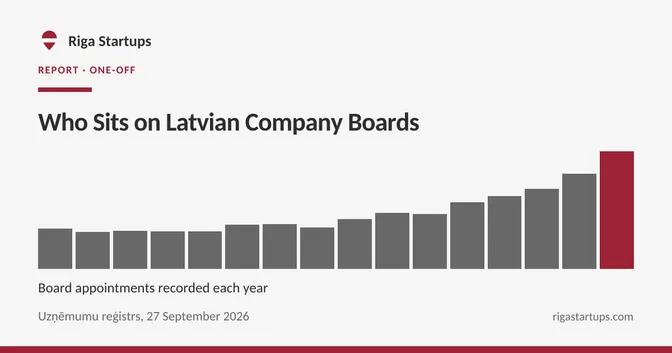
Appointments registered each year
Show the numbers
| Year | Appointments |
|---|---|
| 2007 | 2,441 |
| 2008 | 4,009 |
| 2009 | 9,430 |
| 2010 | 5,916 |
| 2011 | 5,366 |
| 2012 | 5,549 |
| 2013 | 5,504 |
| 2014 | 5,480 |
| 2015 | 6,437 |
| 2016 | 6,524 |
| 2017 | 6,076 |
| 2018 | 7,290 |
| 2019 | 8,192 |
| 2020 | 7,993 |
| 2021 | 9,746 |
| 2022 | 10,651 |
| 2023 | 11,667 |
| 2024 | 13,895 |
| 2025 | 17,185 |
| 2026 (to date) | 15,493 |
Why Do the Dates Start in 2007?
Because the file records when an appointment entered the register’s own system, not when the person joined the board. Of the 25,709 companies incorporated before 2007, 0.5% show their earliest current appointment before that year, while 39.2% show it in 2007 to 2009.
If these dates were appointments, the companies that existed in the 1990s would carry appointments from the 1990s. They do not: 141 appointments in the whole file predate 2007, which is 0.1% of them. The practical consequence is that every tenure here is a floor. A board member recorded as appointed in 2007 may have been there since the company was founded, and the 33.3% of appointments in the ten to twenty year band is where the data stops rather than where Latvian boards settle.
It also means the 12.5% of companies with an appointment in the last year is sound, since recent dates are recorded as they happen. It is the long end that is censored, not the short one.
How long ago the appointments still in place were registered
- Under a year20,205 appointments
- One to three years29,360 appointments
- Three to five years21,828 appointments
- Five to ten years38,461 appointments
- Ten to twenty years55,009 appointments
- Twenty years or more122 appointments
Show the numbers
| Registered | Appointments | Share |
|---|---|---|
| Under a year | 20,205 | 12.2% |
| One to three years | 29,360 | 17.8% |
| Three to five years | 21,828 | 13.2% |
| Five to ten years | 38,461 | 23.3% |
| Ten to twenty years | 55,009 | 33.3% |
| Twenty years or more | 122 | 0.1% |
Can One Board Member Act Alone?
In 98.0% of companies with a named board, yes: every member may represent the company on their own. Joint representation is rare overall, and concentrated where it can exist at all. Among the 21,716 companies with more than one member, 14.9% require some form of acting together.
This matters for anyone signing with a Latvian company. The register states, for each officer, whether they may represent the company alone, only with at least a stated number of colleagues, or only with all of them, and a signature outside that rule is a defect a counterparty can be left holding.
Rights of representation
- Each member may act alone135,741 companies
- Jointly, with every member1,769 companies
- Jointly, with at least a stated number1,612 companies
- Jointly, with the chair124 companies
- Jointly, under more than one rule0 companies
Show the numbers
| Rule | Companies | Share |
|---|---|---|
| Each member may act alone | 135,741 | 98.0% |
| Jointly, with every member | 1,769 | 1.3% |
| Jointly, with at least a stated number | 1,612 | 1.2% |
| Jointly, with the chair | 124 | 0.1% |
| Jointly, under more than one rule | fewer than 20 | 0.0% |
How Many Boards Does One Person Sit On?
Most sit on one. Of 113,480 distinct names, 76.3% appear on a single company and 14.8% on two. 337 names appear on more than ten boards, which is the professional director population, or the namesakes, and the file cannot tell you which.
Names are matched after stripping accents, case and punctuation, and are hashed before counting, so nothing here identifies anyone. Two people who share a name are one row in this cut, and common surnames make the tail an upper bound rather than a count of individuals.
Boards per person
- One company86,560 names
- Two companies16,841 names
- Three to five8,355 names
- Six to ten1,387 names
- More than ten337 names
Show the numbers
| Boards | People | Share |
|---|---|---|
| One company | 86,560 | 76.3% |
| Two companies | 16,841 | 14.8% |
| Three to five | 8,355 | 7.4% |
| Six to ten | 1,387 | 1.2% |
| More than ten | 337 | 0.3% |
Do Older Companies Keep the Same Board?
They keep a smaller one for longer. Companies fifteen years old or more show a sole director in 79.2% of cases against 86.1% of companies under a year old, and their most recent appointment is 14.1 years old against 0.5 years.
The pattern by legal form is sharper than the pattern by age. Of 137,791 SIA, 84.5% have a sole director; of 766 AS, 54.6% do, and an AS has registered an appointment far more recently, a median of 1.9 years ago against 6.2 years. A public company has a council and an audit trail; a private one frequently has one person.
Sole directors by company age
- Under a year old86.1 %
- One to five years86 %
- Five to fifteen years87.2 %
- Fifteen years or more79.2 %
Show the numbers
| Company age | Companies | Sole director | Median since last appointment |
|---|---|---|---|
| Under a year old | 9,889 | 86.1% | 0.5 years |
| One to five years | 28,754 | 86.0% | 2.4 years |
| Five to fifteen years | 56,142 | 87.2% | 7.6 years |
| Fifteen years or more | 43,772 | 79.2% | 14.1 years |
Do Startups Run Bigger Boards Than Other Companies?
Yes, by a wide margin. 60.2% of the 576 startups and scaleups on this map have a sole director, against 84.3% of active limited companies. They also appoint more often: 16.3% registered an appointment in the last year against 12.5%.
Two founders on the board instead of one is the ordinary shape of a company built to raise money, and a company that has raised usually adds someone. The map's population is small and curated, and it is not a sample of Latvian startups so much as the ones we have verified against the register, so read the gap as a difference between populations rather than a measurement of the whole sector.
What Else Does the Officers File Show?
Three things worth naming: 5,320 liquidator appointments sitting on companies that are ending,fewer than 20 companies with another company in an officer role, and a position breakdown in which board member and chair account for nearly everything.
Liquidators. 5,320 appointments on active limited companies are liquidators rather than board members, which is the ending in progress rather than a board. How Latvian companies end covers what happens next, and the liquidation guide covers doing it deliberately.
Companies as officers. fewer than 20 active limited companies have a company rather than a person in an officer role. The board of a Latvian SIA is a role for people.
Positions. board member 128,140, chair of the board 30,788, liquidator 5,320, administrator 715.
Method
Computed from the Register of Enterprises officers file, an extract of 27 September 2026, joined to the company register of 27 September 2026. The population is active SIA and AS with at least one named natural person on the board: 138,557 of 140,286 active limited companies, or 98.8%. Of the file's 282,473 rows, 164,985 belong to those companies and 117,488 to other legal forms, which this report does not count.
- No turnover, anywhere on this page. The file describes the officers registered on the extract date. 0 of its rows belong to a company the register has ended, and it has no end date, status or reason column, so a departure leaves no trace. A report on board churn needs a source that does not exist as open data, or a series of snapshots taken over time.
- Dates are registrations, not appointments. See the section above: tenure is a floor, censored around 2007.
- Personal data. The file carries a masked personal identity code and a birth date. Neither is read. Names are used only to count how many boards a person sits on, hashed in memory, and never stored.
- Withheld figures. A count from 1 to 19 is shown as fewer than 20, and no share or median is published over fewer than 200 companies or where its count is withheld.
Definitions are frozen at version 4. The full set is on the methodology page.
Frequently Asked Questions
How Many Latvian Companies Have a Single Director?
116,841 of the 138,557 active SIA and AS with a named person on the board, or 84.3%, have exactly one. Boards of two account for 12.9% and boards of four or more for 0.5%.
Does the Latvian Register Show When a Director Resigned?
No. The officers file lists the officers registered on the extract date and carries no end date: 0 of its 282,473 rows belong to a company the register has ended. Departures are therefore invisible, and no turnover rate can be computed from it.
How Long Have Latvian Company Boards Been in Place?
The median company last registered an appointment 6.1 years ago. 12.5% of companies registered an appointment in the last year, though the file's dates begin around 2007 and tenure cannot be read further back than that.
Can a Latvian Board Member Act Alone?
Usually. In 98.0% of companies with a named board, every member may represent the company alone. Among boards of more than one member, 14.9% require members to act jointly in some form.
How Many Boards Does One Person Sit On in Latvia?
Of 113,480 distinct names on Latvian limited company boards, 76.3% appear on one company and 337 appear on more than ten. Namesakes cannot be told apart from the file, so the tail is an upper bound.
Cite This
Sageo SIA (2026). Who Sits on Latvian Company Boards. Riga Startups. Computed from the Uzņēmumu reģistrs officers file, extract of 27 September 2026, joined to the company register of 27 September 2026. https://rigastartups.com/reports/board-composition
Permalink: https://rigastartups.com/reports/board-composition · CSV for this edition
The Register publishes these files as CC0. This analysis is free to reuse: credit the source and link back. No personal data from the file is republished.
Sources
- Uzņēmumu reģistrs officers file, the board members and other representatives registered for every legal entity. Extract of 27 September 2026.
- Uzņēmumu reģistrs open data, the company register, for legal form, incorporation date and whether a company is still registered. Extract of 27 September 2026.