Foreign Ownership
Foreign Ownership in the Latvian Register
12.3% of Latvia’s active limited companies have at least one non-Latvian beneficial owner, and 48.4% of those owners live in Latvia. Among the 553 companies on this map the share is 17.5%. The register records an owner for 99.1% of active companies, so this is close to a census rather than a sample.
Source: Uzņēmumu reģistrs beneficial owners and company register, both CC0, dump of 27 September 2026. Population REGISTER_BASELINE, active companies only. 76,846 companies. Definitions v4. Methodology.
How Many Latvian Companies Have Foreign Owners?
12.3% of Latvia’s active limited companies, 9,343 in all, have at least one non-Latvian beneficial owner, and 48.4% of those owners live in Latvia. The largest nationalities are Russia, Lithuania and Ukraine, and among the companies on this map the share is 17.5%.
Where the Owners Are From
- Russia1,163 companies
- Lithuania1,131 companies
- Ukraine1,066 companies
- Estonia809 companies
- Germany571 companies
- India555 companies
- Israel265 companies
- United Kingdom252 companies
- Belarus248 companies
- Italy236 companies
- Uzbekistan223 companies
- France210 companies
Show the numbers
| Nationality | Companies | Share of active |
|---|---|---|
| Russia | 1,163 | 1.5% |
| Lithuania | 1,131 | 1.5% |
| Ukraine | 1,066 | 1.4% |
| Estonia | 809 | 1.1% |
| Germany | 571 | 0.7% |
| India | 555 | 0.7% |
| Israel | 265 | 0.3% |
| United Kingdom | 252 | 0.3% |
| Belarus | 248 | 0.3% |
| Italy | 236 | 0.3% |
| Uzbekistan | 223 | 0.3% |
| France | 210 | 0.3% |
| Sweden | 182 | 0.2% |
| United States | 176 | 0.2% |
| Turkey | 174 | 0.2% |
| Denmark | 151 | 0.2% |
| Poland | 127 | 0.2% |
| Netherlands | 124 | 0.2% |
| Azerbaijan | 122 | 0.2% |
| Finland | 119 | 0.2% |
| China | 111 | 0.1% |
| Norway | 104 | 0.1% |
| Georgia | 96 | 0.1% |
| Pakistan | 95 | 0.1% |
| Romania | 82 | 0.1% |
| Kazakhstan | 71 | 0.1% |
| Belgium | 68 | 0.1% |
| Spain | 65 | 0.1% |
| Cyprus | 60 | 0.1% |
| Armenia | 60 | 0.1% |
| Canada | 58 | 0.1% |
| Austria | 55 | 0.1% |
| Switzerland | 53 | 0.1% |
| Moldova | 53 | 0.1% |
| Ireland | 49 | 0.1% |
| Bulgaria | 41 | 0.1% |
| Kyrgyzstan | 39 | 0.1% |
| MT | 35 | 0% |
| EG | 33 | 0% |
| Hungary | 32 | 0% |
| Portugal | 31 | 0% |
| Czechia | 29 | 0% |
| Australia | 27 | 0% |
| LK | 27 | 0% |
| Vietnam | 23 | 0% |
| IS | 23 | 0% |
| TJ | 22 | 0% |
| Greece | 22 | 0% |
| Slovakia | 21 | 0% |
How Has Foreign Ownership of Latvian Companies Changed?
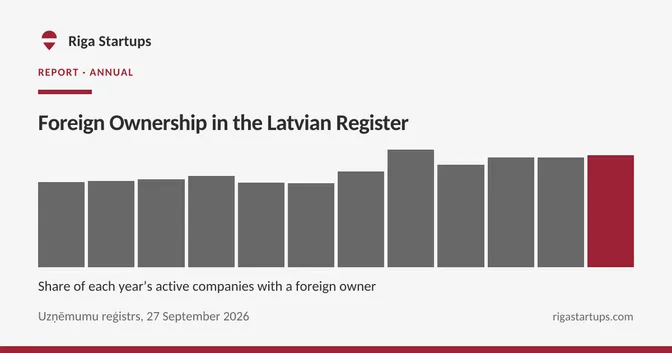
Of active companies formed in 2015, 10.6% have a foreign owner, against 13.9% of those formed in 2026, a part year. The series describes survivors only, but the bias check below finds foreign ownership close to independent of survival, so the movement after 2021 is large enough to survive the doubt.
Foreign Ownership by Formation Year
Show the numbers
| Formed | Active | Foreign owned | Share |
|---|---|---|---|
| 2,015 | 5,343 | 567 | 10.6% |
| 2,016 | 4,783 | 510 | 10.7% |
| 2,017 | 4,937 | 537 | 10.9% |
| 2,018 | 5,719 | 646 | 11.3% |
| 2,019 | 6,055 | 634 | 10.5% |
| 2,020 | 5,588 | 580 | 10.4% |
| 2,021 | 6,435 | 768 | 11.9% |
| 2,022 | 6,377 | 931 | 14.6% |
| 2,023 | 6,771 | 857 | 12.7% |
| 2,024 | 7,614 | 1,038 | 13.6% |
| 2,025 | 9,039 | 1,232 | 13.6% |
| 2,026 | 7,523 | 1,043 | 13.9% |
Which Nationalities Are Registering More Latvian Companies?
Indian owners have grown fastest, roughly tenfold across the period in their share of each year’s active companies. Ukrainian and Russian owners crossed over after 2022, with the Ukrainian share roughly doubling from 2015 and the Russian share falling by more than half. The register records what was declared, not why.
Which Nationalities Are Moving
Show the numbers
| Formed | Ukraine | Russia | India | Lithuania | Estonia | Germany |
|---|---|---|---|---|---|---|
| 2,015 | 0.9% | 1.9% | 0.1% | 1.3% | 1.1% | 0.6% |
| 2,016 | 1.1% | 1.6% | 0.1% | 1.2% | 1.1% | 0.5% |
| 2,017 | 0.9% | 1.8% | 0.2% | 1.5% | 1.2% | 0.6% |
| 2,018 | 1.2% | 2.4% | 0.2% | 1.5% | 0.9% | 0.5% |
| 2,019 | 0.9% | 1.9% | 0.4% | 1.2% | 1.1% | 0.9% |
| 2,020 | 0.6% | 1.6% | 0.3% | 1.6% | 1.1% | 0.6% |
| 2,021 | 0.9% | 2% | 0.5% | 1.8% | 0.9% | 1% |
| 2,022 | 1.6% | 2.1% | 0.6% | 1.6% | 1.2% | 0.9% |
| 2,023 | 1.5% | 1.1% | 0.9% | 1.6% | 1.3% | 0.9% |
| 2,024 | 2% | 1.1% | 1.1% | 1.6% | 1.1% | 0.9% |
| 2,025 | 2.2% | 0.8% | 1.3% | 1.4% | 1% | 0.7% |
| 2,026 | 2.1% | 0.9% | 2% | 1.4% | 0.8% | 0.6% |
Can the Foreign Ownership Trend Be Trusted?
Largely. The register lists owners only for live companies, so every formation-year figure describes survivors. But across 6 cohorts whose survival rates span 25.7 percentage points, the foreign shares span only 0.9 point, with a correlation of -0.189, so ownership looks close to independent of survival.
The register publishes beneficial owners for live companies and for no others. Not one of the terminated companies in this period has an owner on record. So every figure by formation year describes the survivors of that year, and if foreign ownership predicted survival the trend would be an artefact.
That is testable rather than arguable. The 6 cohorts from 2015 to 2020 differ enormously in how many of them are left: their survival rates span 25.7 percentage points. If ownership and survival were linked, their foreign shares would spread out too. Instead those shares span 0.9 point, with a correlation of -0.189.
So foreign ownership looks close to independent of whether a company lives or dies, and the movement after 2021 is large enough to survive the doubt. It is still a survivors’ series, and it is not evidence about companies that have already closed.
Where in Latvia Are Companies Most Often Foreign-Owned?
Among municipalities with at least 200 active companies, Rīga has the highest share, at 18.2% foreign-owned, followed by Jūrmala at 15.3% and Madonas nov. at 12.9%. Across all of Latvia’s active limited companies the share is 12.3%.
Where in Latvia
- Rīga18.2 per cent foreign owned
- Jūrmala15.3 per cent foreign owned
- Madonas nov.12.9 per cent foreign owned
- Mārupes nov.12.4 per cent foreign owned
- Liepāja10 per cent foreign owned
- Daugavpils9.5 per cent foreign owned
- Ludzas nov.9.5 per cent foreign owned
- Ventspils8.9 per cent foreign owned
- Rēzekne8.6 per cent foreign owned
- Ropažu nov.7.8 per cent foreign owned
Show the numbers
| Municipality | Active | Foreign owned | Share |
|---|---|---|---|
| Rīga | 35,666 | 6,505 | 18.2% |
| Jūrmala | 2,365 | 362 | 15.3% |
| Madonas nov. | 1,001 | 129 | 12.9% |
| Mārupes nov. | 2,740 | 339 | 12.4% |
| Liepāja | 1,894 | 189 | 10% |
| Daugavpils | 1,576 | 150 | 9.5% |
| Ludzas nov. | 368 | 35 | 9.5% |
| Ventspils | 740 | 66 | 8.9% |
| Rēzekne | 596 | 51 | 8.6% |
| Ropažu nov. | 1,664 | 129 | 7.8% |
| Olaines nov. | 741 | 56 | 7.6% |
| Krāslavas nov. | 288 | 20 | 6.9% |
| Saldus nov. | 834 | 56 | 6.7% |
| Dobeles nov. | 689 | 46 | 6.7% |
| Kuldīgas nov. | 936 | 63 | 6.7% |
| Ādažu nov. | 1,160 | 75 | 6.5% |
| Dienvidkurzemes nov. | 913 | 58 | 6.4% |
| Balvu nov. | 388 | 25 | 6.4% |
| Salaspils nov. | 913 | 57 | 6.2% |
| Bauskas nov. | 1,081 | 65 | 6% |
| Jelgava | 1,973 | 117 | 5.9% |
| Jēkabpils nov. | 993 | 58 | 5.8% |
| Rēzeknes nov. | 464 | 27 | 5.8% |
| Ķekavas nov. | 1,522 | 80 | 5.3% |
| Ventspils nov. | 284 | 15 | 5.3% |
| Augšdaugavas nov. | 386 | 19 | 4.9% |
| Limbažu nov. | 885 | 41 | 4.6% |
| Saulkrastu nov. | 452 | 21 | 4.6% |
| Aizkraukles nov. | 668 | 29 | 4.3% |
| Gulbenes nov. | 508 | 22 | 4.3% |
| Talsu nov. | 1,010 | 42 | 4.2% |
| Tukuma nov. | 1,258 | 51 | 4.1% |
| Valmieras nov. | 1,574 | 62 | 3.9% |
| Alūksnes nov. | 308 | 12 | 3.9% |
| Cēsu nov. | 1,616 | 63 | 3.9% |
| Ogres nov. | 2,212 | 84 | 3.8% |
| Jelgavas nov. | 1,016 | 38 | 3.7% |
| Siguldas nov. | 1,430 | 48 | 3.4% |
| Smiltenes nov. | 476 | 11 | 2.3% |
| Preiļu nov. | 244 | 2 | 0.8% |
What Does Latvian Foreign Ownership Data Not Show?
Where owners live, beyond one split: 48.4% of foreign owners live in Latvia. Who founded a company, since a beneficial owner is whoever owns or controls it today. Anything about individuals, because the report counts companies. And why the shares moved, since the register records declarations, not reasons.
A nationality is not a residence. Just under half of the foreign owners here live in Latvia, so the same number contains an immigrant who moved to Riga and built a company, and a holding structure run from elsewhere. The two are not the same thing and this report cannot separate them beyond that one split.
Beneficial owner is a legal category, not a founder. It means a person who ultimately owns or controls the company, as declared to the register. A founder who sold out is no longer listed; an investor who took control is. This is ownership today, not who started the business.
Nothing here is about individuals. The source names people, gives partial identity codes and birth dates. This report counts companies. No personal field is written to disk by the pipeline at any stage, and nationalities held by fewer than 20 companies are pooled so that no cell describes a small enough group to identify anyone.
Correlation with events is not causation. The Ukrainian share roughly doubles from 2015 and the Russian share falls by more than half after 2022. The register records what was declared and when. It does not record why, and neither does this page.
Frequently Asked Questions
What Share of Latvian Companies Are Foreign-Owned?
12.3% of active Latvian limited companies, 9,343 in all, have at least one beneficial owner who is not Latvian. The register records an owner for 99.1% of active companies, so this is close to a census.
Which Nationalities Own the Most Latvian Companies?
Counting companies with at least one owner of each nationality, the largest are Russia (1,163), Lithuania (1,131), Ukraine (1,066), Estonia (809).
Do Foreign Owners of Latvian Companies Live in Latvia?
48.4% of foreign beneficial owners live in Latvia, so the same figure covers people who moved to Latvia and built a company as well as holding structures run from elsewhere.
Is a Beneficial Owner the Same as a Founder?
No. A beneficial owner is a person who ultimately owns or controls the company, as declared to the register. A founder who sold out is no longer listed, and an investor who took control is.
How Many Startups in Latvia Have Foreign Owners?
Among the 553 companies on this map with an owner on record, 17.5% have at least one non-Latvian beneficial owner, against 12.3% across the register.
Definitions Changelog
- v4, 9 September 2026. Added BambooHR to the machine readable boards. It is the ninth board we can read and the first found by crawling company careers pages rather than by guessing an account name. It carries no salary field, so it is deliberately absent from the boards that can state pay, and adding it lowers the share of roles on a pay capable board without any employer having changed what they disclose.
Cite This
Sageo SIA (2026). Foreign Ownership in the Latvian Register. Riga Startups. Computed from Uzņēmumu reģistrs open data, extract of 2026-09-27. https://rigastartups.com/reports/foreign-founders
Permalink: https://rigastartups.com/reports/foreign-founders · CSV for this edition
The numbers are free to reuse. The register data underneath is CC0 and this analysis of it is offered on the same terms. An attribution and a link back is the whole ask.
Related
Company survival in Latvia is the series the bias check above is measured against, and the formation index counts how many companies are registered each quarter.