Most founders assume selling to the state means a tender, and that a tender means a bid team they do not have. For a first contract that is usually wrong.
Selling to the Latvian State: Public Procurement for a Small Company
By Deepti Gupta · Reviewed by Vinayak Ravi · Riga Startups Editorial Team
Last verified · every figure links to its source, and the date each was checked is listed at the end · 9 min read
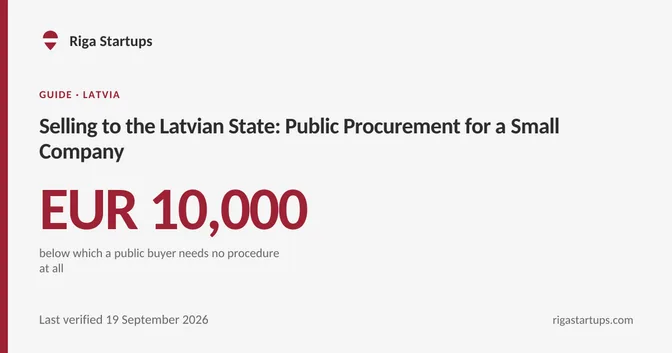
Below EUR 10,000 for supplies or services, the Public Procurement Law's procedures do not apply at all. A public buyer who wants your product at that size can simply buy it. The lighter route runs from there to EUR 42,000, and only above that does a full procedure begin.
This guide covers where those lines fall, what happens at each level, where tenders and results are published, and how to read the open data on who has already won what. Every award Latvia has published since 25 October 2023 is counted in the companion report, and the short version is encouraging: the median award is EUR 20,829, and 29.7% of lots draw exactly one bid.
This states the rules with a link to each. It is written for a small company wondering whether public buyers are worth pursuing. It is not advice, and it is not a bid-writing manual. Thresholds for the largest contracts are set by Cabinet regulation and move; the figures here are the ones the law itself carries.
Can a Small Company Sell to the Latvian State?
Yes, and the first sale often needs no procedure. The Public Procurement Law sets a floor: below EUR 10,000 for supplies and services, its procedures do not apply, so a public buyer can contract directly rather than running anything you would recognise as a tender.
This is the part that changes whether the channel is worth pursuing at all. A startup selling a licence, a subscription or a piece of work at a few thousand euro is selling into the same conversation it would have with a private buyer: a budget holder who wants the thing and has authority to buy it.
What the floor does not do is remove the buyer's own rules. Public bodies have internal procurement policies, and many require quotes or an internal approval well below the statutory line. The law says no procedure is required; your customer's finance department may still say three quotes.
At What Contract Size Do the Rules Begin?
At EUR 10,000 for supplies and services, and EUR 20,000 for works. Between those floors and EUR 42,000 and EUR 170,000 respectively, the buyer runs the lighter route in article 9. Above the upper figures, a full procurement procedure applies.
Article 9 of the Public Procurement Law carries all four figures in a single sentence, which is the most useful sentence in the statute for a small supplier.
| Contract | No procedure required | Article 9 route | Full procedure |
|---|---|---|---|
| Supplies and services | below EUR 10,000 | EUR 10,000 to EUR 42,000 | above EUR 42,000 |
| Works | below EUR 20,000 | EUR 20,000 to EUR 170,000 | above EUR 170,000 |
Software, subscriptions and consulting are supplies or services, so the first row is the one that matters for almost every company on this site. Thresholds for the largest contracts, the ones that also reach EU-level publication, are set separately by Cabinet regulation.
What Does the Article 9 Route Involve?
A committee, published rules, and a decision against them. The buyer forms a procurement commission, draws up regulations setting out what is being bought and how bids will be judged, and decides under the statutory procedure. It is lighter than a full procedure, not informal.
For a bidder the practical consequences are modest but real. There are written rules to read rather than a conversation to have, the criteria are fixed before bids arrive, and the commission has to apply what it published rather than what it meant.
It also produces a record. A buyer using this route publishes an informative notice within 10 working days of signing the contract, which is what turns the whole channel into something you can research rather than guess at.
Where Are Latvian Public Tenders Published?
In the state's publication management system, which the Procurement Monitoring Bureau runs, with the tendering itself conducted through the Electronic Procurement System. Notices for the larger contracts also reach the European Union level publication that the procurement directives require, so a big contract is visible well beyond Latvia.
The two things a supplier needs from this are different. Finding live opportunities means watching the publication system for notices in your category. Understanding whether the channel is worth entering means reading what has already been awarded, which is a different question and better answered from the data below.
The classification to learn is CPV, the EU common procurement vocabulary, because notices are tagged with it and it is how you filter a feed down to things you could actually supply.
How Do You Find Out Who Won, and for How Much?
From the Bureau's open data. It publishes notice data as daily JSON files covering every published notice, and each record carries the buyer, the procedure used, the individual lots, and, where an award has already been made, the supplier who won it and the value they won it at.
This is the part most suppliers skip and should not. Before writing a bid, you can read what the same buyer bought last time, from whom, and at what price, and decide whether the contract is genuinely open or effectively spoken for.
Three things the data will tell you quickly.
- Whether a buyer buys your category at all, which is a faster disqualifier than any conversation.
- What they paid, which sets a realistic expectation before you price.
- Who they bought from, which is the difference between a competitive field and an incumbent renewal with a procedure wrapped around it.
The same records are available through the national open data portal, and the Bureau publishes a CPV classifier alongside them so the category codes can be resolved to something readable.
If you would rather read the answer than the files, Who Wins Latvian Public Contracts is this site's own pass over 79,516 award rows from that feed: contract sizes, how many people bid, what size of firm wins, and which companies on this map have won something.
What If You Think a Procurement Was Unfair?
Complain to the Procurement Monitoring Bureau. A complaint requires a deposit, which is refundable: where one of the listed grounds applies, including the buyer fixing the breach or a court ordering repayment, the Bureau returns it within 5 working days.
The deposit is the design feature to understand rather than resent. It exists so that complaints cost something to bring, which keeps the process from becoming a tactic, and it comes back where the complaint had substance.
Judge it commercially rather than on principle. A challenge that succeeds reopens one contract and costs you the relationship with a buyer you will meet again, and that trade is the real decision rather than the deposit.
Is Public Procurement Worth It for a Startup?
For a first contract under the floor, often yes: it is an ordinary sale to a customer who pays reliably. For anything requiring a bid, the answer turns on whether you would win, and the published record of past awards answers that better than optimism does.
The honest case against is time. A bid is unpaid work with a binary outcome, and a small team's bid costs proportionally far more than a large supplier's. The case for is that public buyers pay, they renew, and a public reference opens other public doors.
A reasonable rule is to let the data decide. If the buyers in your category have bought from a rotating set of suppliers at prices you could meet, the channel is real. If the same name appears on every award for six years, you are reading an incumbent relationship, and your bid is the competitive cover that makes it lawful.
The aggregate picture argues for trying. Across every award published since 25 October 2023, 70.6% of award rows went to firms the buyer recorded as small, micro or SME, against 8.2% to large ones. The median lot drew 2 offers. And 56 of the 634 companies on this map have already won at least one. None of that says your bid wins; it does say the field is thinner than it looks from outside.
Frequently Asked Questions
Does a Latvian public buyer always have to run a tender?
No. Below EUR 10,000 for supplies and services, and EUR 20,000 for works, the Public Procurement Law's procedures do not apply and the buyer can contract directly. Their own internal rules may still require quotes, so the absence of a statutory procedure is not the absence of a process.
What is the article 9 procurement route in Latvia?
The lighter procedure for contracts between EUR 10,000 and EUR 42,000 for supplies and services, or EUR 20,000 and EUR 170,000 for works. The buyer forms a commission, publishes regulations setting out the requirement and the criteria, and decides against them rather than informally.
Where can you see who won Latvian public contracts?
In the Procurement Monitoring Bureau's open data, published as daily JSON files of every notice, with supplier and value where an award was made. The same datasets are listed on Latvia's open data portal, and a CPV classifier is published alongside so category codes can be read.
How long does a buyer have to publish the result of a procurement?
Under the article 9 route, an informative notice about the contract goes up within 10 working days of the contract being signed. That publication duty is what makes the award data usable, since it puts every contract of that size on the public record shortly after it is agreed.
Do small companies actually win Latvian public contracts?
Yes, and they win most of them. Across every award published since 25 October 2023, 70.6% of award rows went to firms recorded as small, micro or SME, against 8.2% to large firms. The companion report sets out the sizes, the values and the competition.
Does it cost anything to challenge a Latvian procurement?
It requires a deposit with the complaint. The deposit is refundable on listed grounds, including where the buyer corrects the breach or a court orders repayment, and the Bureau returns it within 5 working days once a ground applies. The real cost is usually the relationship rather than the money.
Sources
- Public Procurement Law, for the contract values in article 9 that set where procedures begin, the conduct of the lighter route, the publication of an informative notice after signing, and the deposit that accompanies a complaint.
- Procurement Monitoring Bureau open data, for the notice data, published as daily files covering buyers, procedures, suppliers and values.
- Latvia's open data portal, for the same datasets alongside the CPV classifier used to read category codes.
Every Figure, and When It Was Checked
Each value links to the source it was taken from. The date is when that source was last read and matched. Where a source cannot be checked automatically, it says so.
| Figure | Value | Last checked |
|---|---|---|
| Contract value below which the law's procedures do not apply to supplies or services | EUR 10,000 | 19 September 2026 |
| Upper limit of the lighter article 9 route for supplies and services | EUR 42,000 | 19 September 2026 |
| Contract value below which the law's procedures do not apply to works | EUR 20,000 | 19 September 2026 |
| Upper limit of the lighter article 9 route for works | EUR 170,000 | 19 September 2026 |
| Time a buyer has to publish an informative notice after signing a contract under article 9 | 10 working days | 19 September 2026 |
| Time the Procurement Monitoring Bureau has to return a complaint deposit once a listed ground applies | 5 working days | 19 September 2026 |