Official statistics can tell you what tech jobs in Latvia pay on average, and what the main tech occupations earned in the last pay survey. They cannot tell you what a senior backend engineer at a Riga startup should earn, and neither can anyone else working from open data. This page gives the first two, says plainly why the third is missing, and turns the numbers into what a hire costs.
What Tech Jobs Pay in Riga, From the Official Numbers
By Deepti Gupta · Reviewed by Vinayak Ravi · Riga Startups Editorial Team
Last verified · every figure links to its source, and the date each was checked is listed at the end · 9 min read
These are averages from official statistics, updated as each quarter's figures are published. An average is not an offer, and a pay decision needs the role and the person in front of you.
What Do Tech Jobs Pay in Riga?
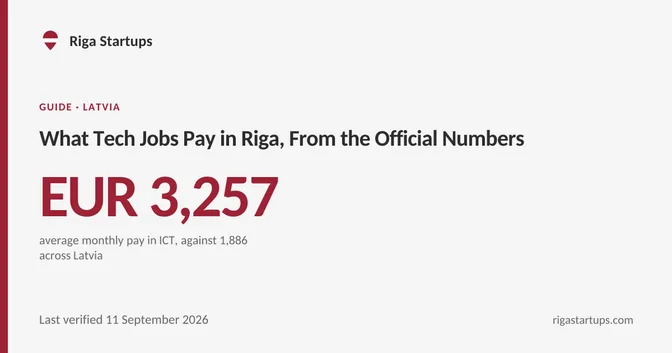
In Latvia's tech sector, meaning programming, IT consulting, and telecoms, the average gross salary was EUR 3,257 a month in the second quarter of 2026, against EUR 1,886 across the economy. The Riga region averaged EUR 2,068, so tech pay runs well above both the national and the Riga averages.
The sector is the Central Statistical Bureau's grouping under the revised classification of economic activities: telecommunication, computer programming, consulting, computing infrastructure, and other information services. It takes in telecoms operators and large outsourcing firms as well as product startups.
An average is pulled up by a well-paid minority, which is why the median across the whole economy, EUR 1,527, sits well below the average. The regional figures follow the employer's registered office, so the staff of a company registered in Riga count as Riga wherever they work.
What Do Software Developers Earn in Latvia?
In the last full pay survey, for 2022, software and applications developers and analysts in Latvia averaged EUR 3,312 a month gross, database and network professionals EUR 2,878, and ICT service managers EUR 4,259. Pay across the economy has risen since, so these read low against today's market.
The Structure of Earnings Survey runs every four years across the EU on one method, which makes it the only official source that separates occupations. It still averages everyone in an occupation, from a graduate to a principal engineer, and the edition covering 2026 will not be published for some time.
Are Tech Salaries in Riga Still Rising?
Yes, and more slowly than the pay around them. Latvian gross earnings rose 4.3% in the year to the second quarter of 2026, but after prices the real increase in net pay was 1.1%. Information and communication stayed the best-paid sector without being among the fastest-rising.
That last point is the one worth sitting with, because it inverts the assumption most founders bring. The sharpest year-on-year rises in the second quarter of 2026 were in mining and quarrying, real estate, administrative and support services, and wholesale and retail trade. Telecommunications and computer programming led on level and did not appear in that list at all.
- The gap between sectors is narrowing, not widening. A tech salary is still roughly EUR 3,257 against EUR 1,886 across the economy, but the rest of the labour market is closing distance. Budget for tech pay rising with the market rather than ahead of it.
- Private pay is pulling away from public pay. Private sector earnings rose 5.4% against 2.1% in the public sector. A startup is competing with other private employers, not with the state.
- Real terms is the number that reaches the employee. Gross pay rose 4.3%, net pay a little more, and after consumer prices the real gain was 1.1%. An increase that looks generous on the offer letter can be close to flat in what it buys, which is worth knowing before a retention conversation.
None of this separates seniority, and none of it is tech-specific below the sector line. It is the direction of travel around the two occupation figures above, which were measured in 2022 and have not been remeasured since. The payroll report tracks the same question from company accounts instead, including what labour cost per employee has done against inflation.
Why Is There No Reliable Salary Data by Seniority in Latvia?
Because nobody collects it openly. Salary websites rely on figures from whoever chooses to answer, company accounts give one average per company, and job adverts cover whoever is hiring this month. Of the roles advertised by companies on this map, 15 carry a stated salary, from 2 companies, and that is not a market.
Filed accounts do not rescue it. Latvia publishes no industry code for each company, so the register cannot be cut down to tech firms, and only 10 of the 598 companies on this map filed latest accounts that show personnel costs at all.
A band by seniority built from any of these would be an average of whoever happened to be in the sample, presented with a confidence the sample cannot carry. The two official figures above are coarser, and they are real.
What Do Latvian Company Accounts Show About Pay?
Labour cost, not salary. In the 2025 accounts that show it, the median labour cost per employee was EUR 771 a month, about EUR 624 before the employer's contribution, rising to EUR 1,922 at companies with 50 or more staff. Most of the companies behind the median are very small.
In fact 91.1% of them have fewer than ten staff, and the figure counts part-time staff as whole employees, across every industry. The Payroll Report explains what the number measures and what it does not.
How Does Riga Tech Pay Compare With Tallinn and Vilnius?
Riga pays the least of the three. Across all jobs, the Riga region averaged EUR 2,068 a month in the second quarter of 2026, Tallinn EUR 2,611, and Vilnius county EUR 2,808 in the first quarter. In tech, Estonia's sector averaged EUR 3,837 against EUR 3,257 in Latvia.
Nationally the order is the same: EUR 1,886 in Latvia, EUR 2,243 in Estonia, and EUR 2,628.20 in Lithuania, all in the second quarter.
The comparison is rougher than it looks. The areas differ, a region, a city, and a county, and the Vilnius figure is a quarter older. Estonia's figure covers information and communication as a whole, including publishing and broadcasting, which Latvia's tech figure leaves out. Lithuania's State Data Agency publishes sector figures too, but its site refuses automated requests, so we have not quoted one we could not check.
For a founder choosing where to hire, the gap is the headline: the same tech role costs less in Riga, before anything else about the city is weighed.
What Does It Cost to Hire a Tech Worker in Riga?
The salary plus 23.59% in the employer's social contributions, so gross times 1.2359. On Latvia's tech sector average of EUR 3,257, that gives the total below, and the employee takes home a good deal less, because their own contributions and income tax come out of the gross.
One job at the tech sector average, with the tax book filed and no dependants, at 2026 rates.
| Per month | Amount |
|---|---|
| Gross salary | EUR 3,257.00 |
| Employer's social contributions, 23.59% | EUR 768.33 |
| Total cost to the employer | EUR 4,025.33 |
| Employee's social contributions, 10.5% | EUR 341.99 |
| Income tax, 25.5% after the EUR 550 minimum | EUR 603.08 |
| Net pay | EUR 2,311.93 |
The salary calculator runs the same arithmetic on any other salary, and the cost of hiring guide covers the rest of what a hire costs, from sick pay to notice.
How Should a Startup in Riga Set Tech Salaries?
Anchor on the official averages, then set a range for each role by the value of the work. The sector average of EUR 3,257 is a midpoint across every tech job, not a senior engineer's rate, so place junior roles below it and experienced ones above it, and write down why.
Two rules shape the result. A job advert in Latvia must state the pay, so a range becomes public the moment you hire, and the EU Pay Transparency Directive will let staff ask how their pay compares with colleagues doing equal work. The pay transparency guide has a banding exercise you can run in an afternoon.
Frequently Asked Questions
What Is the Average Salary in Latvia?
EUR 1,886 a month gross in the second quarter of 2026, according to the Central Statistical Bureau, with a median of EUR 1,527. The average is pulled up by higher earners, so the median is the better guide to a typical salary.
What Is the Average IT Salary in Latvia?
EUR 3,257 a month gross in the second quarter of 2026, for telecommunication, computer programming, consulting, computing infrastructure, and other information services.
How Much Does a Software Developer Earn in Riga?
The last official figure is EUR 3,312 a month gross, the 2022 average for software and applications developers and analysts across Latvia. No open source gives a reliable current figure by seniority.
Do Tech Jobs Pay More in Tallinn Than in Riga?
On official averages, yes. Estonia's information and communication sector averaged EUR 3,837 a month in the second quarter of 2026, against EUR 3,257 in Latvia's tech sector, though the two sectors are grouped slightly differently.
How Much Does It Cost to Employ a Developer in Latvia?
The gross salary plus 23.59% in social contributions. At the tech sector average of EUR 3,257, that comes to a little over four thousand euros a month.
Why Does This Page Not Give Salary Bands by Seniority?
Because no open data supports them. Pay surveys average whole occupations, company accounts give one figure per company, and the salaries in job adverts come from too few companies to be a market.
Sources
- Central Statistical Bureau, wages and salaries in the second quarter of 2026, for the Latvian averages, the median, the tech sector, and the Riga region.
- Central Statistical Bureau, Structure of Earnings Survey 2022, for pay by occupation.
- Statistics Estonia, wages and salaries in the second quarter of 2026, for Estonia and Tallinn.
- LRT, reporting the State Data Agency's figures for Lithuania, and the Lithuanian data portal for Vilnius county.
- The Payroll Report, from filed annual accounts, and our own job feed for the advertised salaries.
- Par valsts sociālo apdrošināšanu, for the employer's contribution rate.
These figures describe markets, not jobs. What a particular role should pay depends on the work, the person, and the company, and no average settles that.
Every Figure, and When It Was Checked
Each value links to the source it was taken from. The date is when that source was last read and matched. Where a source cannot be checked automatically, it says so.
| Figure | Value | Last checked |
|---|---|---|
| Average gross monthly wages and salaries in Latvia, full-time units, second quarter of 2026 | EUR 1,886 | 11 September 2026 |
| Median gross monthly wages and salaries in Latvia, full-time units, second quarter of 2026 | EUR 1,527 | 11 September 2026 |
| Average gross monthly earnings in telecommunication, computer programming, consulting, computing infrastructure and other information services in Latvia, second quarter of 2026 | EUR 3,257 | 11 September 2026 |
| Average gross monthly earnings in the Riga region, by the employer's registered office, second quarter of 2026 | EUR 2,068 | 11 September 2026 |
| Average gross monthly earnings of software and applications developers and analysts in Latvia in 2022 | EUR 3,312 | 11 September 2026, by hand |
| Average gross monthly earnings of database and network professionals in Latvia in 2022 | EUR 2,878 | 11 September 2026, by hand |
| Average gross monthly earnings of ICT service managers in Latvia in 2022 | EUR 4,259 | 11 September 2026 |
| Average gross monthly wages and salaries in Estonia, second quarter of 2026 | EUR 2,243 | 11 September 2026 |
| Average gross monthly wages in information and communication in Estonia, second quarter of 2026 | EUR 3,837 | 11 September 2026 |
| Average gross monthly wages in Tallinn, second quarter of 2026 | EUR 2,611 | 11 September 2026 |
| Average gross monthly wages in Lithuania excluding individual enterprises, second quarter of 2026, as reported from the State Data Agency | EUR 2,628.20 | 11 September 2026 |
| Average gross monthly wages in Vilnius county, first quarter of 2026 | EUR 2,808 | 11 September 2026, by hand |
| The employer's share of the mandatory social contribution | 23.59% | 8 September 2026 |
| Year-on-year rise in Latvian average gross monthly earnings, second quarter of 2026 | 4.3% | 15 September 2026 |
| Real year-on-year increase in Latvian net earnings after consumer prices, second quarter of 2026 | 1.1% | 15 September 2026 |
| Year-on-year rise in average gross earnings in the Latvian private sector, second quarter of 2026 | 5.4% | 15 September 2026 |
| Year-on-year rise in average gross earnings in the Latvian public sector, second quarter of 2026 | 2.1% | 15 September 2026 |