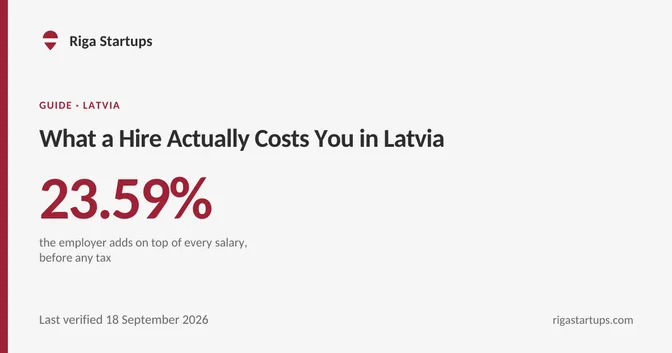
Employing someone in Latvia costs you their gross salary plus 23.59%, so your total cost is gross times 1.2359 and nothing else is hidden behind it. What reaches the employee is a good deal less than that, and the gap widens as the salary rises, because the untaxed allowance is a flat amount rather than a share.
What a Hire Actually Costs You in Latvia
By Deepti Gupta · Reviewed by Vinayak Ravi · Riga Startups Editorial Team
Last verified · every figure links to its source, and the date each was checked is listed at the end · 32 min read
The rules here are stated with a link to each. The arithmetic that follows is the rules applied to round numbers, not a payroll run: it assumes one job, no dependants, no benefits in kind and a full month worked. Your accountant's software is the authority on any real payslip.
What Does It Cost an Employer to Hire Someone in Latvia?
An employer in Latvia pays the gross salary plus 23.59% in social contributions, so the total cost is gross times 1.2359. From that gross, the employee loses 10.5% in their own contributions and 25.5% income tax on what remains above the EUR 550 monthly non-taxable minimum.
Four things come out between what you spend and what your employee banks.
| Rate | Paid by | On what | |
|---|---|---|---|
| Social contribution, employer share | 23.59% | You, on top of gross | Gross pay, up to the annual ceiling |
| Social contribution, employee share | 10.5% | Withheld from gross | The same |
| Payroll income tax | 25.5% | Withheld from gross | Gross, less the employee share and the non-taxable minimum |
| Solidarity tax | 25% | Above the ceiling | Income above the annual ceiling |
The two social shares together are 34.09%, which is the number quoted in most comparisons. Only 23.59% of it is a cost to you; the rest comes out of the salary you have already agreed.
Three thresholds change the arithmetic, and none of them bites at ordinary startup salaries:
- The non-taxable minimum is EUR 550 a month. Income tax is charged on what is left after the employee's own contribution and this. It is worth noting that this figure is set by a transitional provision rather than by the article that appears to state it, and that article currently reads EUR 570. The transitional provision wins for 2026, so a guide that quotes the article alone is wrong by twenty euros a month.
- Each dependant adds EUR 250 a month to what is untaxed, claimed by the employee through their tax book rather than by you.
- The ceiling is EUR 105,300 a year. Above it, social contributions stop, income tax rises to 33% and solidarity tax applies. Divided across twelve months it sits well above any of the salaries below, so it reaches a founder salary or a very senior hire and almost nobody else.
The statutory minimum wage is EUR 780 a month, which matters less as a floor than as the unit several other rules are built from.
How Much Does an Employee Take Home in Latvia?
An employee in Latvia takes home gross pay less 10.5% social contributions and 25.5% income tax on the part above the non-taxable minimum. Because that minimum is a flat monthly amount, the share they keep falls as the salary rises, while the employer's cost stays a fixed 1.2359 times gross.
Round gross salaries so you can scale them. None of these reaches the annual ceiling, so no solidarity tax and no upper rate.
| Monthly gross | Costs you | Employee banks | Your cost per EUR 100 they receive |
|---|---|---|---|
| EUR 1,500 | EUR 1,853.85 | EUR 1,140.41 | EUR 162.56 |
| EUR 3,000 | EUR 3,707.70 | EUR 2,140.58 | EUR 173.21 |
| EUR 6,000 | EUR 7,415.40 | EUR 4,140.90 | EUR 179.08 |
Your side of that is perfectly linear: 1.2359 times gross, at every salary, with no steps in it. The employee's side is not, because the non-taxable minimum is a flat amount and matters proportionally less the more they earn. That is the whole reason the last column climbs.
The practical consequence is a budgeting rule. Take the gross you intend to offer, add a quarter, and you have your real cost near enough to plan with.
Those three rows stay fixed. The salary calculator runs the same rules on any salary, and adds dependants, disability relief, and pension age.
How Does the Startup Law Change the Cost of Hiring?
Under the Startup Law, one flat monthly payment calculated on two minimum wages replaces the contribution stack, and the employee pays no income tax. It costs the employer more than the normal regime on a junior salary and less on a senior one, and every employee takes home more.
The employee must instead put at least ten per cent of the gap between their pay and that base into a pension, and the Startup Law guide covers who qualifies.
The flat payment is EUR 531.80 a month. Running the same three hires through it:
| Monthly gross | Costs you | Against the normal stack | Employee banks | Against the normal stack |
|---|---|---|---|---|
| EUR 1,500 | EUR 2,031.80 | EUR 177.95 worse | EUR 1,500.00 | EUR 359.59 better |
| EUR 3,000 | EUR 3,531.80 | EUR 175.90 better | EUR 2,856.00 | EUR 715.42 better |
| EUR 6,000 | EUR 6,531.80 | EUR 883.60 better | EUR 5,556.00 | EUR 1,415.10 better |
Read the first row twice. On a junior salary the programme costs you more than the ordinary regime, because a flat EUR 531.80 is more than 23.59% of EUR 1,500. The break-even for your side is a gross salary of about EUR 2,254; below that you are paying for the privilege.
Every row is better for the employee, and by much more than it is ever worth to you. That is worth being straight about internally: the Startup Law is mostly a pay rise you are administering, not a cost saving you are making. It also comes with a real cost to the employee that no table shows, because their pension and sickness entitlement accrues on the flat base rather than their salary. That trade, and the disclosure the law obliges you to make about it, is covered in the Startup Law guide.
What Are the Employment Contract Rules in Latvia?
Probation in Latvia is at most 3 months, with three days notice on either side during it. An employee resigns on one month, paid leave is four calendar weeks on top of public holidays, and the employer pays sick pay from its own funds for up to nine calendar days before the state takes over.
- Probation is at most 3 months, and can go to six only under a collective agreement with a trade union. During it either side can end the contract on three days notice.
- An employee resigns on one month unless their contract sets something shorter. You cannot lengthen it beyond what the law allows.
- Your notice depends on why you are dismissing. The Labour Law sets immediate, ten days, one month or two months according to the ground, and the grounds are a closed list. This is the part where "at will" instincts from other jurisdictions go wrong: you need a statutory ground, not a reason.
- Paid leave is four calendar weeks, on top of public holidays rather than including them.
And the one that surprises founders every time: sick pay is yours for the first stretch. When an employee is ill, you pay from your own funds, at 75% of average earnings for the second and third day and 80% from the fourth, for no longer than nine calendar days. The state picks it up after that. On a small team a bad winter is a real line in the budget, and nobody plans for it.
What Does Parental Leave Cost a Latvian Employer?
Almost nothing in payroll, and a great deal in planning. Maternity leave runs 112 days, the father gets 10 working days, and any employee may take parental leave of up to 1.5 years. The state pays the benefit throughout. What the employer carries is the job, held open, and a ban on giving notice.
This is the opposite shape to sick pay, and founders who have absorbed the sick pay rule tend to assume parental leave works the same way. It does not. Maternity benefit is a social insurance payment at 80% of the recipient's average contribution wage, paid by the state, and the same is true of paternity and parental benefit. Nothing leaves your payroll.
- Maternity leave is 112 days, counted as one period under article 154 of the Labour Law whatever the split either side of the birth. It extends to 70 days on either leg where care began before the twelfth week of pregnancy, or where there were complications or more than one child. It does not come out of annual leave.
- The father gets 10 working days, under article 155, taken straight after the birth and no later than six months afterwards.
- Parental leave is every employee's right, not only the mother's. Article 156 gives up to 1.5 years per child, usable in whole or in parts of at least a week, at any time until the child turns 8 years. The employee owes 1 month written notice of each part.
- The job is protected, and so is a similar one. The employee returns to their previous work, or if that is genuinely impossible, to similar or equivalent work on terms no less favourable. Time on parental leave counts toward total length of service.
- You cannot give notice. Article 109 forbids dismissing a pregnant employee, or a woman in the 1 year after birth, or one who is breastfeeding, up to the child's second birthday, outside a short list of exceptions in article 101. This is the provision that makes a redundancy round harder than it looks.
The real cost is therefore a vacancy of up to eighteen months that you may not fill permanently, in a company that may only have six people. Plan it as a cover hire on a fixed-term contract tied to the absence, which is one of the few situations where Latvian law readily allows one, rather than as a gap you will absorb.
Can a Latvian Job Advert Require English?
Only with a reason, and you have to print the reason. Article 32 of the Labour Law forbids naming a specific foreign language in a job advert unless it is justifiably necessary for the duties, and says it is not necessary where the work serves Latvia's internal market. The advert must state the justification.
Most Riga startups run in English and advertise in English, and the rule bites exactly there. It came in with amendments in force from 22 October 2024, alongside the pay disclosure duty in the section below, and it is the half of that amendment nobody talks about.
- The default is that you may not ask. Naming a specific foreign language is prohibited unless the language is an objective and justified precondition of the job.
- Serving the Latvian market defeats the justification. The law says outright that foreign language skill is not justifiably necessary where the work involves producing goods, supplying services, or other activity in Latvia's internal market. A support role for Latvian customers does not get to demand English.
- Working with other countries restores it. The same provision lets the rule be disapplied for internal-market work where the language genuinely is a precondition, including where performing the job involves foreign countries. A company whose customers, investors, or codebase are outside Latvia is on solid ground, which covers most of the companies on this map.
- Write the reason into the advert. Article 32, third part, requires the advert to carry the employer's name and registration number, the salary range, and the justification for the language requirement. The reason is a required field, not a nicety, and an advert that names English without one is defective even where the requirement itself would have been lawful.
- A dispute puts the burden on you. If a candidate or employee points to circumstances suggesting discrimination on language grounds, article 32 makes it the employer's job to prove the difference in treatment rested on objective circumstances, or that the language really was a precondition. Having written the justification down at the time is most of that proof.
The practical version is one sentence in the advert: say which language, and say why. "Our customers and investors are outside Latvia, so the working language is English" is both true for most startups here and exactly what the provision asks for.
How Much Does It Cost to Dismiss an Employee in Latvia?
Latvia has no dismissal at will. An employer needs a statutory ground, which sets notice at immediate, ten days, one month or two months, and where the ground carries severance it owes 1 month of average earnings under 5 years of service, rising to 4 months beyond 20.
Founders model the cost of hiring and almost never model the cost of stopping. In Latvia the second number is knowable in advance, and it is larger than the instinct imported from other jurisdictions suggests.
There is no dismissal at will. Article 101 sets a closed list of grounds, and you need one of them. Not a reason, a ground. "It is not working out" is a reason; it is not on the list. The two that most small companies actually use are an inability to do the work, and a reduction in the number of employees.
Notice depends on which ground you used, and the law sets it at immediate dismissal, 10 days, 1 month or 2 months. Choosing the ground therefore chooses the notice, which is one reason the ground is worth getting right before the conversation rather than after it.
Severance is statutory and scales with service. It is owed where the ground is lack of skills, ill health, a predecessor's reinstatement, redundancy, liquidation, or long illness, and it runs 1 month of average earnings under 5 years of service with that employer, 2 months up to 10, 3 months up to 20, and 4 months beyond. Average earnings, not contractual salary, so bonuses and overtime in the reference period raise it. It goes through payroll like pay, because social contributions fall on all income from paid work on which income tax must be withheld, so the employer's share comes on top.
Put those together for the case a startup actually meets.
An engineer on EUR 3,000 a month, two years in, let go on the redundancy ground. Notice is a month, worked or paid out, severance is one month's average earnings, and ten days of leave are untaken. Average earnings are taken as the salary, a day's pay as one twenty-first of it, and the last column adds the employer's 23.59%.
| What you pay | Gross | With employer contributions |
|---|---|---|
| Notice month | EUR 3,000.00 | EUR 3,707.70 |
| Severance | EUR 3,000.00 | EUR 3,707.70 |
| Ten days of untaken leave | EUR 1,428.57 | EUR 1,765.57 |
| An exit done properly | EUR 7,428.57 | EUR 9,180.97 |
| Six months of forced absence, if a court overturns it | EUR 18,000.00 | EUR 22,246.20 |
A lawful exit costs about two and a half months of that person's full cost, and it lands in the month you were cutting costs. The last row is the one to plan around. It is not a fine but pay for the time the employee was kept out of work, it grows with every month the case takes, and the court can put the engineer back in the job as well.
The table above is one case. The calculator runs yours, including the last row, which is the one worth planning around.
Cost of ending employment calculator
Rates, the severance scale and the audit window from the ledger at the end of this page.
- Notice, worked or paid out
- EUR 3,707.70
- Severance
- EUR 3,707.70
- Untaken annual leave
- EUR 1,765.57
- An exit done properly
- EUR 9,180.97
Every figure includes the employer’s 23.59% on top, because severance and notice both go through payroll like pay. Gross is EUR 7,428.57.
- Forced absence, if a court overturns it
- EUR 22,246.20
This is not added to the total above, because it is what the other outcome costs rather than an extra line of this one. It is not a fine but pay for the time the employee was kept out of work, so it grows with every month the case takes, and the court can order the job back as well.
At 2 years of service the scale gives 1 month of average earnings. It steps up at 5, 10 and 20 years, so someone close to a step costs materially more a month later.
What Mistakes Get a Dismissal Overturned in Latvia?
Most are procedural rather than about the ground. A court voids a dismissal that is unsound or procedurally flawed, and the employer must prove it was neither. The usual failures are a notice without written reasons, no written explanation sought before a misconduct dismissal, acting too late, and dismissing someone the law protects.
Each is a separate way to lose, and they come in roughly the order you meet them.
- Ask about the union first. Before any notice you must find out whether the employee is a trade union member. For someone who has been a member for more than six months, most dismissals need the union's prior consent.
- Misconduct needs an explanation. Before dismissing for a breach, you must ask the employee for a written explanation, and weigh the breach, its circumstances, and the employee's record.
- Misconduct also has a deadline. Notice must be given within one month of discovering the breach, and no later than 12 months after it, not counting time the employee was ill or on leave.
- Capability, health, and redundancy need a look for other work first. Those grounds are available only where the employee cannot be moved, with their consent, to other work in the same or another company.
- The notice must give reasons. You must state in writing the circumstances the dismissal rests on.
- Some people cannot be given notice for a time. Notice may not be given while the employee is on sick leave, on holiday, or absent for another justified reason. And you may not dismiss a pregnant employee, a woman within a year of giving birth, or a mother breastfeeding a child under two, except for misconduct or liquidation.
The employee has one month from receiving the notice to go to court. If they win, the dismissal is void, they are reinstated, and they are paid average earnings for the whole period of forced absence, which is owed even where the court ends the employment at their request instead. That is why the cost of getting this wrong has no ceiling: it grows with every month the case takes.
How Does Redundancy Work in Latvia?
Redundancy is dismissal for economic, organisational, or technological reasons, not for anything the employee did. It carries a month's notice and severance, the employer must first look for other work the person could do, and where it chooses between people, those with better work results and higher qualifications have priority to stay.
Only where results and qualifications do not differ significantly does a list of personal circumstances in article 108 decide, and that list starts with length of service. A startup choosing between two engineers should be able to show why it kept the one it kept, in writing and before the notice goes out.
During notice the employee is entitled to time within working hours to look for other work, if they ask in writing. How much time, and whether it is paid, is for the employment contract or a collective agreement to say.
Collective redundancy is a different regime, and the threshold is lower than most founders assume: five people in thirty days, for an employer with more than twenty and fewer than fifty staff. It brings consultation with employee representatives and a notice to the State Employment Agency, and the dismissals can begin no earlier than 30 days after that notice. A thirty-person company cutting five people in a month is inside it.
Can You End Employment by Mutual Agreement in Latvia?
Yes, at any time and on any terms both sides accept, provided the agreement is made in writing. There is no statutory notice or severance, no ground to prove, and no employer's notice for a court to void, which is what an employer is paying for when it offers more than the statutory scale.
Any payment under it is income from the employment, and social contributions fall on it as they do on all income from paid work on which income tax must be withheld. Write down the last working day, what is paid and when, what happens to untaken leave, and the return of equipment and confidential material.
Agreements can count towards a collective redundancy too. Any exit the employer prompted is counted even when nobody was given notice, so several agreements in one month can add up to one.
None of this is a reason not to hire. It is a reason to write the offer knowing what the exit costs, to use probation for what it is for, and to treat the ground for dismissal as something you establish while it is happening rather than reconstruct afterwards.
Can You Hire Contractors Instead of Employees in Latvia?
Only genuine ones. The Personal Income Tax Act lists six signs of an employment relationship, and any one of them is enough for a contractor's pay to be treated as salary. A full-time contractor who sits with the team and uses a company laptop meets five, and the back tax and interest fall on the company.
The tempting structure is to engage everyone as a self-employed contractor or through their own company, pay an invoice, and skip the stack entirely. It is common, and it is the single largest tax risk a small Latvian company can carry.
The Personal Income Tax Act lists six signs of an employment relationship, and finding any one of them is enough for the income to be treated as salary:
- The person is economically dependent on the company they invoice.
- They carry no financial risk when work is unprofitable or a debtor does not pay.
- They are integrated into the business: a desk, a break room, an obligation to follow internal rules.
- Their holidays follow the company's internal schedule or the rota of its staff.
- They work under someone's direction or control, and cannot bring in their own people or subcontract.
- They do not own the equipment and materials they use, beyond a personal car and personal tools.
Read that list against a full-time engineer who invoices monthly, sits with the team, takes holiday when the team does and uses a company laptop. That arrangement meets five of the six. Reclassification is not a distant risk in that case, it is the described outcome, and it lands as back tax on the employer with interest.
The genuine contractor exists: several clients, own tools, own risk, own schedule. The test is what the relationship actually looks like, not what the contract calls it.
What Makes a Contractor Arrangement Defensible in Latvia?
One where none of the six signs is true in practice, not merely in the contract. The contractor has other clients, sets their own hours and holidays, can send someone else to do the work, uses their own equipment, carries the cost of their own mistakes, and is paid for results rather than time.
Paper helps only when it matches what happens. A contract for a defined deliverable, invoices that vary with the work, a right to subcontract that is actually used, and no place on the holiday rota are evidence for the arrangement. A job title, an email address on your domain, and a seat in the weekly team meeting are evidence against it.
Does Invoicing Through an IK or Micro-Enterprise Avoid Reclassification?
No. None of the six signs of an employment relationship mentions the legal form of whoever invoices, so a full-time engineer integrated into your team meets the same signs as a private individual, an IK, or through their own company. The wrapper changes their own tax position, not your reclassification risk.
The usual next move is to ask the person to register as an individual merchant, or as a self-employed person, or to set up a micro-enterprise, and then invoice from that. It feels more solid than a bare invoice, and for the reclassification question it changes nothing at all.
Look back at the six signs. Not one of them mentions the legal form of whoever is invoicing. They describe the relationship: dependence, risk, integration, holidays, direction, equipment. A full-time engineer who sits with your team and takes holiday when your team does meets the same five signs whether they invoice as a private individual, as an IK, or through a company they own. The wrapper is not the thing being tested.
What the wrapper does change is the counterparty's own tax position, and that is genuinely their business rather than yours. The regimes differ in rate, in what they may deduct, and in what they build up for a pension, and choosing between them is a real decision for someone genuinely self-employed, which the freelancing guide works through. It is not a defence available to you.
How Far Back Can a Contractor Be Reclassified in Latvia?
For up to three years. The State Revenue Service may audit a tax within 3 years of the payment deadline, so a contractor found to be an employee is recalculated as salary for every month inside that window, with late payment interest of 0.05% a day on the tax that should have been withheld.
Run that on an engineer invoicing EUR 3,000 a month for three years. Treated as salary, that is EUR 108,000 of gross pay, and the employer's share of contributions on it alone is EUR 25,477.20. The employee's share and the income tax that should have been withheld come on top, with interest on all of it, and the company is the one asked for them.
Interest is why waiting makes it worse. Each month an arrangement that fails keeps running adds its own tax to the bill and its own days of interest, so the cheapest time to fix one is the day you notice it, by putting the person on payroll from then on.
How Much Does a Contractor Save Compared With an Employee in Latvia?
A contractor costs the invoice and nothing else, so it saves the 23.59% employer contribution, sick pay, leave, notice, and severance. The saving lasts only while the arrangement survives scrutiny: if it is reclassified, the whole stack is recalculated as though you had employed the person all along, plus interest.
The same EUR 3,000 a month, three ways: as an employee's gross salary, as an invoice from a self-employed person on the general regime, and as an invoice from a self-employed person or an individual merchant (IK) paying micro-enterprise tax. It assumes a whole year at that rate, no expenses, no other income, and no VAT registration. The general regime column pays full contributions on the minimum wage of EUR 780 and 10% for pension on the rest, and claims the non-taxable minimum.
| Per month | Employee | Self-employed | Micro-enterprise tax |
|---|---|---|---|
| Costs you | EUR 3,707.70 | EUR 3,000.00 | EUR 3,000.00 |
| Tax and contributions | EUR 1,567.12 | EUR 970.69 | EUR 750.00 |
| They keep | EUR 2,140.58 | EUR 2,029.31 | EUR 2,250.00 |
On these assumptions a contractor saves you EUR 707.70 a month, and on micro-enterprise tax keeps more than an employee would. What the table cannot show is what each column buys. The employee is insured on the full salary, for pension, sickness, and unemployment, and has sick pay, paid leave, notice, and severance from you. The self-employed person is insured on the minimum wage and a pension top-up, and has none of the rest.
The contractor columns rest on two regimes. A self-employed person pays the full rate on an amount of at least the minimum wage, plus 10 per cent for pension on the rest of that month's income, and the full rate is 31.07%. Micro-enterprise tax is 25% of turnover, covering income tax and social contributions together. Choosing between them is the contractor's decision, and the freelancing guide works through it.
Set against the saving, a genuine contractor prices their own tax and their own risk into the rate, so the invoice is not the salary you would have paid. And the saving only exists while the arrangement survives scrutiny. If it does not, the outcome is not a fine on top of the saving; it is the whole stack recalculated as though you had employed them all along, plus interest, landing on you rather than on them. A year of an engineer's contributions is a large number to find at once, and the fact that they invoiced from an IK will not be a defence.
The honest way to hold both is that a contractor is cheaper because it carries less: less obligation from you, less security for them. Where that trade is real, the arrangement is real. Where you want the security of an employee for the price of a contractor, you are not saving money, you are deferring it.
If the person is not an EU citizen, all of this still applies and a residence permit comes first, with its own salary floor, a State Employment Agency step for most roles, and a timeline measured in months. That is its own guide.
Can a Latvian Company Use Foreign Contractors?
Yes, but moving the contractor abroad does not move the risk. Latvian income tax on a non-resident covers paid work, including work done outside Latvia for a Latvian employer, so a remote contractor who works like staff can still be reclassified. VAT on the service is paid by the Latvian customer, if it is registered for VAT.
Where Latvia has a double taxation treaty with the contractor's country, the treaty usually gives the right to tax pay for work to the country where the work is physically done, so the practical exposure turns on the treaty and on that country's own employment test, which applies alongside Latvia's.
One Latvian rule applies whatever the arrangement is called: a Latvian company paying anyone in the jurisdictions on Annex I of the EU list of non-cooperative jurisdictions withholds 20% from the payment.
Can You Hire in Latvia Without a Latvian Company?
Yes. An employer of record hires the person onto its own Latvian payroll and invoices you, usually as a percentage of salary or a flat monthly fee per head. The tax stack is the same either way, so the fee is the cost difference, and your own company usually wins once you have a handful of people.
The comparison is not really about cost, because the underlying tax stack is the same either way and the fee is the only difference. It is about what you are buying. An employer of record makes sense when you want one or two people quickly, when you are testing whether a market works before committing, or when nobody on your team wants to learn Latvian payroll. Your own company makes sense once you have a handful of people, because the fee scales with headcount and the incorporation does not, and because a Latvian company is what makes you eligible for the Startup Law, for LIAA programmes, and for the corporate income tax treatment that is Latvia's actual advantage.
We have not put a negotiated fee range here, because that is a number we could not verify. What providers publish is verifiable, and the employer of record guide sets those list prices against running your own company, along with the parts of the arrangement that are not about price.
Do Job Adverts in Latvia Have to Show the Salary?
Yes. Since 22 October 2024, the Labour Law has required a job advertisement in Latvia to state the range of the post's total gross monthly or annual pay, or of the intended hourly rate. It is a condition of advertising the job, not a courtesy, and what job boards let us count is a floor on compliance, not a rate.
That reframes the only question worth asking here. Not who is willing to disclose, but who is complying, and we cannot answer that from what we collect.
Here is what we do collect. Of the roles currently advertised by companies on this map, 79 are on applicant tracking systems with a structured salary field, across 8 companies, and 15 of those have that field filled in, from 2 companies. A further 17 roles sit on systems with no salary field at all.
Read the middle number as a floor and nothing more. It counts a database field, and the law is satisfied by the advert. Those are not the same thing, and we have checked: of nine Riga roles on one board that our reader records as stating nothing, five carry a gross euro range written into the description, one employer complying in every advert we sampled while appearing here as silent.
We do not parse pay out of prose, and we are not going to start. One role we already carry advertises a learning budget quoted in euros, and a pattern hunting for a euro amount in a description would file that as the salary. A number that is wrong is worse than a number that is missing, particularly this number, because the thing being measured is whether employers can be trusted to state it.
So the honest position is that we can see a floor on disclosure and not a rate, and that any figure you see quoted as a Latvian pay transparency rate is worth asking the same question of. Counting silence as refusal turns a software limitation into a moral failing, and it names companies while doing it.
What none of this supports is a table of salary bands by function, because a handful of companies is not a market. For what Latvian employers actually pay, the Payroll Report works from filed accounts and the tech pay guide from official statistics. A proper read on compliance is a separate piece of work, and it needs a reader that examines adverts rather than fields.
The EU Pay Transparency Directive will add more on top, from a ban on asking about pay history to pay gap reports, and the pay transparency guide covers where Latvia's law for it stands.
In the meantime, the roles themselves are on the map, ranges included where the board gave one, which is at least a primary source rather than a survey.
Corrected on 9 September 2026. This section previously reported the filled-in salary fields as the share of employers who state a range, which implied the rest had chosen not to. Checking the adverts showed otherwise, and the law has required the disclosure since 22 October 2024 in any case. The numbers have not changed; what they are said to mean has.
Frequently Asked Questions
What Is the Minimum Wage in Latvia?
The statutory minimum monthly wage in Latvia is EUR 780. It matters less as a floor than as the unit other rules are built from, including the Startup Law's fixed payment, which is calculated on two minimum wages whatever the employee is actually paid.
What Is the Social Security Rate in Latvia?
The total social contribution rate is 34.09%, split between 23.59% paid by the employer on top of gross pay and 10.5% withheld from the employee's salary. Contributions stop above the annual ceiling of EUR 105,300, where solidarity tax applies instead.
What Is the Non-Taxable Minimum in Latvia?
The non-taxable minimum is EUR 550 a month in 2026, set by a transitional provision, although the article that appears to state it reads EUR 570. Each dependant adds EUR 250 a month, claimed by the employee through their tax book.
Who Pays Sick Pay in Latvia?
The employer, for the first stretch. It pays 75% of average earnings for the second and third day of illness and 80% from the fourth, for no longer than nine calendar days, and the state picks it up after that.
How Much Notice Does an Employee Give to Resign in Latvia?
An employee resigns on one month notice unless their contract sets something shorter, and the employer cannot lengthen it beyond what the law allows. During probation, either side can end the contract on three days notice.
When Does Collective Redundancy Apply in Latvia?
The threshold is five people in thirty days, for an employer with more than twenty and fewer than fifty staff, which a thirty-person company cutting five people in a month is inside. It brings a consultation duty, notification to the State Employment Agency, and a waiting period before the dismissals take effect.
How Much Severance Pay Is Owed in Latvia?
It runs from 1 month of average earnings under 5 years of service to 4 months beyond 20, where the dismissal is for lack of skills, ill health, a predecessor's reinstatement, redundancy, liquidation, or long illness. A contract or collective agreement can set more, and a dismissal for misconduct carries none.
Can a Contractor Be Reclassified as an Employee in Latvia?
Yes. If any one of the six signs of an employment relationship in the Personal Income Tax Act is present, the pay is treated as salary. The State Revenue Service can reassess it within 3 years of the payment deadline, with late payment interest of 0.05% a day.
Sources
- Par valsts sociālo apdrošināšanu, for the contribution rates, the annual ceiling, what contributions are charged on in article 14, and the self-employed person's contributions. Cabinet Regulation No. 786 has the self-employed rate.
- Par iedzīvotāju ienākuma nodokli. Article 15 has the rates, article 12 and transitional provision 197 the non-taxable minimum, article 13 the dependant allowance, article 8 the six signs of an employment relationship, and article 3 what a non-resident is taxed on.
- Par nodokļiem un nodevām, article 23 for how far back tax can be reassessed and article 29 for late payment interest.
- Pievienotās vērtības nodokļa likums, article 84, for who pays VAT on services bought from abroad.
- Uzņēmumu ienākuma nodokļa likums, for withholding on payments to low-tax jurisdictions, and the Cabinet regulation that lists them.
- Mikrouzņēmumu nodokļa likums, for the micro-enterprise tax rate.
- Solidaritātes nodokļa likums for the rate above the ceiling.
- Darba likums, for probation, notice, leave, termination and the pay you must put in an advertisement. Article 32, third part, has the advertising duty, article 101 the grounds for dismissal and the steps before notice, article 102 the written reasons, article 103 the notice each ground carries, articles 104 and 108 redundancy and who stays, articles 105 to 107 collective redundancy, articles 109 and 110 the employees protected from dismissal, article 111 time to look for work, article 112 the severance scale, article 114 mutual agreement, and articles 122 and 124 to 126 the challenge in court and its remedies.
- Par maternitātes un slimības apdrošināšanu, article 36, for the days of sick pay you carry.
- The minimum wage regulation.
- Our own job feed, for the disclosure counts.
This page states rules and does arithmetic with them. It is not advice, and a payroll decision needs someone who can see your actual contracts.
Every Figure, and When It Was Checked
Each value links to the source it was taken from. The date is when that source was last read and matched. Where a source cannot be checked automatically, it says so.
| Figure | Value | Last checked |
|---|---|---|
| The employer's share of the mandatory social contribution | 23.59% | 8 September 2026 |
| The employee's share, withheld from gross pay | 10.5% | 8 September 2026 |
| The two shares together | 34.09% | 8 September 2026 |
| The payroll income tax rate on monthly taxable income | 25.5% | 8 September 2026 |
| The rate on the annual income above the contribution ceiling | 33% | 8 September 2026 |
| The monthly non-taxable minimum for 2026 | EUR 550 | 8 September 2026 |
| The non-taxable minimum stated in article 12 itself, which a transitional provision overrides for 2026 | EUR 570 | 8 September 2026 |
| Monthly tax allowance for each dependant | EUR 250 | 8 September 2026 |
| Annual income above which social contributions stop and the upper rates begin | EUR 105,300 | 8 September 2026 |
| The solidarity tax rate on income above the contribution ceiling | 25% | 8 September 2026 |
| The statutory minimum monthly wage | EUR 780 | 8 September 2026 |
| The longest probation an employment contract may set | 3 months | 8 September 2026 |
| Notice either side must give during probation | three days | 8 September 2026 |
| Notice an employee must give to resign, absent a shorter contractual term | one month | 8 September 2026 |
| The statutory minimum paid annual leave, excluding public holidays | four calendar weeks | 8 September 2026 |
| How long the employer pays sick pay from its own funds before the state takes over | nine calendar days | 8 September 2026 |
| Employer sick pay for the second and third day, as a share of average earnings | 75% | 8 September 2026 |
| Severance under the first service band | 1 month | 18 September 2026 |
| Years of service below which the first severance band applies | 5 | 18 September 2026 |
| Severance in the second service band | 2 months | 18 September 2026 |
| Top of the second severance service band, in years | 10 | 18 September 2026 |
| Severance in the third service band | 3 months | 18 September 2026 |
| Top of the third severance service band, in years | 20 | 18 September 2026 |
| Severance beyond the longest service band | 4 months | 18 September 2026 |
| The short statutory notice period, by ground | 10 days | 18 September 2026 |
| The ordinary statutory notice period, by ground | 1 month | 18 September 2026 |
| The longest statutory notice period, by ground | 2 months | 18 September 2026 |
| The employer's notice period, which depends on the ground for dismissal | immediate, ten days, one month or two | 10 September 2026 |
| The smallest headcount reduction that counts as a collective redundancy | five people in thirty days, for an employer with more than twenty and fewer than fifty staff | 10 September 2026 |
| Since when a job advertisement must state the pay | 22 October 2024 | 9 September 2026 |
| Employer sick pay from the fourth day | 80% | 8 September 2026 |
| The grounds for dismissal that carry statutory severance | lack of skills, ill health, a predecessor's reinstatement, redundancy, liquidation, or long illness | 11 September 2026 |
| What an employee's social contributions are charged on | all income from paid work on which income tax must be withheld | 11 September 2026 |
| Who must prove in court that a dismissal was lawful and properly carried out | the employer | 11 September 2026 |
| What an employer must check before giving notice | find out whether the employee is a trade union member | 11 September 2026 |
| How long a trade union member must have belonged before most dismissals need the union's prior consent | more than six months | 11 September 2026 |
| What an employer must do before dismissing for misconduct | ask the employee for a written explanation, and weigh the breach, its circumstances, and the employee's record | 11 September 2026 |
| The deadline for dismissing on a misconduct ground | within one month of discovering the breach, and no later than 12 months after it | 11 September 2026 |
| The condition for dismissing on grounds of capability, health, a reinstated predecessor, or redundancy | the employee cannot be moved, with their consent, to other work in the same or another company | 11 September 2026 |
| What the employer's notice must contain | state in writing the circumstances the dismissal rests on | 11 September 2026 |
| When an employer may not give notice, long illness and liquidation aside | while the employee is on sick leave, on holiday, or absent for another justified reason | 11 September 2026 |
| Who may not be dismissed except for misconduct or liquidation | a pregnant employee, a woman within a year of giving birth, or a mother breastfeeding a child under two | 11 September 2026 |
| The time an employee has to challenge a dismissal in court | one month from receiving the notice | 11 September 2026 |
| What a court awards an unlawfully dismissed employee, including where it ends the employment at their request | average earnings for the whole period of forced absence | 11 September 2026 |
| Who has priority to stay in a redundancy | better work results and higher qualifications | 11 September 2026 |
| What decides who stays where results and qualifications do not differ significantly | a list of personal circumstances in article 108 | 11 September 2026 |
| What an employee dismissed for capability, health, a reinstated predecessor, redundancy, or liquidation is entitled to | time within working hours to look for other work, if they ask in writing | 11 September 2026 |
| How long after notifying the State Employment Agency a collective redundancy may begin | 30 days | 11 September 2026 |
| How an agreement to end employment must be made | in writing | 11 September 2026 |
| How far back the State Revenue Service may audit and reassess a tax | 3 years | 18 September 2026 |
| Late payment interest on unpaid tax, per day | 0.05% | 18 September 2026 |
| The full social contribution rate for a self-employed person | 31.07% | 10 September 2026 |
| What a self-employed person pays in a month when income reaches the minimum wage | the full rate on an amount of at least the minimum wage, plus 10 per cent for pension on the rest of that month's income | 10 September 2026 |
| The micro-enterprise tax rate, applied to turnover | 25% | 10 September 2026 |
| Part of the paid work a non-resident is taxed on in Latvia | work done outside Latvia for a Latvian employer | 11 September 2026 |
| Who pays VAT on a service bought from a foreign business not registered for VAT in Latvia | the Latvian customer, if it is registered for VAT | 11 September 2026 |
| What Latvian regulations define as low-tax or no-tax jurisdictions | the jurisdictions on Annex I of the EU list of non-cooperative jurisdictions | 11 September 2026 |
| Tax a Latvian company withholds from payments and dividends to persons in low-tax or no-tax jurisdictions | 20% | 11 September 2026 |
| Combined pregnancy and maternity leave, granted as one period | 112 days | 15 September 2026 |
| Maternity benefit as a share of the recipient's average contribution wage, paid by the state | 80% | 15 September 2026 |
| Leave for the child's father, taken within six months of the birth | 10 working days | 15 September 2026 |
| The longest parental leave any employee may take for one child | 1.5 years | 15 September 2026 |
| The age of the child up to which parental leave may still be taken | 8 years | 15 September 2026 |
| Written notice an employee owes the employer before starting parental leave or a part of it | 1 month | 15 September 2026 |
| How long after birth an employer may not give notice to a woman, absent the listed exceptions | 1 year | 15 September 2026 |