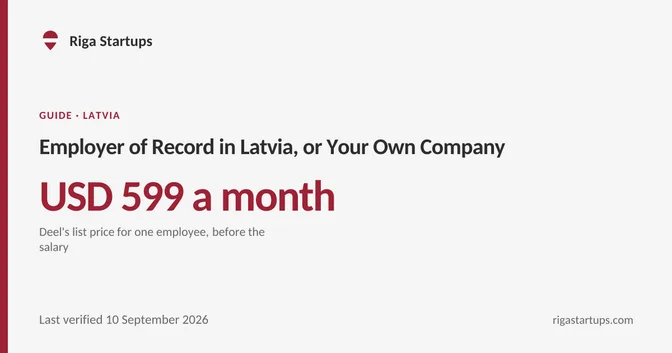
An employer of record hires your person onto its own payroll in Latvia and invoices you for their salary, the employer taxes and a monthly fee. Three widely used providers publish that fee: Deel lists USD 599 a month per employee, Remote USD 699 a month and Oyster USD 699 a month. Your own company costs EUR 75 in state fees to register, needs EUR 2,800 of share capital that stays the company's money, and then it needs running.
Employer of Record in Latvia, or Your Own Company
By Deepti Gupta · Reviewed by Vinayak Ravi · Riga Startups Editorial Team
Last verified · every figure links to its source, and the date each was checked is listed at the end · 19 min read
So far that is a spreadsheet. What turns it into a decision is three things the pricing pages do not lead with, each of them in Latvian law:
- Latvian law has no employer of record. The nearest thing it recognises is labour supply, and labour supply needs a licence.
- Code written for you belongs to the employer by default, and under this arrangement the employer is not you.
- Latvia's tax-free share options require the holder to work for the company granting them, or a related one. A provider is neither.
This states the rules with a link to each and quotes prices as the providers publish them. We have no commercial relationship with any employer of record, and none of them has seen this page. It is not advice, and where a question turns on your contract or your home country's tax law, it says so.
What Is an Employer of Record in Latvia?
An employer of record is a provider that hires your person onto its own Latvian payroll, runs payroll and the contract, and invoices you for the salary, the employer taxes, and a monthly fee. It lets a foreign company hire in Latvia without registering a company of its own, at the cost of that fee and some control.
Is an Employer of Record Legal in Latvia?
Latvian law has no employer of record as such. Its nearest concept is labour supply: the provider is the employer, it needs a State Employment Agency licence, the contract must say so, and the worker gets the same working conditions and terms of employment they would have if employed directly by the business they work for.
"Employer of record" is a sales term. The Labour Law's nearest concept is a labour supply service, where a provider employs someone and sends them to work for another business, under that business's direction. When that happens, the Labour Law says the employer is the provider that supplies the worker, not the business the work is done for.
That is the arrangement an employer of record sells, and Latvian law attaches conditions to it:
- A licence. Under the Unemployed and Jobseekers Support Law, labour supply may be provided only by companies holding a licence from the State Employment Agency. A provider licensed in another EU state must notify the agency in writing before it starts here.
- A contract that says so. The employment contract must state that the employer is a labour supply provider, and that the employee must also follow the client's work rules and instructions.
- Equal treatment. The provider must give the worker the same working conditions and terms of employment they would have if employed directly by the business they work for.
- No lock-in. An agreement between provider and client that stops the worker being hired directly by the client is void. The provider may agree only proportionate compensation for its costs of placing, recruiting and training the worker.
One honest caveat. Both laws describe sending the worker for a fixed period, and most employer of record contracts are open-ended. Whether a particular arrangement falls inside the definition is a question for a Latvian employment lawyer, not for this page.
What you can do without one is ask any provider two questions before signing: which company is the employer in Latvia, and what is its State Employment Agency licence. A provider that runs Latvian payroll through a local partner should be able to name the partner.
What Does an Employer of Record Handle in Latvia?
An employer of record runs Latvian payroll: monthly contribution reports by the 17th of the following month, payments by the 23rd, sick pay, leave, and a compliant contract. It does not remove the 23.59% employer contributions, your permanent establishment risk, the question of who owns the code, day-to-day management, or residence permit sponsorship.
It takes the payroll. A Latvian employer files a report on each month's contributions by the 17th of the following month and pays them by the 23rd, handles sick pay and leave, and writes a contract that holds up under Latvian law. The provider does all of that, and it is real work.
It does not take:
- The employer taxes. The fee sits on top of them. The employer's share of social contributions is still 23.59%, and the cost of hiring guide works through the whole stack.
- Your tax position. Whether your company has a taxable presence in Latvia depends on what the person does, not on whose payroll they are on. See below.
- The code. Also below, and it needs a clause.
- Managing them. You direct the work, which is exactly what makes it labour supply.
- The permit. If the person is not an EU citizen, the employer sponsors the residence permit, so ask whether the provider will. The non-EU hiring guide covers what that involves.
How Much Does an Employer of Record Cost in Latvia?
Deel lists USD 599 a month per employee, Remote USD 699 a month, and Oyster USD 699 a month, on top of salary and employer taxes, and these are global list prices that providers discount. Your own company costs EUR 75 in state fees and EUR 2,800 of share capital that stays yours, plus bookkeeping and running costs.
An employer of record. Published list prices, per employee per month, on top of salary and employer taxes:
| Provider | List price |
|---|---|
| Deel | USD 599 a month |
| Remote | USD 699 a month |
| Oyster | USD 699 a month |
These are global list prices in US dollars rather than Latvian ones, and providers discount for annual commitments and for volume. They are where negotiation starts. We have not listed negotiated prices, because we could not verify them.
Your own company. The statutory part is small: EUR 75 to register a standard SIA or EUR 20 for the reduced-capital version, plus share capital of EUR 2,800 for the standard one. The capital is not a cost. It stays in the company and can be spent on the business.
The running costs are market prices: a bookkeeper who also runs payroll, a registered address, a bank account, and someone's time on the board. We do not publish ranges for those either, for the same reason, and the registration guide explains what each involves, including the bank account, which is usually the slowest part.
When Is Your Own Company Cheaper Than an Employer of Record?
Divide your own company's monthly running cost by the provider's monthly fee per person, and the result is the headcount at which the two cost the same. Above that headcount your own Latvian company is cheaper, before counting permanent establishment, share options, and code ownership, which mostly favour your own company as well.
The fee scales with headcount, and your own company's overhead mostly does not, which is why the comparison reduces to that one division.
A worked example, using a round fee in the region of the published list prices:
| People | Fees a month, at EUR 600 each | Fees a year |
|---|---|---|
| 1 | EUR 600 | EUR 7,200 |
| 2 | EUR 1,200 | EUR 14,400 |
| 3 | EUR 1,800 | EUR 21,600 |
| 5 | EUR 3,000 | EUR 36,000 |
| 10 | EUR 6,000 | EUR 72,000 |
Get three quotes for bookkeeping with payroll and a registered address. If they come in below the middle column at the headcount you are planning, your own company is cheaper to run from that point, before anything else on this page is counted.
The division leaves out two things, and they point in opposite directions. Setting up a company takes weeks, most of them spent on the bank account, and a provider is usually faster to start. The costs in the next three sections are not fees at all, and they mostly point the other way.
Does an Employer of Record Avoid Permanent Establishment in Latvia?
No. A foreign company has a permanent establishment in Latvia if it provides services through employees or engaged personnel for more than 30 days in any six-month period, or works through a person who is authorised to conclude contracts in its name and regularly does so, more than once in a tax period. Whose payroll they are on does not matter.
The worry with hiring abroad is that the person gives your company a taxable presence in Latvia, a permanent establishment, which then owes Latvian tax on the profit attributable to it. An employer of record does not make that go away, and the Latvian definition shows why.
Under the Law on Taxes and Duties, a foreign company has a permanent establishment here if it uses a fixed place of business in Latvia, permanently, for its business. Separately from that test, it has one if it:
- provides services here, using its own employees or engaged personnel, for more than 30 days in any six-month period, or
- works through a person who is authorised to conclude contracts in its name and regularly does so, more than once in a tax period.
"Engaged personnel" is the phrase to notice. The domestic definition does not ask whose payroll the people are on. A salesperson on a provider's payroll who signs deals for you, or a team delivering your service to customers here, raises the same question as if you had employed them yourself.
Two things narrow it in practice. Where Latvia has a double taxation treaty with your home country, the treaty's definition applies, and treaties usually draw it more tightly than domestic law. And an engineer building your product for customers elsewhere is a different case from a person selling or delivering in Latvia. Neither makes this safe to guess at once there is more than one person, and it is a question for a tax adviser who can see both countries.
Your own company answers the question differently. The Latvian activity belongs to a Latvian company and is taxed as one, and the question becomes how the parent pays it for its work.
Can Employer of Record Staff Get Tax-Free Share Options in Latvia?
Usually not. The tax-free option route requires the holder to be employed by the company that granted the options, or by a company related to the one that did for at least 12 months, and a person employed by an unrelated employer of record is neither. Move people onto your own company before granting options.
Latvia has a tax-free route for share options, and the share options guide covers it in full. One of its conditions is that throughout the holding period of at least 12 months, the holder is employed by the company that granted the options, or by a company related to the one that did.
A person employed by a provider is employed by the provider. Unless the provider is related to the company granting the options, which a third-party employer of record is not, that condition fails and the options lose the exemption. Another condition, that the employer files the plan with the State Revenue Service, would also fall to the provider.
So if options are part of the offer, this is the section that decides it. The holding period starts at grant, which makes the practical answer to move people onto your own company before granting rather than after.
Who Owns Code Written Through an Employer of Record in Latvia?
By default, the employer of record. Under the Latvian Copyright Law, the economic rights to a program an employee writes as part of their job belong to the employer, unless the contract says otherwise, and the employer is the provider, so the code reaches you only if both the employment contract and the provider's contract with you assign it onward.
Under the Copyright Law, when an employee writes a computer program as part of their job, the economic rights belong to the employer, unless the contract says otherwise. For anything else an employee creates at work, such as designs, copy or documentation, the rights stay with the author, and the employer gets the right to use the work for the purpose it was made.
So ask to see both clauses, in the employment contract and in the provider's contract with you, before the first commit.
The second rule applies whoever the employer is. Designs and documents do not move to any employer without an assignment, your own company included, so the same clause belongs in your own contracts. The intellectual property guide works through both rules, and what a contractor's agreement has to say to move anything at all.
Can a Foreign Company Employ Someone in Latvia Without an Entity?
Yes. A foreign company can employ someone in Latvia directly, and the worker is then treated as a person living in Latvia and employed here by an employer that is a foreign taxpayer. The employee registers with the State Revenue Service within 10 days, reports quarterly, and pays contributions at the full rate set in article 18, both halves included.
There is a third option, and it is lawful: a foreign company employs someone in Latvia directly, with no entity and no provider. The Social Insurance Law has a status for exactly this, a person living in Latvia and employed here by an employer that is a foreign taxpayer.
It moves the employer's paperwork onto the employee. They register themselves with the State Revenue Service within 10 days of taking up the job, report by the 17th of the month after each quarter, and calculate contributions at the full rate set in article 18, both halves included. An employer established in another EU state can instead agree with the person which of the two statuses the contributions are paid in, which lets it keep the reporting on its own side.
Asking a new hire to run their own social insurance is an odd way to begin, and it does nothing about the permanent establishment question. But it exists, it carries no fee, and for one senior person who is comfortable with it, it can be the right answer.
Can a Latvian Company Send Its Own Staff to Work Abroad?
Yes, and it is the mirror of everything above. Posting an employee to another EU state keeps them in Latvian social security for an anticipated posting of up to 24 months, on an A1 certificate from the state social insurance agency, but the destination country's pay and working conditions apply to them from day one.
A company that has understood why an employer of record exists in Latvia usually has the same question pointing outwards, because the answer is not symmetrical. Employing someone in another country needs an entity or a provider there. Sending your own Latvian employee there temporarily does not.
- Social security follows the A1, not the work. Under article 12 of Regulation 883/2004 a posted worker stays in the sending state's system where the anticipated posting is no longer than 24 months and they are not replacing someone else whose posting has ended. The A1 certificate from the Valsts sociālās apdrošināšanas aģentūra is the proof, and it is requested before the posting rather than after. Without it the host country can charge its own contributions on the same work.
- The no-replacement rule has teeth. Rotating a second person into the same role when the first one's posting ends is the thing article 12 exists to stop, and it is the commonest way a genuine posting turns into an obligation to register locally.
- Employment conditions are the destination's. The Posted Workers Directive, which Latvia implements in article 14 of the Labour Law for postings in the other direction, gives the posted worker the host country's minimum pay, working time, leave, and health and safety rules where those are better than the contract's. You keep the employment relationship; you do not keep your own terms.
- Tax residence moves on its own timetable. Social security, employment law, and income tax each have their own test, and a posting can sit inside the 24 months for one and outside the threshold for another. The treaty between Latvia and the destination decides the income tax.
- Long enough, and it becomes an establishment. A posting that keeps extending, or a person who stops returning, raises the same permanent establishment question the section above asks about foreign companies operating in Latvia, pointed the other way.
The practical line is duration and intent. A defined project with an end date, on an A1, is a posting. An employee who has moved and works from the other country indefinitely is not, whatever the paperwork says, and the answer for them is an entity or a provider in that country.
How Do You Move Staff From an Employer of Record to Your Own Latvian Company?
Settle five things first: whether the conversion fee is lawful, since a clause blocking direct hiring is void under labour supply rules; whether earlier service counts toward severance; granting options only after the move; collecting every code assignment; and a new residence permit sponsorship for a non-EU employee.
Most companies that start with a provider move later, and it goes better when these are settled in advance:
- Read the conversion fee. If the arrangement is labour supply, a clause stopping you hiring the person directly is void, and the provider may agree only proportionate compensation for its costs. A fee set as a multiple of salary is worth questioning against that.
- Decide about service. Statutory severance is one month's average earnings under five years of service, two up to ten, three up to twenty, four beyond, counted with that employer. Moving the person to your company starts a new count unless you agree to recognise the earlier service, and it is fairer to decide that openly than to let them find out later.
- Grant options after the move, for the reason above.
- Collect the code. Make sure the provider has assigned everything written so far before its contract ends.
- Mind the permit. For a non-EU employee a change of employer means a new sponsorship, and the non-EU hiring guide has the timing.
Should You Use an Employer of Record or Register a Latvian Company?
Use an employer of record for one or two people hired quickly, to test Latvia, for building rather than selling here, and when options are not part of the offer. Register your own company when you plan to grant options, will pass the break-even headcount, or will have someone selling or signing contracts in Latvia.
Use an employer of record when you want one or two people quickly, when you are testing whether Latvia works before committing, when the work is building rather than selling here, and when options are not part of the offer.
Register your own company when you plan to grant options, when headcount will pass the break-even above, when the person will sell or sign for you here, or when you want what only a Latvian company gets: eligibility for the Startup Law's support and corporate income tax that waits until you distribute.
Whichever provider you talk to, ask:
- Which company is the employer in Latvia, and what is its State Employment Agency licence?
- Where is the clause assigning the code, and everything else the person makes, to us?
- What does moving the person to our own company cost, and on what basis?
- Who pays statutory severance if the role ends?
- Will you sponsor a residence permit, and will you file an option plan with the State Revenue Service?
Frequently Asked Questions
Does an Employer of Record Need a Licence in Latvia?
Yes, if the arrangement is labour supply. Under the Unemployed and Jobseekers Support Law, labour supply may be provided only by companies holding a licence from the State Employment Agency, and a provider licensed in another EU state must notify the agency before it starts in Latvia.
Can an Employer of Record Stop You Hiring the Worker Directly?
No. Under Latvian labour supply rules, an agreement stopping the client from hiring the worker directly is void. The provider may agree only proportionate compensation for its costs of placing, recruiting and training the worker.
How Much Is Statutory Severance in Latvia?
Statutory severance in Latvia is one month's average earnings under five years of service, two up to ten, three up to twenty, four beyond, counted with the same employer. Moving a worker from an employer of record to your own company starts a new count unless you agree to recognise the earlier service.
Does an Employer of Record Sponsor Work Permits in Latvia?
Only if the provider agrees. For a non-EU worker the employer sponsors the residence permit, and under an employer of record the employer is the provider, so ask whether it will sponsor before signing.
Who Pays Employer Social Contributions Under an Employer of Record?
You do, through the provider's invoice. The employer's share of Latvian social contributions stays 23.59% of gross pay, and the provider's monthly fee sits on top of the salary and those taxes.
Sources
- Darba likums, the Labour Law. Article 4(2) makes the provider the employer, 7(4) requires equal treatment, and 40(8) sets what the contract must state. Article 112 has the severance scale.
- Bezdarbnieku un darba meklētāju atbalsta likums, article 17, for the licence, the notification for providers from other EU states, and the rules on hiring the worker directly.
- Par nodokļiem un nodevām, article 14(7) and (8), for the domestic definition of a permanent establishment.
- Par valsts sociālo apdrošināšanu. Article 1(4) defines an employee of a foreign employer, 6(17) gives EU employers their choice, 13(4) requires self-registration, 20(7) sets the rate, and 21 and 23 the payment and reporting dates.
- Par iedzīvotāju ienākuma nodokli, article 9(1)(43), for the share option conditions.
- Autortiesību likums, article 12, for who owns work made in employment.
- The registration fee and share capital come from the fee regulation and the Commercial Law, as in the registration guide.
- The pricing pages of Deel, Remote and Oyster, as published on 10 September 2026.
This page states rules and published prices. How they apply to your company, in your two countries, is a question for someone who can see both.
Every Figure, and When It Was Checked
Each value links to the source it was taken from. The date is when that source was last read and matched. Where a source cannot be checked automatically, it says so.
| Figure | Value | Last checked |
|---|---|---|
| Deel's published list price for an employer of record, per employee | USD 599 a month | 10 September 2026 |
| Remote's published list price for an employer of record, per employee | USD 699 a month | 10 September 2026 |
| Oyster's published list price for an employer of record, per employee, billed monthly | USD 699 a month | 10 September 2026 |
| Who the Labour Law treats as the employer in a labour supply arrangement | the provider that supplies the worker, not the business the work is done for | 10 September 2026 |
| The equal treatment a labour supply provider owes the worker it places | the same working conditions and terms of employment they would have if employed directly | 10 September 2026 |
| What a labour supply employment contract must say on top of the usual terms | that the employer is a labour supply provider, and that the employee must also follow the client's work rules and instructions | 10 September 2026 |
| Who may provide labour supply services in Latvia | companies holding a licence from the State Employment Agency | 10 September 2026 |
| The status of an agreement stopping a supplied worker from being hired directly by the client | void | 10 September 2026 |
| What a provider may agree to receive when the client hires the worker directly | proportionate compensation for its costs of placing, recruiting and training the worker | 10 September 2026 |
| The deadline for an employer's monthly report on social contributions | the 17th of the following month | 10 September 2026 |
| The day of the following month by which an employer pays each month's contributions | the 23rd | 10 September 2026 |
| The employer's share of the mandatory social contribution | 23.59% | 8 September 2026 |
| State fee to register a standard SIA | EUR 75 | 8 September 2026 |
| State fee to register a reduced-capital SIA | EUR 20 | 8 September 2026 |
| Minimum share capital for a standard SIA | EUR 2,800 | 8 September 2026 |
| How long a foreign company can provide services in Latvia through its own or engaged staff before that alone is a permanent establishment | 30 days in any six-month period | 10 September 2026 |
| The dependent agent test for a permanent establishment in domestic law | is authorised to conclude contracts in its name and regularly does so, more than once in a tax period | 10 September 2026 |
| Minimum holding period between grant and the first day options may be exercised | 12 months | 8 September 2026 |
| The employment condition for the share option exemption | employed by the company that granted the options, or by a company related to the one that did | 10 September 2026 |
| Who holds the economic rights in software an employee writes as part of the job | belong to the employer, unless the contract says otherwise | 10 September 2026 |
| Who holds the rights in anything other than software an employee creates at work | stay with the author, and the employer gets the right to use the work for the purpose it was made | 10 September 2026 |
| The social insurance status for someone employed directly by a foreign company with no Latvian entity | a person living in Latvia and employed here by an employer that is a foreign taxpayer | 10 September 2026 |
| How soon an employee of a foreign employer must register themselves with the State Revenue Service | 10 days | 10 September 2026 |
| When an employee of a foreign employer reports their own contributions | by the 17th of the month after each quarter | 10 September 2026 |
| The contribution rate an employee of a foreign employer calculates for themselves | the full rate set in article 18, both halves included | 10 September 2026 |
| What an employer from another EU state may agree with a person covered by Latvian social insurance | which of the two statuses the contributions are paid in | 10 September 2026 |
| The statutory severance scale, by length of service with that employer | one month's average earnings under five years of service, two up to ten, three up to twenty, four beyond | 10 September 2026 |
| The longest anticipated posting for which a worker stays in the sending state's social security system | 24 months | 15 September 2026, by hand |