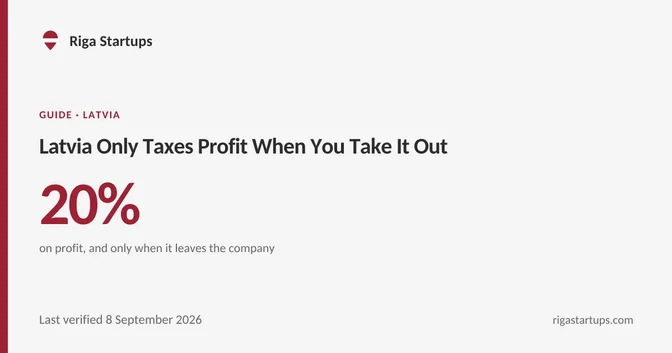
Latvian corporate income tax falls due when profit leaves the company, not when it is earned. A company that reinvests everything it makes pays no corporate income tax at all, for as long as it keeps doing that, and a dividend that has borne the tax at company level is not taxed again in a Latvian shareholder's hands.
Latvia Only Taxes Profit When You Take It Out
By Deepti Gupta · Reviewed by Vinayak Ravi · Riga Startups Editorial Team
Last verified · every figure links to its source, and the date each was checked is listed at the end · 14 min read
What this does not cover. This describes the ordinary case: a Latvian company taxed under the Corporate Income Tax Act. It does not cover micro-enterprise tax, tonnage tax, the separate treatment of credit institutions, permanent establishments of foreign companies, or any double tax treaty. It says what the rule is, not what you should do, and it is not tax advice. Every number links to the provision it comes from.
Corporate income tax calculator
Latvian corporate income tax, at the rates in the ledger at the end of this page.
- Reaches the shareholder
- EUR 80,000.00
- Taxable base, the distribution divided by 0.8
- EUR 100,000.00
- Corporate income tax, 20%
- − EUR 20,000.00
- Total the company parts with
- EUR 100,000.00
- Tax as a share of the profit
- 20%
- Tax as a share of what arrives
- 25%
Both of those are true and they describe the same payment. The statute sets the first; the second is what a founder deciding whether to take money out is actually choosing against. A Latvian shareholder pays no further income tax on a dividend that has borne this.
How Does Corporate Income Tax Work in Latvia?
Latvian corporate income tax is charged when profit is distributed, not when it is earned. The rate is 20%, applied after the distributed amount is divided by 0.8, so a company that pays out 80 owes 20, and a company that retains all of its profit pays nothing.
The rate is 20%, and it is applied to a base rather than to profit. Before the rate bites, the value of the taxable object is divided by a coefficient of 0.8.
That division is the part people miss, and without it the arithmetic below looks wrong. The base is built from the sum the company hands over, not from the profit that sum came out of, so dividing by 0.8 grosses it back up. Pay a shareholder 80 and the base is 100, on which the tax is 20.
What Is the Effective Tax Rate on a Dividend From a Latvian Company?
A dividend from a Latvian company bears corporate income tax of 20% of the gross profit distributed, which is a quarter of the amount the shareholder actually receives. On 100 of profit, the company pays 20 and the shareholder receives 80, with no further personal income tax in Latvia.
Take a company with EUR 100 of profit and no deductions to argue about.
| What it does | Base | Tax | Reaches the shareholder |
|---|---|---|---|
| Retains all of it | nil | nil | nothing, yet |
| Distributes all of it | 100 | 20 | 80 |
| Distributes half | 50 | 10 | 40 |
Read the middle row from the other end. The shareholder receives 80 and the state receives 20, so the tax is 20% of the profit and 25% of the sum that actually arrives. Quote whichever you like, but know which one you are quoting: a founder planning a distribution is asking what lands in the account, and for them the number is 25%.
The top row is the whole point of the regime. Not "deferred at a low rate". Nil.
Do Shareholders Pay Tax on Dividends From a Latvian Company?
Not in the ordinary case. Dividends are exempt from Latvian personal income tax where corporate income tax has already been paid on the profit behind them, including profit taxed abroad. The exemption does not cover profit earned under micro-enterprise tax, or distributions routed through a structure set up mainly to obtain it.
Dividends are exempt from personal income tax where corporate income tax has already been paid on the profit they come from, under article 9 of the Personal Income Tax Act. The exemption also covers profit that bore corporate tax abroad. It does not cover profit earned while the company was paying micro-enterprise tax, and it does not cover distributions routed through a structure set up mainly to obtain the exemption.
One qualification reaches the largest distributions: an exempt dividend still counts toward the income threshold for the additional income tax rate. Whether a dividend is a better way to pay yourself than a salary is a separate question with a less obvious answer, and the founder pay guide works it through.
So for the ordinary case the answer to "what does it cost me to get money out of my company" is the corporate tax and nothing after it.
What Counts as a Deemed Distribution Under Latvian Corporate Tax?
Latvian corporate income tax also applies to deemed distributions: expenses unrelated to the business, bad debts still unrecovered after 36 months, excess interest, loans to related persons, transfer pricing adjustments, and a liquidation quota. Each is taxed as though the money had been paid out, which is where founders are most often caught.
Distributing a dividend is the obvious trigger. It is not the only one, and the others are where founders are caught, because none of them feels like taking money out.
The Act builds the taxable base from distributed profit, which is dividends, payments treated as dividends, and deemed dividends. Then it adds deemed distributed profit, which is a list:
- Expenses not related to economic activity. The catch-all, and the commonest. A cost the company carried that was not for the business is treated as though the money had been distributed.
- Bad debts. A provisioned debt that is still unrecovered after 36 months enters the base. The window is 60 months where insolvency proceedings have started against the debtor. This one runs on a clock nobody is watching, and chasing the debt is cheaper than being taxed on it.
- Increased interest payments. Thin capitalisation: interest above the statutory limits is treated as a distribution.
- Loans to a related person. Lending to a shareholder is the classic way of taking money out without declaring a dividend, and the Act treats it as one.
- Transfer pricing adjustments. Income the company would have received, or costs it would not have borne, had it dealt with a related party at arm's length.
- Benefits a non-resident grants to staff where they are attributable to a permanent establishment in Latvia.
- Liquidation quota, assets moved out in a reorganisation, and assets transferred abroad where Latvia loses the right to tax them.
- Hybrid mismatch outcomes.
Expenses from which personal income tax has already been withheld are excluded, which is the mechanism that stops a taxed benefit in kind being taxed twice.
The full list is in article 4 of the Act. It is worth reading once properly rather than trusting a summary, including this one.
What Tax Does Latvia Withhold on Payments Abroad?
Latvia withholds on a short, closed list. Management and consultancy fees to a non-resident bear 20%, rent of Latvian property 5%, and the sale of Latvian property 3%. Ordinary interest and royalties bear nothing, unless the recipient sits in a low-tax jurisdiction, where everything bears 20%.
Article 5 of the Act is the whole of it, and reading it as a list is the point: what is absent matters more than what is present. A Latvian company paying interest to a foreign lender, or royalties to a foreign licensor, withholds nothing, provided the recipient is an ordinary taxpayer somewhere ordinary. Most jurisdictions withhold on both.
| Payment to a non-resident | Withheld |
|---|---|
| Management and consultancy fees | 20% |
| Rent or lease of immovable property in Latvia | 5% |
| Disposal of immovable property in Latvia | 3% |
| Interest | nothing |
| Royalties and other payments for intellectual property | nothing |
| Dividends | nothing |
| Anything at all, where the recipient is in a low-tax jurisdiction | 20% |
Four things qualify that table.
- Management and consultancy is defined, not self-declared. Article 5, fifth part describes it as work a non-resident does, directly or through personnel it brings in, to manage a Latvian company or to advise it. Naming an invoice "software development" does not settle the question if the substance is advice, and naming it "consultancy" when it is development invites a withholding nobody owed.
- Property reaches through shares. Article 5, second part treats the sale of shares as a disposal of Latvian property where more than half the company's assets are, or were in the previous year, Latvian immovable property. A startup owning its own building is inside this rule on an exit.
- A treaty or EU resident can be taxed on the net. Under article 5, fourth part, a resident of an EU state or a treaty country can file a return with evidence of the costs behind the income and have the 20%% rate applied to the profit rather than to the gross fee.
- The low-tax rule is deliberately blunt. Article 5, sixth part withholds 20% from every payment and dividend to a person located or established in a low-tax or no-tax jurisdiction, including payments to their representatives, into third-party bank accounts, and by set-off. Article 5, eighth part applies the same 20% to interest and intellectual property payments. Payments for goods, and for EU or EEA publicly traded securities bought at market prices, are excluded. The list of jurisdictions is Cabinet Regulation No. 333, which adopts the EU list of non-cooperative jurisdictions.
There is a release valve on the last of these. Article 5, ninth part lets the Revenue Service permit a payment to go untaxed where the payer proves it is not made to reduce Latvian tax, and lets the Service cancel that permission later. Whether Latvia is a low-tax jurisdiction itself, rather than a payer into one, is the question the tax haven guide takes apart.
How Does Latvia Tax Money Left With a Related Party?
A loan to a related person is a deemed distribution and is taxed like a dividend. Article 11 says so outright, then carves out the cases that are plainly commercial: a loan running 12 months or less, a loan from a shareholder to the company, and a loan matched by borrowing the company itself took from an unrelated lender.
This is the provision that catches founders, because it taxes a transaction nobody thinks of as taking money out. The company has cash, the founder needs cash, the bookkeeper writes "loan to shareholder", and the corporate income tax return for that month should have carried a taxable object.
The carve-outs in article 11, third and fourth parts, are the working part of the rule:
- A loan that runs 12 months or less is outside it. A genuine short-term advance repaid inside the year is not a distribution. Rolling the same loan over each year to stay under the limit is not what the provision describes.
- A loan from a shareholder to the company is outside it, which is the direction most founders actually lend in. So is a loan from a company to its own permanent establishment abroad.
- A loan matched by an arm's length borrowing is outside it, to the extent the company itself borrowed the money from someone unrelated.
- A loan made in a year that opened with no retained earnings is outside it, and so is a loan up to the registered share capital at the start of the year, less loans issued in earlier years and not yet recovered.
- Repayment reverses the charge. Article 11, fifth part reduces the taxable base by a repaid loan that was taxed in an earlier period, so the tax follows the money back.
Two neighbouring provisions do related work. Article 10 puts a ceiling on deductible interest, so a related-party loan priced generously runs into thin capitalisation before it runs into anything else. And a transfer pricing adjustment under article 4 reaches any related-party dealing that is not at arm's length, whether or not it is a loan. Paying yourself properly, rather than lending to yourself, is the subject of the founder pay guide.
Is Latvia's Corporate Tax Good for a Bootstrapped Company?
Yes, if the company retains profit. A bootstrapped Latvian company compounds its whole profit untaxed and pays 20% corporate income tax only when it distributes, so the deferral grows every year it reinvests. A company that distributes everything each year, or has no profit, gets nothing from the regime.
Under a conventional regime a company pays tax on profit each year and compounds what is left. Under this one it compounds the whole amount and settles up only when the money comes out. The gap widens every year the company keeps reinvesting, and it does not close until a distribution happens.
Which is also the honest limit of the argument. The deferral is worth exactly as much as the profit you retain. A company that distributes everything each year gets nothing from it, and neither does a company with no profit to retain.
Does Latvia's Corporate Tax Help a Venture-Backed Startup?
Much less. A venture-backed startup burning investor money has no profit to defer tax on, and one heading for an acquisition cares about tax on selling its shares, which the distribution-based regime does not address. For most of the venture path, corporate income tax is not a reason to choose Latvia.
A company burning investor money has no profit to defer tax on. A company that does become profitable and is heading for an acquisition is thinking about the tax on the sale of shares, which this regime says nothing about. For most of the venture path, the corporate income tax model is not the reason to be in Latvia.
How Many Latvian Startups Actually Retain Profit?
Of the 519 companies on this map with both figures on record, 291 have equity above their share capital, a workable proxy for retained profit, and 166 have equity below zero. The median company's latest annual report covers 2025, so the count describes recent filings rather than today.
We can check this rather than assert it. The Register of Enterprises publishes company annual reports and registered share capital as open data, so equity above share capital is a workable proxy for profit that stayed in the business.
That is 519 of the 600 companies on this map.
So the majority are retaining something and the regime is doing real work for them, and close to a third have accumulated losses, for whom it does nothing at all. Both halves matter. A tax deferral is a benefit to profitable companies and an irrelevance to everyone else, and a startup ecosystem contains plenty of both.
Three caveats on that count. Equity above share capital includes share premium, so some of what it counts is money investors put in rather than profit the company made. An annual report describes a year that ended before it was filed, and for the median company here the most recent one on file covers 2025. And it is the latest filing rather than the current position, so a company that distributed everything last month still reads as retaining. It is a floor and a shape, not a precise count.
You can see the companies themselves and what the register holds on each.
When Is Latvian Corporate Income Tax Filed?
Monthly. When a taxable object such as a dividend or a deemed distribution arises in a month, a Latvian company declares it and pays the tax for that month, rather than settling once a year. Payments to non-residents, particularly in low-tax jurisdictions, follow separate rules that the ordinary case does not cover.
The return is monthly, not annual. Corporate income tax here is not a once-a-year reckoning. When a taxable object arises in a month, it is declared and paid for that month. A company with nothing to declare still has the obligation to think about it.
Payments abroad have their own rules. Certain payments to non-residents, and particularly to low-tax jurisdictions, are treated differently from the domestic case, and whether any of this makes Latvia a tax haven has its own page.
The comparison with the neighbours needs its own page. Estonia runs a near-identical model and Lithuania does not, and the useful version of that comparison is a table of current rates for three countries. Getting three foreign tax codes right to the standard this site holds itself to is a separate piece of work, and it is the guide after next rather than a paragraph here. A half-checked comparison table would be worse than none.
Frequently Asked Questions
What Is the Corporate Tax Rate in Latvia?
The Latvian corporate income tax rate is 20%, applied to distributed profit after dividing it by 0.8. In practice that is 20% of the gross profit distributed, or a quarter of the net amount a shareholder receives. Retained profit is not taxed.
Is Retained Profit Taxed in Latvia?
No. Latvian corporate income tax falls due only when profit is distributed or treated as distributed, so a company that reinvests everything it earns pays no corporate income tax on that profit for as long as it keeps it.
Do Latvian Companies Pay Corporate Tax Monthly?
Yes. When a taxable object arises in a month, a Latvian company declares and pays corporate income tax for that month instead of waiting for the year end.
Is a Loan to a Shareholder Taxed Like a Dividend in Latvia?
It can be. The Corporate Income Tax Act treats loans to related persons as deemed distributed profit, so lending company money to a shareholder can bear corporate income tax as though a dividend had been paid.
When Does an Unpaid Debt Become Taxable in Latvia?
A provisioned bad debt that is still unrecovered after 36 months enters the corporate income tax base, or after 60 months where insolvency proceedings have started against the debtor.
Sources
- Uzņēmumu ienākuma nodokļa likums, the Corporate Income Tax Act. Article 3 has the rate and the coefficient. Article 4 has the taxable objects, including the deemed distributions. Article 9 has the bad debt windows.
- Par iedzīvotāju ienākuma nodokli, the Personal Income Tax Act, for the dividend exemption and its limits.
- Company annual reports and registered capital, both from the Register of Enterprises open data, for the retained earnings figures.
This page states rules. It does not tell you what to do with them, and a decision about your own company needs an adviser who knows it.
Every Figure, and When It Was Checked
Each value links to the source it was taken from. The date is when that source was last read and matched. Where a source cannot be checked automatically, it says so.
| Figure | Value | Last checked |
|---|---|---|
| Corporate income tax rate on the taxable base | 20% | 8 September 2026 |
| Coefficient the taxable object is divided by before the rate applies | 0.8 | 8 September 2026 |
| How long a provisioned debt may go unrecovered before it is taxed | 36 months | 8 September 2026 |
| The same window where insolvency proceedings have begun against the debtor | 60 months | 8 September 2026 |
| Tax withheld from management and consultancy fees paid to a non-resident | 20% | 15 September 2026 |
| Tax withheld from consideration for disposing of immovable property in Latvia | 3% | 15 September 2026 |
| Tax withheld from rent paid to a non-resident for immovable property in Latvia | 5% | 15 September 2026 |
| Tax withheld from every payment and dividend to a person in a low-tax or no-tax jurisdiction | 20% | 15 September 2026 |
| Tax withheld from interest and intellectual property payments to a low-tax or no-tax jurisdiction | 20% | 15 September 2026 |
| Loan term at or below which a loan to a related person is not treated as a distribution | 12 months | 15 September 2026 |