Latvia gets asked this because of one feature: a company that keeps its profit pays no corporate income tax on it. That sounds like a tax haven, and by the definitions governments actually use it is not one. This page answers the reputation question with the lists, puts Latvia's rates beside four other EU countries, and sets out the rules that stop a Latvian company being used as a letterbox.
Is Latvia a Tax Haven?
By Deepti Gupta · Reviewed by Vinayak Ravi · Riga Startups Editorial Team
Last verified · every figure links to its source, and the date each was checked is listed at the end · 8 min read
This compares the company-level tax each country charges and cites the source for every rate. It is not advice. How a structure is taxed depends on where its owners live and where it is run, which is a question for an adviser who can see both.
Is Latvia a Tax Haven?
No, by the definitions governments use. Latvia is not on the EU list of non-cooperative jurisdictions, it uses that list to penalise payments to the places on it, and it taxes profit shifted into foreign companies its companies control. What looks like a haven is a tax deferred until profit is paid out.
The EU list is the one Latvian law relies on. After its revision on 17 February 2026 it named American Samoa, Anguilla, Guam, Palau, Panama, Russia, the Turks and Caicos Islands, the US Virgin Islands, Vanuatu and Viet Nam, and it is reviewed twice a year. Latvia's own list of low-tax or no-tax jurisdictions is, by Cabinet regulation, the jurisdictions on Annex I of the EU list of non-cooperative jurisdictions, and it changes whenever the Council revises that annex.
The critics' index is less kind. The Tax Justice Network's Corporate Tax Haven Index, in its 2024 country profiles, ranks Latvia 36th, with a haven score of 71 out of 100, its measure of how much room a country's rules leave for corporate tax avoidance. The same index puts Latvia's share of the world's multinational financial activity at less than 0.1%, so on its own terms Latvia's rules allow more than they are used for.
Why Do People Ask Whether Latvia Is a Tax Haven?
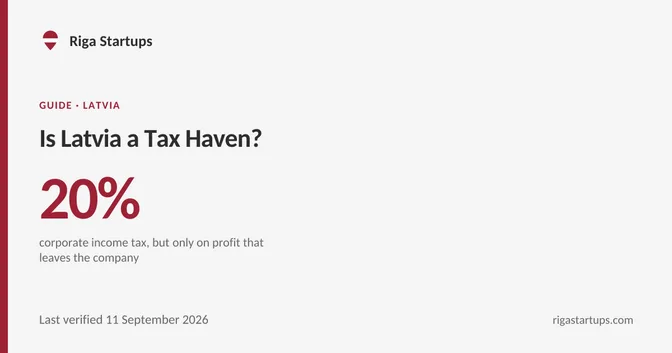
Because a Latvian company that keeps its profit pays no corporate income tax on it. Tax falls due only when profit is distributed, at 20% after dividing the payout by 0.8, so the headline of zero tax on retained earnings is true, and easy to mistake for a haven.
The mechanism, including the deemed distributions that count as paying profit out without a dividend, is in the corporate income tax guide. This page does not repeat it.
How Does Latvia's Corporate Tax Compare With Estonia, Lithuania, Ireland, and Cyprus?
On profit a company pays out, Latvia takes 20% of it, against 24% in Estonia, 17% in Lithuania, 12.5% of trading profit in Ireland and 15% in Cyprus. Latvia and Estonia take nothing from profit a company keeps, while the other three tax it every year.
| Taxed | On profit kept | On profit paid out | |
|---|---|---|---|
| Latvia | When paid out | Nothing | 20% |
| Estonia | When paid out | Nothing | 24% |
| Lithuania | Every year | 17% | 17% |
| Ireland | Every year | 12.5% | 12.5% |
| Cyprus | Every year | 15% | 15% |
Ireland's rate is the one on trading profit; other income is taxed at a higher rate there.
This is company-level tax only. What a shareholder then pays on the dividend depends on the country and on where the shareholder lives, and a Latvian resident shareholder pays nothing more on a dividend that has already borne Latvian corporate income tax. Latvia's and Estonia's shares are of the profit before tax; measured against the dividend actually received they are higher, which the Baltic comparison guide works through.
Where Is Latvia's Tax System Genuinely Advantageous?
For a company that reinvests. Profit kept in a Latvian company and spent on hiring, product or equipment bears no corporate income tax at all, so a bootstrapped company can compound its earnings untaxed for as long as it keeps them. The advantage is a deferral, and it ends when the profit is paid out.
That makes the benefit largest for a profitable company with a long runway of things to spend on, and smallest for one that makes a profit and immediately wants it in its owners' hands. The corporate income tax guide counts how many companies on this map carry retained profit.
Where Is Latvia Not a Low-Tax Country?
On salaries, and on profit paid out. Employing someone carries social contributions of 34.09%, split between employer and employee, plus payroll income tax of 25.5%, and profit a founder takes as a dividend bears 20% at company level, more than in Lithuania, Ireland or Cyprus.
A company that exists to move money to its owners gains nothing from the deferral, and pays a higher company-level rate on the way out than three of the four countries above. What a hire really costs is in the cost of hiring guide, and how founders draw money from a Latvian company is in the founder pay guide.
Can You Use a Latvian Company as a Letterbox?
Not safely. Latvia withholds 20% from payments to companies in listed low-tax jurisdictions, taxes a Latvian parent on profit from artificial arrangements in a foreign company it controls, and a company actually run from another country may be taxed where it is run. A brass plate in Riga changes none of that.
- Payments to listed jurisdictions. Under article 5 of the Corporate Income Tax Act a Latvian company withholds 20% from payments and dividends to people and companies in low-tax or no-tax jurisdictions, and article 4 treats a transaction with one as a transaction with a related party.
- Controlled foreign companies. Article 6.1 makes a Latvian company that holds more than 50% of a foreign company's shares or votes, alone or with related parties, include in its own taxable base the foreign company's profit from artificial arrangements, defined as a transaction whose main reason is to obtain a tax advantage. Small foreign companies, measured against EUR 750,000 of profit and EUR 75,000 of income not from selling goods and services, fall outside it, except in a listed low-tax jurisdiction.
- Where the company is run. A Latvian company managed day to day from another country can create a taxable presence there, whatever the Latvian register records. The Baltic comparison guide and the employer of record guide set out how that risk arises.
- Large groups. Latvia's global minimum tax law applies to groups with consolidated revenue of EUR 750 million or more in at least two of the four preceding years. It does not reach a startup.
Who Is Latvia a Good Fit For?
A company that will make money and keep it working: a bootstrapped software business, a founder reinvesting in hiring, or a startup that expects years before it distributes anything. It is a poor fit for a structure built to route profit elsewhere, and for owners who need the profit paid out to them every year.
If Latvia is the right answer, the registration guide covers setting a company up, and the compliance calendar what it files once it is running.
Frequently Asked Questions
What Is the Corporate Tax Rate in Latvia?
20%, charged only when profit is distributed and applied after dividing the distribution by 0.8. Profit a company keeps is not taxed, and a dividend that has borne the tax is not taxed again in a Latvian resident shareholder's hands.
Is Latvia on the EU Tax Haven Blacklist?
No. The EU list of non-cooperative jurisdictions, revised on 17 February 2026, names American Samoa, Anguilla, Guam, Palau, Panama, Russia, the Turks and Caicos Islands, the US Virgin Islands, Vanuatu and Viet Nam. Latvia uses that list as its own list of low-tax jurisdictions.
Does Latvia Have Controlled Foreign Company Rules?
Yes. Article 6.1 of the Corporate Income Tax Act taxes a Latvian company on profit from artificial arrangements in a foreign company in which it holds more than 50% of the shares or votes, alone or with related parties.
What Does Latvia Charge on Payments to Tax Havens?
A Latvian company withholds 20% from payments and dividends to people and companies in low-tax or no-tax jurisdictions, which Latvian law defines as the jurisdictions on Annex I of the EU list of non-cooperative jurisdictions.
Is Latvia Cheaper Than Cyprus or Ireland for a Company?
Only for profit that stays in the company. Profit kept in a Latvian company is not taxed, while Cyprus charges 15% and Ireland 12.5% of trading profit every year. On profit paid out, Latvia's 20% is the higher company-level charge.
Sources
- Uzņēmumu ienākuma nodokļa likums, the Corporate Income Tax Act. Article 3 has the rate, article 4 the divisor and the treatment of low-tax jurisdictions, article 5 the withholding on payments to them, and article 6.1 the controlled foreign company rule.
- Cabinet Regulation No. 333, which defines Latvia's low-tax or no-tax jurisdictions as the EU list.
- The European Commission, on the revision of the EU list of non-cooperative jurisdictions of 17 February 2026.
- Lielu uzņēmumu grupu globāla minimāla nodokļu līmeņa nodrošināšanas likums, Latvia's global minimum tax law, article 2.
- Riigi Teataja, the Estonian Income Tax Act, and e-Seimas, the Lithuanian Law on Corporate Income Tax.
- Revenue, the Irish tax authority, for the rate on trading income, and PwC Worldwide Tax Summaries for the Cyprus rate from 2026.
- The Tax Justice Network's Corporate Tax Haven Index, for Latvia's rank, haven score and scale weight.
- Par valsts sociālo apdrošināšanu and Par iedzīvotāju ienākuma nodokli, for the payroll rates.
This page compares published rates and states the rules behind them. It does not tell you where to incorporate.
Every Figure, and When It Was Checked
Each value links to the source it was taken from. The date is when that source was last read and matched. Where a source cannot be checked automatically, it says so.
| Figure | Value | Last checked |
|---|---|---|
| Latvian corporate income tax rate | 20% | 11 September 2026 |
| The divisor applied to the Latvian taxable object before the rate | 0.8 | 11 September 2026 |
| Estonian income tax rate, which is also the rate on distributed profit | 24% | 11 September 2026, by hand |
| Lithuanian corporate income tax rate on annual taxable profit | 17% | 8 September 2026, by hand |
| Irish corporation tax rate on trading income | 12.5% | 11 September 2026 |
| Cyprus standard corporate income tax rate from 1 January 2026 | 15% | 11 September 2026 |
| The jurisdictions on Annex I of the EU list of non-cooperative jurisdictions after its revision of 17 February 2026 | American Samoa, Anguilla, Guam, Palau, Panama, Russia, the Turks and Caicos Islands, the US Virgin Islands, Vanuatu and Viet Nam | 11 September 2026 |
| What Latvian regulations define as low-tax or no-tax jurisdictions | the jurisdictions on Annex I of the EU list of non-cooperative jurisdictions | 11 September 2026 |
| Tax a Latvian company withholds from payments and dividends to persons in low-tax or no-tax jurisdictions | 20% | 11 September 2026 |
| Holding of a foreign company's shares or votes, alone or with related parties, above which Latvia's controlled foreign company rule applies | 50% | 11 September 2026 |
| What the Corporate Income Tax Act treats as an artificial arrangement for the controlled foreign company rule | a transaction whose main reason is to obtain a tax advantage | 11 September 2026 |
| Annual profit of a foreign company at or below which the controlled foreign company rule does not apply, outside listed low-tax jurisdictions | EUR 750,000 | 11 September 2026 |
| Annual income not from selling goods and services at or below which the controlled foreign company rule does not apply, outside listed low-tax jurisdictions | EUR 75,000 | 11 September 2026 |
| Consolidated annual revenue, in at least two of the four preceding years, from which Latvia's global minimum tax law applies to a group | EUR 750 million | 11 September 2026 |
| Latvia's rank on the Tax Justice Network's Corporate Tax Haven Index | 36th | 11 September 2026 |
| Latvia's haven score on the Tax Justice Network's Corporate Tax Haven Index | 71 out of 100 | 11 September 2026, by hand |
| Latvia's share of the world's multinational corporate financial activity, as the index weights it | less than 0.1% | 11 September 2026, by hand |
| The employer's and employee's social contributions together | 34.09% | 11 September 2026 |
| The payroll income tax rate on monthly taxable income | 25.5% | 11 September 2026 |