There are two ways money reaches you from a company you own and run: as pay, which is taxed like anyone's pay, or as a dividend, which is taxed once at company level and then left alone. The usual advice is to take dividends because they are cheaper. On the arithmetic alone that is right.
How to Pay Yourself From a Latvian Company
By Deepti Gupta · Reviewed by Vinayak Ravi · Riga Startups Editorial Team
Last verified · every figure links to its source, and the date each was checked is listed at the end · 15 min read
It stops being right the month your company starts trading, because Latvian social insurance law does not let the director of a trading company be paid nothing. The cheapest route for a profitable company you run yourself is almost never all dividends. It is a minimum-wage salary with the rest as dividends, and the reason is a rule most founders have never heard of.
The rules here are stated with a link to each. The worked figures apply those rules to round numbers for one person with no other income and no dependants. They are not a payroll run and they are not advice; your accountant, who can see your company, is the authority on your own pay.
How Can You Pay Yourself From a Latvian Company?
A founder takes money from a Latvian company as salary or as dividends. Salary carries 23.59% employer contributions, 10.5% employee contributions, and income tax at 25.5%. A dividend bears 20% corporate income tax after dividing by 0.8, and is then exempt from personal income tax where corporate income tax was paid on the profit it came from.
Salary. Taxed exactly as it is for anyone you hire. The company pays 23.59% on top of the gross, you pay 10.5% out of it, and income tax at 25.5% applies to what is left after your own contribution and the EUR 550 monthly non-taxable minimum. Pay for sitting on the board is treated the same way as pay for doing a job. The hiring guide has the whole stack, and the salary calculator runs it on your own figure.
Dividends. The company pays corporate income tax when it distributes: 20% of the distribution after dividing it by 0.8, which the corporate income tax guide explains. In your hands the dividend is then exempt from personal income tax where corporate income tax was paid on the profit it came from. No social contributions, and no income tax.
Per euro of company money, a salary delivers well under two thirds of it to you and a dividend delivers four fifths. That gap is the entire case for dividends, and it is real.
Can a Director Take Only Dividends From a Latvian Company?
Not once the company trades, unless this is its first calendar year. In any month a Latvian company's turnover exceeds 5 minimum monthly wages with no employee paid at least the minimum wage, social insurance law treats its board member as an employee, and contributions are due on at least the minimum monthly wage, whether or not any salary was paid.
Social insurance law treats the board member of a capital company as an employee in any month when the company's turnover exceeds 5 minimum monthly wages, which is EUR 3,900 at today's minimum wage, and it has no employee paid at least the minimum wage. In those months contributions are due on a base of at least the minimum monthly wage, whether or not you paid yourself anything at all.
One carve-out is worth knowing before you budget for this, because most summaries of the rule omit it. The director rule does not apply in the calendar year the company was registered. A company incorporated in March that starts invoicing in April is outside it until 1 January, which is the window in which a founder is most likely to read about the rule and assume it already applies to them.
Separately, every employee carries a minimum contribution base of 3 minimum monthly wages a quarter, currently EUR 2,340, and where pay falls below it the employer pays contributions on the shortfall from its own funds. A token salary does not get you underneath it. That one is a quarterly bill from the Revenue Service rather than something withheld from anybody's pay, and it lands after the quarter it relates to.
The quarterly minimum has two kinds of relief, and they work differently. Some people are outside it entirely: convicts, people at or past pension age, people with a disability, a parent with a child under three or three or more children in the tax book, and students under 24 in full-time education. Everyone else is charged in proportion to the calendar days they were employed, and the days that do not count are unpaid leave, parental and paternity leave, carer's leave, suspension without pay, and days of incapacity or maternity leave on a "B" sheet. So a person who joined mid-quarter, or spent six weeks of it on parental leave, carries less than the full base rather than none of it.
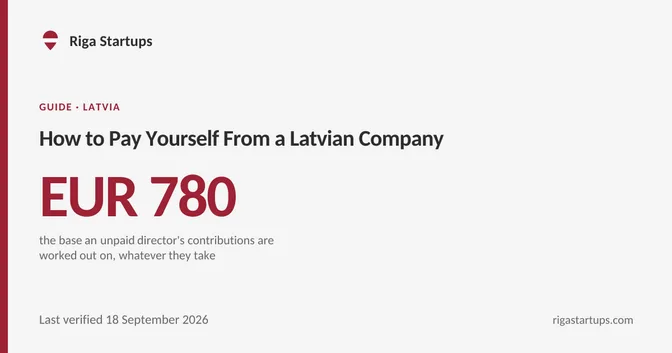
So for a company with real turnover, taking nothing but dividends does not avoid social contributions. It pays them on the minimum wage and gives you nothing for the money. Paying yourself the minimum wage, currently EUR 780 a month, costs the same contributions and puts an actual salary in your pocket, taxed at the ordinary rate but with the non-taxable minimum absorbing most of it.
Both rules take figures a founder already has to hand, and both are easier to get wrong than to compute. The calculator runs each one, and says which condition decided the answer rather than only what the answer was.
Social contributions calculator
Rates and multipliers from the ledger at the end of this page.
Contributions are due, even though no salary was paid
- Deemed contribution base
- EUR 780.00
- Employer share, 23.59%
- EUR 184.00
- Employee share, 10.5%
- EUR 81.90
- Due for the month
- EUR 265.90
Paying yourself EUR 780.00 a month costs the same EUR 265.90 in contributions, because the base is already deemed to be that. Taking nothing buys nothing; paying the minimum wage turns the same money into pay, which the non-taxable minimum then absorbs most of the income tax on.
A board member in a group company whose determined remuneration is at least 5 minimum wages is outside this rule on a different ground, which this does not model.
Is Salary or Dividends Cheaper for a Latvian Founder?
For a profitable company its founder runs alone, a salary at the minimum wage of EUR 780 a month plus dividends is cheapest. The director rule makes contributions due on a minimum-wage base anyway, so paying that salary turns contributions that would buy nothing into pay, which puts it ahead of dividends alone at every size modelled below.
Salary, dividends, or both
Every rate below is read from the ledger at the end of this guide.
What the company can spend on paying you, before any tax or contributions.
If yes, contributions on a minimum wage base are due whether or not anyone is paid.
Minimum wage plus dividends puts the most in your hand: EUR 46,669.59 of EUR 60,000.00, which is 77.8% of what the company spent. It is ahead of the next route by EUR 1,222.25.
All salary
EUR 34,053.34
56.8% of the company’s money
- Gross salaryEUR 48,547.62
- Employer contributions(EUR 11,452.38)
- Employee contributions(EUR 5,097.50)
- Personal income tax(EUR 9,396.78)
All dividends
EUR 45,447.34
75.7% of the company’s money
- Contributions the director rule makes due anyway(EUR 3,190.82)
- Corporate income tax on the distribution(EUR 11,361.84)
- Dividend in handEUR 45,447.34
Minimum wage plus dividends
EUR 46,669.59
77.8% of the company’s money
- Gross salary at the minimum wageEUR 9,360.00
- Employer contributions(EUR 2,208.02)
- Employee contributions(EUR 982.80)
- Personal income tax(EUR 453.19)
- Salary in handEUR 7,924.01
- Corporate income tax on what is left(EUR 9,686.40)
- Dividend in handEUR 38,745.58
The all-dividends column carries the contributions the director rule makes due anyway. That is why the mixed route wins by a fixed sum rather than a percentage: the minimum wage buys pay with money that was leaving regardless. This assumes one founder, no other income and no dependants. A company with no distributable profit, or with investors who take their share of any dividend, has only the salary column.
Take the money your company has available to pay you over a year, and push it out three ways. Rates are for 2026, for one founder with no other income and no dependants, in a company whose turnover is above the director threshold every month. Figures are rounded.
| Company money for the year | All salary | All dividends | Minimum wage plus dividends |
|---|---|---|---|
| EUR 30,000 | EUR 17,868 (59.6%) | EUR 21,447 (71.5%) | EUR 22,670 (75.6%) |
| EUR 60,000 | EUR 34,053 (56.8%) | EUR 45,447 (75.7%) | EUR 46,670 (77.8%) |
| EUR 120,000 | EUR 66,424 (55.4%) | EUR 93,447 (77.9%) | EUR 94,670 (78.9%) |
The all-dividends column already carries EUR 3,190.82 a year of contributions on a minimum-wage base, because the director rule makes them due. The minimum-wage route pays the same contributions, but its EUR 9,360 of salary reaches you as EUR 7,924 instead of buying nothing. That is why it comes out ahead by about EUR 1,222 a year at every one of these sizes: the saving is fixed, not a percentage.
None of the all-salary figures reaches the contribution ceiling of EUR 105,300 a year, so none of them meets the upper income tax rate or solidarity tax. Above the ceiling, salary moves onto 33% income tax and solidarity tax at 25%, and the gap in favour of dividends widens further.
When Can a Founder Only Be Paid a Salary?
A Latvian company can only pay its founder a salary when it has no distributable profit, which describes most startups still spending more than they earn, or when investors hold shares, because a dividend goes to every shareholder in proportion to their holding. Salary can be paid in a loss year; a dividend cannot.
The table assumes the company has profit to distribute and that you are its only shareholder. Two ordinary situations remove the dividend option entirely.
- The company has not made a profit. A dividend comes out of distributable profit. A startup still spending more than it earns, which is most of them, has none. Salary is a cost and can be paid in a loss year; a dividend cannot.
- You have investors. A dividend goes to every shareholder in proportion to their holding. Once a fund owns part of the company, a dividend to you is also a dividend to them, which is rarely what anyone had in mind. Salary is paid only to the person doing the work.
What Can a Latvian Company Reimburse a Founder Tax-Free?
Documented business expenses, a remote work allowance of up to EUR 40 a month, and per diem on business trips at EUR 8 a day inside Latvia and a published rate abroad. None of it is pay, none carries social contributions, and all of it needs the paperwork the rules attach.
This is the third channel, after salary and dividends, and the one founders use least well. It will not replace either: reimbursement covers costs the company should have borne anyway, and dressing up pay as expenses is exactly what the corporate income tax treats as an expense unrelated to economic activity.
- Remote work costs, up to EUR 40 a month. Article 8 of the Personal Income Tax Act excludes employer-paid remote working expenses from employment income at that ceiling for full-time work. Three conditions attach: the remote work arrangement is written into the employment contract or an employer's order, which names the expenses covered; the payroll tax book is filed with the employer paying it; and the amount is set in proportion to the workload and the number of remote days where the person also works on site. It is not paid during a long absence.
- Per diem, at the published rate. Cabinet Regulation No. 969 sets EUR 8 a day for a trip inside Latvia, halved where the founder can return home each night and it is sensible for them to, and nothing at all for a single-day trip they return from. Foreign trips have a rate for each country in the regulation's annex. Tax and contributions fall only on the part above the rate, so staying inside it is the whole point.
- Travel and accommodation, on documents. Fares and hotel bills are reimbursed against the receipts, and unlike per diem there is no flat rate to stay under.
- Anything the company genuinely bought. A laptop the company owns and the founder uses is the company's asset rather than a reimbursement. That is usually the cleaner route, because it puts the VAT and the depreciation in the right place too.
Two warnings. A reimbursement without a documented business purpose is an expense unrelated to economic activity, which the corporate income tax guide explains is taxed as though the money had been distributed. And a founder who takes only dividends is not an employee, so the remote work allowance and per diem have nothing to attach to: both run through employment. If you want this channel, it is another argument for paying yourself something.
Do Dividends Count Toward a Latvian State Pension?
No. Social contributions are what a Latvian state pension, sick pay, and parental benefit are calculated from, and dividends carry none, so a founder living on dividends builds no benefit record. A minimum-wage salary builds one, but every benefit is then calculated on the minimum wage.
Contributions are not only a tax. They are the base your state pension, your sick pay and your parental benefit are calculated from. A founder living on dividends builds none of that record.
The minimum-wage route builds one, but a thin one, because every benefit is then calculated on the minimum wage. That is a genuine cost rather than a technicality, and how much it matters depends on things no table can see: whether you are planning a family, what you expect from the state pension, and what you would live on if you were ill for three months.
Do Large Dividends Face Extra Tax in Latvia?
Yes, above EUR 200,000 of total annual income. Since 1 January 2025, an additional 3% applies above that threshold, and the total includes dividends that are exempt from personal income tax. It is settled through the annual income tax return, so it arrives as a bill the following year.
Dividends are exempt from income tax. They are not exempt from being counted.
Since 1 January 2025, an additional 3% applies to total annual income above EUR 200,000, and that total includes dividends that are exempt from personal income tax. It is settled through your annual income tax return rather than withheld, so it arrives as a bill the following year.
A founder who takes a dividend of EUR 300,000 in a year and has no other income owes the additional rate on the EUR 100,000 above the threshold, which is EUR 3,000.
Salary and dividends both count toward the threshold, so splitting one large payment between the two routes does not get underneath it. Spreading distributions across tax years can, and that is a decision to make with an adviser before the dividend is declared rather than after.
How Does the Startup Law Change Founder Pay?
The Startup Law's fixed payment replaces the ordinary tax and contribution stack for an employee of a qualifying startup, so a founder employed by their own startup under it faces a very different comparison. The statute does not say directly whether a board seat alone qualifies, so confirm with the programme before relying on it.
The flat payment replaces the ordinary stack for an employee of a qualifying startup, and the statute describes it in terms of an employment contract that tells the employee about the arrangement. If you are employed by your own startup that way, the programme changes this comparison substantially, and the Startup Law guide has the numbers.
Whether a board seat on its own qualifies is not something the statute answers directly. Confirm it with the programme before building your pay around it.
Can a Founder on an Employment-Based Residence Permit Take Dividends Instead?
Often not. Some Latvian residence permits are tied to employment at a stated salary, and a dividend is not a salary, so a founder whose permit depends on pay may be unable to use the cheaper dividend route without putting the permit at risk. The founder permit, the startup visa, has conditions of its own.
Some residence permits are tied to employment, and some to a salary level. A dividend is not a salary. If your right to be here depends on being employed at a stated wage, the cheapest route on this page may simply not be available to you, and choosing it could put the permit at risk. The startup visa guide sets out the founder permit and its conditions.
How Do Latvian Founders Actually Pay Themselves?
Public data cannot say. Latvian company filings do not separate director pay from other staff costs, and the cash flow statements that show dividends are filed only by larger companies. The rules push a profitable founder-run company toward the minimum wage plus dividends, and a loss-making startup toward a salary or nothing.
Company filings do not report director pay separately from other staff costs. The cash flow statements that do record dividends paid are only filed by companies large enough to be required to prepare one, which leaves too few of the companies on this map to publish a rate from under the sample size this site holds itself to. And a dividend goes to investors as well as founders, so even a clean count of companies paying one would not say how any founder chose to pay themselves.
What the rules push a profitable company you run yourself toward is the minimum wage plus dividends. What a startup still making losses can do is pay a salary, or pay nothing.
Frequently Asked Questions
What Is the Dividend Tax in Latvia?
A Latvian company pays corporate income tax of 20% on a dividend after dividing it by 0.8, and the dividend is then exempt from personal income tax where corporate income tax was paid on the profit it came from. Total annual income above EUR 200,000, dividends included, can also carry an additional 3%.
What Is the Minimum Salary for a Board Member in Latvia?
In a month when the company's turnover exceeds 5 minimum monthly wages and no employee earns at least the minimum wage, contributions are due for the board member on at least the minimum monthly wage, currently EUR 780, whether or not a salary is paid. The rule does not apply in the calendar year the company was registered.
How Much Tax Does a Salary Carry in Latvia?
The employer pays 23.59% on top of gross pay, the employee pays 10.5%, and income tax at 25.5% applies after the employee's contribution and the EUR 550 monthly non-taxable minimum. Income above EUR 105,300 a year moves to 33%.
Can a Loss-Making Latvian Company Pay Dividends?
No. A dividend comes out of distributable profit, so a company still spending more than it earns cannot pay one. It can still pay its founder a salary, because salary is a cost that can be paid in a loss year.
Is There Solidarity Tax on Founder Salaries in Latvia?
Only above the contribution ceiling. Salary above EUR 105,300 a year moves onto income tax at 33% and solidarity tax at 25%, which widens the gap in favour of dividends at high pay.
Sources
- Par iedzīvotāju ienākuma nodokli, the Personal Income Tax Act. Article 9(1)(2.1) has the dividend exemption, article 15 the rates, article 15.1 the additional rate and what counts toward its threshold, and transitional provision 202 the date it began to apply.
- Par valsts sociālo apdrošināšanu, the social insurance law. Article 1(2)(m) makes a director of a trading company an employee, article 20.4 sets the minimum contribution base, and the contribution rates and ceiling are there too.
- Solidaritātes nodokļa likums, for the rate above the ceiling.
- Uzņēmumu ienākuma nodokļa likums, for the corporate income tax on distributions.
- The minimum wage regulation.
- Jaunuzņēmumu darbības atbalsta likums, the Startup Law. Article 6 has the flat payment and its employment contract condition.
Every Figure, and When It Was Checked
Each value links to the source it was taken from. The date is when that source was last read and matched. Where a source cannot be checked automatically, it says so.
| Figure | Value | Last checked |
|---|---|---|
| The employer's share of the mandatory social contribution | 23.59% | 8 September 2026 |
| The employee's share, withheld from gross pay | 10.5% | 8 September 2026 |
| The payroll income tax rate on monthly taxable income | 25.5% | 8 September 2026 |
| The rate on the annual income above the contribution ceiling | 33% | 8 September 2026 |
| The monthly non-taxable minimum for 2026 | EUR 550 | 8 September 2026 |
| Annual income above which social contributions stop and the upper rates begin | EUR 105,300 | 8 September 2026 |
| The solidarity tax rate on income above the contribution ceiling | 25% | 8 September 2026 |
| The statutory minimum monthly wage | EUR 780 | 8 September 2026 |
| Monthly turnover above which an unpaid director is treated as an employee | 5 minimum monthly wages | 18 September 2026 |
| The carve-out that exempts a newly incorporated company from the director rule | does not apply in the calendar year the company was registered | 18 September 2026 |
| The contribution base such a director is deemed to have, whatever they are actually paid | the minimum monthly wage | 8 September 2026 |
| The minimum contribution base every employee carries a quarter, whatever they are paid | 3 minimum monthly wages | 18 September 2026 |
| Who the quarterly minimum contribution object is not charged for at all | convicts, people at or past pension age, people with a disability, a parent with a child under three or three or more children in the tax book, and students under 24 in full-time education | 18 September 2026 |
| The calendar days the quarterly minimum is reduced in proportion to | unpaid leave, parental and paternity leave, carer's leave, suspension without pay, and days of incapacity or maternity leave on a "B" sheet | 18 September 2026 |
| What happens when an employee's pay falls below the minimum contribution base | the employer pays contributions on the shortfall from its own funds | 10 September 2026 |
| Corporate income tax rate on the taxable base | 20% | 8 September 2026 |
| Coefficient the taxable object is divided by before the rate applies | 0.8 | 8 September 2026 |
| How a dividend is treated in the hands of an individual shareholder | exempt from personal income tax where corporate income tax was paid on the profit it came from | 10 September 2026 |
| The additional income tax rate on total annual income above the threshold | 3% | 10 September 2026 |
| Total annual income above which the additional rate applies | EUR 200,000 | 10 September 2026 |
| Whether exempt dividends count toward the additional rate threshold | includes dividends that are exempt from personal income tax | 10 September 2026 |
| When the additional rate and its inclusion of dividends began to apply | 1 January 2025 | 10 September 2026 |
| Remote work expenses an employer may cover free of payroll tax, for full-time work | EUR 40 a month | 15 September 2026 |
| Per diem for a business trip inside Latvia, above which tax and contributions apply | EUR 8 | 15 September 2026 |