Working for yourself in Latvia involves three decisions that usually get blurred into one. The first is the legal form: a self-employed person registered with the State Revenue Service, an individual merchant (IK), or a company. The second is the tax regime: the general one, or micro-enterprise tax. The third is VAT, and it quietly decides the second.
Freelancing in Latvia: Self-Employed, IK or Micro-Enterprise Tax
By Deepti Gupta · Reviewed by Vinayak Ravi · Riga Startups Editorial Team
Last verified · every figure links to its source, and the date each was checked is listed at the end · 17 min read
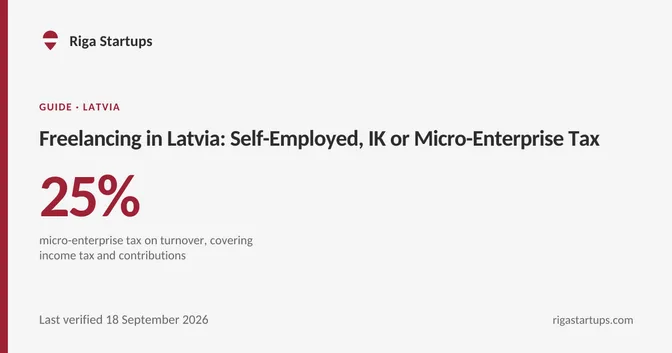
Micro-enterprise tax is the one everyone asks about, because it is simple: 25% of turnover, covering your income tax and social contributions together. What most explanations leave out is who cannot use it. That includes anyone who invoices a business in another EU country, because the VAT Law makes them register for VAT however small they are, and a VAT-registered person is not a micro-enterprise.
This states the rules with a link to each. The worked comparison further down is arithmetic on stated assumptions, not a quote for your situation. It is not advice, and your accountant is the authority on your own filings.
How Can You Work for Yourself in Latvia?
A freelancer in Latvia works as a self-employed person registered with the State Revenue Service, as an individual merchant (IK) in the commercial register, or through a company. The self-employed person and the IK are taxed identically, under the general regime or micro-enterprise tax; only a company is a separate legal person with limited liability.
A self-employed person is you, registered with the State Revenue Service as carrying on business. The Personal Income Tax Act requires you to register before starting, stating the field you will work in. There is no company and no entry in the commercial register.
An individual merchant (IK) is the same person, entered in the commercial register, for a state fee of EUR 30. It is optional for most freelancers. The Commercial Law makes it compulsory only once annual turnover passes EUR 284,600, for commercial agents and brokers, or where turnover passes EUR 28,500 while you employ more than five people at once.
The IK is where most of the confusion lives, so plainly: an IK does not change how you are taxed. It is still you, the Commercial Law defines it as a natural person, and it pays the same tax as a self-employed person under either regime. What it buys is a trading name on a public register, which some clients and banks prefer. It does not limit your liability, because there is no separate person to hold the debts.
Micro-enterprise tax is a tax regime, not a legal form. It is open to individual merchants, individual enterprises and farms, and people registered with the State Revenue Service as self-employed, as long as they are not registered for VAT.
A company (SIA) is a separate legal person with limited liability, taxed under corporate income tax, and it is not on that list. The micro-enterprise definition names individual merchants, individual enterprises, farms and the self-employed, and a company is not among them. The registration guide covers setting one up, and the founder pay guide covers getting money out of one.
How Is a Self-Employed Person Taxed in Latvia?
Under the general regime a self-employed person in Latvia pays income tax at 25.5% on profit after expenses, contributions, and the EUR 550 monthly non-taxable minimum, filed once a year. Social contributions are paid monthly on an amount you choose, at 31.07% in months when income reaches the minimum wage.
Under the general regime you pay income tax on profit and social contributions on an amount tied to it.
Income tax. Your taxable income is business income, less the costs connected with earning that year's business income, less the social insurance contributions you paid, less the non-taxable minimum of EUR 550 a month. The rate is 25.5%, rising to 33% on income above EUR 105,300. It is settled once a year, by filing a declaration between 1 March and 1 June of the following year.
Expenses need documents, and they need to be connected with earning the income. Keep every invoice and receipt from the first day. Simple single-entry bookkeeping is normal at this size, and it is the difference between paying tax on profit and paying it on turnover.
Social contributions are calculated on an amount of business income you choose yourself, month by month, and the minimum wage of EUR 780 is the line that matters:
- In a month when income is below it, you pay 10% of that income, and only into pension insurance.
- In a month when income reaches it, you pay the full 31.07% on an object of at least the minimum wage, plus 10% for pension on the difference between that object and what you actually earned.
You report contributions by the 17th of the month after each quarter and pay them by the 23rd of that month. You may declare more than the minimum wage, and doing so buys more sickness, parental and pension cover, because benefits follow what you paid in.
The slow month. Most descriptions warn about a minimum contribution you owe regardless of income. For the self-employed that is wrong: the quarterly minimum that applies to employers is disapplied for the self-employed by the Social Insurance Law. The real cost of a slow month runs the other way. A month below the minimum wage pays only into your pension, so that month buys no sickness or parental insurance, and a freelancer who has several of them in a year is less insured than they think.
Both halves of that are easier to run than to hold in your head, and the split at the minimum wage is the part a yearly average hides. The calculator does a month at a time, and then the two regimes side by side on the same turnover.
Self-employed calculator
Rates and thresholds from the ledger at the end of this page.
- Business income
- EUR 3,000.00
- Contributed on EUR 780.00 at 31.07%
- EUR 242.35
- Pension on the remaining EUR 2,220.00, 10%
- EUR 222.00
- Contributions for the month
- EUR 464.35
- Share of the month's income
- 15.48%
Contributing on the whole EUR 3,000.00 instead would cost EUR 932.10 this month. The difference is not a penalty for declaring less: benefits are calculated from what you contributed on, so the cheaper choice buys a smaller sick pay and a smaller parental benefit.
How Does Micro-Enterprise Tax Work in Latvia?
Micro-enterprise tax is 25% of turnover, covering income tax and social contributions together, with no expenses deducted and a quarterly declaration. It is open to self-employed people, individual merchants, individual enterprises, and farms expecting turnover under EUR 50,000, and it ends once the person must register for VAT.
The appeal is real. You pay 25% of turnover and nothing else, with no expense records to defend and a quarterly declaration rather than a yearly reconciliation. The declaration is due by the 15th of the month after each quarter in which there was turnover, and the tax by the 23rd of that month.
The conditions are where it narrows:
- Turnover, not profit. No expenses come off. A freelancer with real costs pays the rate on money they never kept.
- A turnover ceiling. You must expect turnover to stay under the VAT registration threshold, which is EUR 50,000. Once you become or must become VAT-registered, you lose the regime from the next tax year.
- No mixing. A person on the general regime cannot at the same time pay micro-enterprise tax or the reduced patent fee. Choose one.
- Timing. You can choose it when you first register. An existing business must apply by 15 December to use it the following year. If you stop, then register again in the same year, you cannot choose it again for that year or the next.
Can You Use Micro-Enterprise Tax With EU Clients?
Usually not. A Latvian freelancer who invoices a business in another EU member state must register for VAT whatever their turnover, because the right to stay unregistered does not apply to anyone providing services to a business in another member state. A VAT-registered person cannot be a micro-enterprise, so the regime ends from the next tax year.
This is the rule that decides micro-enterprise tax for most freelancers who work internationally, and it sits in the VAT Law rather than the micro-enterprise one.
Below EUR 50,000 of domestic turnover, you are normally allowed to stay unregistered for VAT. That permission does not apply to anyone providing services to a business in another member state. So a designer, developer or consultant invoicing a company in Germany, Estonia or the Netherlands has to register for VAT, whatever their turnover.
A micro-enterprise must not be VAT-registered. The only registration the Micro-Enterprise Tax Law tolerates is a special registration used only for receiving services from abroad and acquiring goods from other member states, which covers buying, not selling. Registering for VAT to invoice an EU business therefore ends micro-enterprise tax from the next tax year.
Three things stay outside this rule. Clients outside the EU, such as a US or UK company, are not businesses in another member state. Consumers are a different mechanism, which the VAT guide covers alongside the reverse charge and the EU sales list. And Latvian clients simply count towards the domestic threshold.
Those conditions sit in three different statutes, and the one that disqualifies most freelancers who go looking for this regime is in the VAT Law rather than this one. The calculator checks all of them at once and reports every condition that fails, not just the first.
Micro-enterprise tax calculator
Rate, ceiling and deadlines from the ledger at the end of this page.
Nothing here stops you using micro-enterprise tax
You can choose it when you register, so there is no separate application.
- Rate on turnover
- 25%
- Ceiling
- EUR 50,000.00
Eligible is not the same as cheaper. The rate is charged on turnover with no expenses deducted, so genuine costs close the gap with the general regime quickly. The self-employed calculator runs both on the same figures.
A micro-enterprise taxpayer with no turnover for two tax years in a row loses the status, and for a self-employed person the Revenue Service then removes them from the taxpayer register. That is not a move onto the general regime, so it matters if you keep a registration open between contracts.
What Changed in Micro-Enterprise Tax in 2026?
Since 1 January 2026, someone who works irregularly may take micro-enterprise status for one or more quarters of the year. A micro-enterprise taxpayer with no turnover for two tax years in a row loses the status, and for a self-employed person the State Revenue Service then removes them from the taxpayer register.
The Micro-Enterprise Tax Law was amended in 2025, and two changes matter to a freelancer:
- Registering for part of a year. Since 1 January 2026, someone who expects to work irregularly may register and take micro-enterprise status for one or more quarters of the year, rather than for the whole year.
- Losing it for having no turnover. A micro-enterprise taxpayer with no turnover for two tax years in a row loses the status. For a self-employed person, the State Revenue Service then removes them from the taxpayer register. That is not a move onto the general regime. It means you are no longer registered to do business at all, which is worth knowing if you keep a registration open between contracts. Since 2026 that decision is made automatically.
Is Micro-Enterprise Tax Cheaper Than the General Regime?
With no business expenses, yes: micro-enterprise tax at 25% of turnover costs less than the general regime, by a margin that grows with revenue until the EUR 50,000 ceiling ends it. Genuine expenses close the gap quickly, because micro-enterprise tax ignores them, and above the ceiling the choice is the general regime or a company.
A worked example on stated assumptions, all of them simplifications. One person, no other income, revenue spread evenly across twelve months, all of it from clients who do not trigger VAT registration. On the general regime they pay full contributions on the minimum wage of EUR 780 a month and 10 per cent for pension on the rest, and claim the non-taxable minimum of EUR 550 a month. The rates are the 2026 ones.
| Revenue in the year | General regime, no expenses | General regime, EUR 10,000 of expenses | Micro-enterprise tax |
|---|---|---|---|
| EUR 20,000 | EUR 6,376 | EUR 3,081 | EUR 5,000 |
| EUR 45,000 | EUR 14,614 | EUR 11,319 | EUR 11,250 |
| EUR 80,000 | EUR 26,146 | EUR 22,851 | Not available |
At EUR 20,000 with no expenses, the general regime works out as EUR 2,908 of full contributions on the minimum wage, EUR 1,064 for pension on the rest, and EUR 2,404 of income tax on what remains after contributions and the non-taxable minimum.
Three things fall out of it:
- With no expenses, micro-enterprise tax is cheaper, by a margin that grows with revenue, until the ceiling ends it.
- Expenses close the gap quickly. At the middle level, genuine costs of a little over a fifth of revenue put the two regimes level, because micro-enterprise tax ignores them.
- Above the VAT threshold the choice is the general regime or a company, and at that level a company is worth pricing, because corporate income tax is only due when profit is distributed.
The table does not compare what each buys in social insurance. Micro-enterprise tax and a minimum-wage declaration both buy modest sickness, parental and pension cover, and a freelancer planning a family or a long career should look at that as closely as at the tax.
What Happens When a Foreign Client Withholds Tax?
Latvia taxes a resident on worldwide income, then reduces the tax by what was paid abroad, but only against documents from the foreign tax authority showing the taxable income and the tax paid. A client's word is not enough. Where a double tax treaty applies, the treaty decides which country may tax at all.
The section above is about VAT, which is the rule most Latvian freelancers meet first. This is the one they meet second, usually from a client outside the EU, and it arrives as a payment smaller than the invoice with no explanation attached.
- The credit is conditional on paperwork, not on the deduction. Article 24 of the Personal Income Tax Act reduces Latvian tax by an amount equal to the tax paid abroad, where that payment is certified by documents approved by the foreign tax collection authority stating the taxable income and the tax paid. A remittance advice showing a smaller number does not satisfy it. Ask for the certificate at the time, because chasing one from a client in another country a year later is the part that fails.
- A treaty may stop the withholding before it happens. Where Latvia has a double taxation treaty with the client's country, it usually assigns the right to tax business profits to the country of residence, which is Latvia. Claiming that generally needs a residence certificate from the State Revenue Service handed to the client before they pay, not after they have withheld.
- Micro-enterprise tax has nothing for the credit to reduce. The credit works by lowering personal income tax computed under the Act. A micro-enterprise taxpayer pays a turnover tax instead, so there is no such computation sitting there to reduce. Treat foreign withholding as a straight loss under that regime until your accountant tells you otherwise, and count it when comparing the two regimes.
- Withheld is not the same as owed. Some clients withhold because their own law tells them to, some because their finance team applies one rule to every foreign supplier. The second is recoverable from that country's tax authority, and only worth chasing above a certain size.
The practical order is to settle this before the first invoice rather than after the first short payment: ask the client whether they will withhold, and if they say yes, ask what certificate they issue and when.
When Should a Latvian Freelancer Become a Company?
A Latvian freelancer should consider a company when a client needs limited liability, revenue passes the EUR 50,000 VAT threshold, profit is worth keeping in the business, or they plan to hire, raise money, or grant options. A company pays corporate income tax only when profit is distributed.
The signals, roughly in the order they usually arrive:
- A client or a contract needs limited liability. Neither form above has it.
- Revenue passes the VAT threshold and you are choosing between the general regime and a company anyway.
- You want to keep profit in the business. A company pays corporate income tax only on distribution, which the corporate income tax guide explains, while a self-employed person is taxed on profit in the year it is made.
- You hire, raise money, or want to grant options. All of those assume a company.
Can a Freelancer in Latvia Be Treated as an Employee?
Yes. The Personal Income Tax Act tests the working relationship, not the invoice, so a full-time contractor who works like staff is treated as an employee whether they invoice as a self-employed person, an IK, or a micro-enterprise. The cost of hiring guide sets out the six signs and what reclassification costs.
None of these forms settles whether the person is really an employee. The Personal Income Tax Act tests the relationship, not the invoice, and a full-time contractor who works like staff is treated as staff whether they invoice as a person, an IK or a micro-enterprise. The cost of hiring guide sets out the six signs and what reclassification costs.
What Does This Guide Not Cover?
This guide does not cover the reduced patent fee, royalty income for authors and performers, farming, fishing, and forestry income, or non-residents and people of pension age, whose contribution rates differ. Each has its own rules, and a Latvian accountant can say which of them applies to you.
- The reduced patent fee, a flat-fee regime limited to certain professions and circumstances set by Cabinet Regulation No. 36.
- Royalty income for authors and performers, which has its own deemed-expense rules.
- Farming, fishing and forestry income, which each have special treatment.
- Non-residents, and people who have reached pension age, whose contribution rates differ.
Frequently Asked Questions
What Is the Micro-Enterprise Tax Rate in Latvia?
Micro-enterprise tax in Latvia is 25% of turnover, covering income tax and social contributions together. No expenses are deducted, and the declaration is due by the 15th of the month after each quarter in which there was turnover, with payment by the 23rd of that month.
Do You Need to Register an IK to Freelance in Latvia?
No. A self-employed person registered with the State Revenue Service can freelance without an IK, registering before starting, stating the field you will work in. An IK becomes compulsory only at the turnover and staffing levels the Commercial Law sets, and it does not change how you are taxed.
When Do Self-Employed People File Tax Returns in Latvia?
A self-employed person on the general regime files the annual income tax declaration between 1 March and 1 June of the following year. Social contributions are reported by the 17th of the month after each quarter and paid by the 23rd of that month.
Can You Switch to Micro-Enterprise Tax Mid-Year in Latvia?
Not for an existing business. It must apply by 15 December to use micro-enterprise tax the following year, although a new registration can choose it from the start. Someone who stops and registers again in the same year cannot choose it again for that year or the next.
Does Micro-Enterprise Tax Include Social Insurance?
Yes. The 25% of turnover covers income tax and social contributions together, and it buys modest sickness, parental, and pension cover. A freelancer planning a family or a long career should compare that cover as closely as the tax.
Sources
- Par iedzīvotāju ienākuma nodokli, the Personal Income Tax Act. Article 10 has the deduction for contributions paid, 11 business income, expenses and the bar on combining regimes, 15 the rates, 19 the declaration window, and 28 the duty to register before starting. The non-taxable minimum is in article 12 and transitional provision 197.
- Par valsts sociālo apdrošināšanu. Article 14(2) sets what the self-employed pay on, 14.1 the pension-only rule below the minimum wage, 20.4(6) disapplies the quarterly minimum for the self-employed, 21(3) sets the payment date, and 23(2) the report.
- Cabinet Regulation No. 786, point 9, for the self-employed contribution rate, and the minimum wage regulation.
- Mikrouzņēmumu nodokļa likums, the Micro-Enterprise Tax Law. Article 1 defines a micro-enterprise and what the tax covers, 2 the bar on mixing regimes, 4 registration, the ceiling and every way the status is lost, 6 the rate, and 7 declaring and paying.
- Pievienotās vērtības nodokļa likums, the VAT Law. Article 59(1) is the threshold, 59(8) the exception for services to businesses in other member states, and 139.2 the special registration.
- Komerclikums, the Commercial Law, article 1 for what an individual merchant is and article 75 for when registering as one is compulsory, and the fee regulation for the fee.
This page states rules and does arithmetic on assumptions. Which regime suits you depends on your clients, your costs and your plans, and a Latvian accountant can see all three.
Every Figure, and When It Was Checked
Each value links to the source it was taken from. The date is when that source was last read and matched. Where a source cannot be checked automatically, it says so.
| Figure | Value | Last checked |
|---|---|---|
| When a self-employed person must register with the State Revenue Service | before starting, stating the field you will work in | 10 September 2026 |
| State fee to register an individual merchant | EUR 30 | 8 September 2026 |
| Annual turnover above which a self-employed person must register as an individual merchant | EUR 284,600 | 10 September 2026 |
| The lower turnover that triggers IK registration when combined with the staff condition | EUR 28,500 | 10 September 2026 |
| The number of people employed at once that, with the lower turnover, triggers IK registration | five | 10 September 2026 |
| What a self-employed person may deduct under the general regime | the costs connected with earning that year's business income | 10 September 2026 |
| The deduction from annual taxable income for social insurance paid | the social insurance contributions you paid | 10 September 2026 |
| The monthly non-taxable minimum for 2026 | EUR 550 | 8 September 2026 |
| The income tax rate on annual taxable income up to the contribution ceiling | 25.5% | 10 September 2026 |
| The rate on the annual income above the contribution ceiling | 33% | 8 September 2026 |
| Annual income above which social contributions stop and the upper rates begin | EUR 105,300 | 8 September 2026 |
| When the annual income declaration is filed, for income under the contribution ceiling | between 1 March and 1 June of the following year | 10 September 2026 |
| The bar on mixing the general regime with the special ones | cannot at the same time pay micro-enterprise tax or the reduced patent fee | 10 September 2026 |
| What a self-employed person's social contributions are calculated on | an amount of business income you choose yourself | 10 September 2026 |
| The statutory minimum monthly wage | EUR 780 | 8 September 2026 |
| The pension-only rate on a month's income where it does not reach the minimum wage | 10% | 18 September 2026 |
| The pension rate on the gap between the object you declare and what you actually earned | 10% | 18 September 2026 |
| The full social contribution rate for a self-employed person | 31.07% | 10 September 2026 |
| When a self-employed person reports their contributions | the 17th of the month after each quarter | 10 September 2026 |
| The day of the month after each quarter by which a self-employed person pays contributions | the 23rd | 10 September 2026 |
| Who the Micro-Enterprise Tax Law counts as a micro-enterprise | individual merchants, individual enterprises and farms, and people registered with the State Revenue Service as self-employed, as long as they are not registered for VAT | 10 September 2026 |
| The micro-enterprise tax rate, applied to turnover | 25% | 10 September 2026 |
| The turnover a micro-enterprise taxpayer must expect to stay under | the VAT registration threshold | 10 September 2026 |
| Annual domestic turnover below which a taxpayer need not register for VAT | EUR 50,000 | 10 September 2026 |
| The deadline for an existing business to apply for micro-enterprise tax for the following year | 15 December | 10 September 2026 |
| When the quarterly micro-enterprise tax declaration is due | the 15th of the month after each quarter in which there was turnover | 10 September 2026 |
| The day of the month after each quarter by which micro-enterprise tax is paid | the 23rd | 10 September 2026 |
| When a micro-enterprise that becomes VAT-registered loses the regime | from the next tax year | 10 September 2026 |
| How long someone who leaves micro-enterprise tax and re-registers in the same year is barred from choosing it again | that year or the next | 10 September 2026 |
| The 2026 option for someone whose work is irregular | for one or more quarters of the year | 10 September 2026 |
| How long without turnover before micro-enterprise status is lost | two tax years in a row | 10 September 2026 |
| What the State Revenue Service does to a self-employed person who loses micro-enterprise status that way | removes them from the taxpayer register | 10 September 2026 |
| The exception to the right to stay unregistered for VAT below the threshold | does not apply to anyone providing services to a business in another member state | 10 September 2026 |
| The one kind of VAT registration a micro-enterprise taxpayer may hold | a special registration used only for receiving services from abroad and acquiring goods from other member states | 10 September 2026 |