Latvian VAT has one number everyone knows and three that decide what actually happens to you. The one everyone knows is EUR 50,000. The three are a EUR 5,000 grace band above it, a separate EUR 10,000 rule that has nothing to do with the first and catches anyone selling across the EU, and the date the application is due, which is sooner than most people assume.
VAT Registration in Latvia
By Deepti Gupta · Reviewed by Vinayak Ravi · Riga Startups Editorial Team
Last verified · every figure links to its source, and the date each was checked is listed at the end · 14 min read
The rules here are stated with a link to each. Where a section describes what happens in practice rather than what a statute says, it says so. It is not advice, and your accountant is the authority on your own filings.
What Are the VAT Rates in Latvia?
Latvia's standard VAT rate is 21%, and the reduced rates are 12% and 5%, each limited to an itemised list of supplies in the VAT Act. Exports and most intra-EU supplies of goods are zero-rated, which still lets the seller reclaim VAT on its purchases, unlike an exempt supply.
- 21% is the standard rate, and unless the law says otherwise this is the one.
- 12% and 5% are the reduced rates. Neither is a sector you can argue yourself into: each applies to an itemised list in the statute, and if your supply is not on the list it is standard-rated.
- Zero per cent is a rate, not an exemption, and the difference matters. A zero-rated supply is taxable at nothing, so you still reclaim the VAT on what you bought to make it. An exempt supply is outside the system, and the input VAT stays yours to bear. Exports and most intra-EU supplies of goods are zero-rated.
For almost every software company reading this, the answer is 21% and the reduced rates never come up.
When Do You Have to Register for VAT in Latvia?
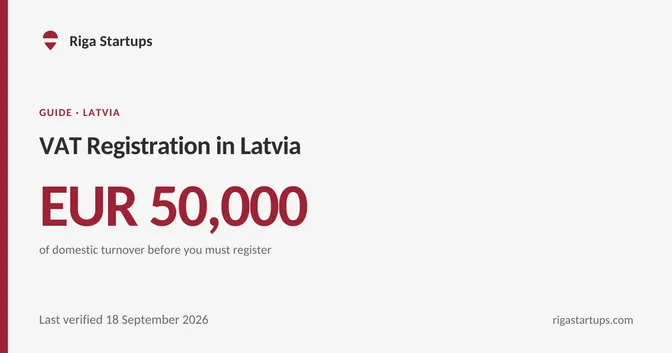
A Latvian business must register for VAT once its domestic turnover in a calendar year exceeds EUR 50,000, applying by the fifteenth of the month after the month you crossed it. If it goes over by no more than EUR 5,000, it may defer registration to the end of the year and apply by 30 November.
You need not register while your domestic turnover in a calendar year stays under EUR 50,000, excluding tax. Two words in that sentence do a lot of work.
Domestic. It counts supplies made inside Latvia. Cross-border sales have their own rules and their own, much lower, trigger, which is the next section and the one that catches software companies first.
Calendar year. It resets on 1 January. It is not a rolling twelve months, which is what the equivalent British rule uses and what people arriving from there tend to assume.
Now the part almost no guide covers. If you exceed the threshold by no more than EUR 5,000, you may defer registering until the end of the calendar year.
So there are two deadlines, and which one applies depends on how far over you went.
| Where you land | When the application is due |
|---|---|
| Over EUR 50,000 by more than EUR 5,000 | the fifteenth of the month after the month you crossed it |
| Over EUR 50,000 by EUR 5,000 or less | 30 November, if you take the deferral |
A consultancy invoicing EUR 4,500 a month crosses EUR 50,000 in November, at EUR 54,000. That is inside the grace band, so it can finish the year unregistered and apply by 30 November. The same consultancy invoicing EUR 9,000 a month crosses in June at EUR 63,000, which is well outside it, and the application is due by 15 July.
The grace band is worth understanding rather than relying on. It exists so that a business which drifts slightly over near the year end is not forced into mid-year registration for a few thousand euro of turnover. It is not a planning tool, and a business that expects to keep growing gains a few months of paperwork deferred and then registers anyway.
Must You Register for VAT in Latvia Below the Threshold?
Sometimes, and the commonest case has no threshold at all. Selling services to a VAT-registered business in another member state obliges a Latvian company to register whatever its turnover. Buying goods from the EU obliges it once those purchases reach EUR 10,000 in a calendar year. Neither depends on the EUR 50,000 figure.
This is the part of Latvian VAT that catches software companies, and it catches them early. The EUR 50,000 threshold in the previous section measures domestic turnover only, and a company whose first real customer is a business in Germany or the Netherlands may owe a registration in its first month while its domestic turnover is nil. For where that threshold sits against real companies, the revenue report reads turnover straight from filed accounts.
- Supplying services to a business in another member state. Article 59, eighth part disapplies the right not to register where a Latvian taxpayer supplies services to a taxable person in another member state whose place of supply is set by article 19, first part, which is the ordinary business-to-business rule. There is no threshold and no grace band. One invoice to one German company is enough. This is also the mechanism that makes the reverse charge work at the other end, and it needs your VAT number to function at all.
- Acquiring goods from the EU. Article 57 requires registration once intra-EU goods acquisitions reach EUR 10,000 without tax in a calendar year, with the application due by the fifteenth of the month after the one in which the threshold was crossed. A single purchase that crosses the line, with no more expected next year, can be settled by paying the tax without registering.
- Receiving services from abroad. A company that receives services from a supplier in another member state or a third country, where the place of supply is Latvia, accounts for the tax itself. Article 59, ninth part lets it keep the domestic threshold only if it registers under the special procedure in article 139.2, which exists for exactly this.
- Leaving again takes 2 years. Under article 57, third part, a person who registered for intra-EU goods acquisitions before reaching the threshold may only withdraw voluntarily 2 years after registering.
The practical reading for a Latvian software company is short. If any customer or supplier is a business outside Latvia and inside the EU, assume you are registering, and ask your accountant which of these provisions puts you there rather than whether one does. Whether you also have to register in the customer's country is a separate question, and for the two nearest markets it is answered in the expansion guides for Estonia and Lithuania.
What Is the EU VAT Threshold for Selling to Consumers From Latvia?
A Latvian company selling to consumers in other EU member states must charge each customer's own VAT rate once those sales exceed EUR 10,000 across the whole EU, not per country. It registers once for the One Stop Shop and files a single quarterly return instead of registering in each country.
If you sell to consumers in other member states, whether that is a physical product shipped or a subscription delivered, a completely separate rule applies and the number is EUR 10,000 across the whole EU, not per country.
Below it, you may charge Latvian VAT on those sales. Above it, you charge the rate of the country your customer is in, which means twenty-seven possible rates rather than one.
You do not register in twenty-seven countries. The One Stop Shop exists precisely so you do not: you register for OSS once, keep charging each customer their own country's rate, and file a single quarterly return that distributes the money. It is administratively a great deal better than it sounds, and it is the standard answer for any Latvian company selling software to consumers in Europe.
Two traps in that paragraph.
EUR 10,000 is small, and it is measured across all member states together. A SaaS company with a few hundred consumer subscribers across Europe passes it without anything that feels like an expansion.
It applies to consumers, not businesses. Selling to a VAT-registered business in another member state is a different mechanism entirely: you do not charge VAT, the customer accounts for it themselves under the reverse charge, and you report the sale on an EU sales list. Getting the customer's VAT number, and checking it, is what puts you in the right regime.
Every rule above takes figures you already have. The calculator puts them together, and it reports every provision that fires rather than a single yes or no, because more than one usually does.
Latvian VAT calculator
Rates and thresholds from the ledger at the end of this page.
- Price before tax
- EUR 1,000.00
- VAT at 21%
- EUR 210.00
- Price including tax
- EUR 1,210.00
Should You Register for VAT in Latvia Before You Have To?
Often, if you sell to businesses. A registered company charges 21% VAT but reclaims the VAT on everything it buys, and business customers reclaim what they are charged, so registering costs them nothing. For a company selling to consumers, registering means raising prices or absorbing the tax.
Staying unregistered is not automatically the cheaper position, and for a company in its first year it is often the more expensive one.
An unregistered company charges no VAT and reclaims none. A registered one charges 21% and reclaims the 21% it paid on everything it bought: laptops, software subscriptions, professional fees, the office. Which is better depends almost entirely on who your customers are.
- Selling to businesses. VAT is not a cost to them; they reclaim it. Registering costs your customers nothing and gets you your input VAT back. This is usually the obvious answer, and the only real objection is the filing burden.
- Selling to consumers. VAT is a real cost to them, so registering means either raising your price by 21% or absorbing it. Staying out while you can is genuinely worth something.
- Spending heavily before earning. A company buying equipment or paying developers before it has revenue accumulates reclaimable input VAT it cannot touch while unregistered.
Voluntary registration is available before you hit the threshold. It is a decision about your customer mix and your purchase profile, not about your size.
How Often Do You File VAT Returns in Latvia?
Monthly or quarterly, as the State Revenue Service assigns, with monthly the default for a company making intra-EU supplies. A company supplying businesses in other member states also files an EU sales list, and every return goes through VID's electronic declaration system, which needs a Latvian electronic identity.
Returns run monthly or quarterly depending on turnover and on what kind of transactions you do, with monthly the default for anything involving intra-EU supplies. The State Revenue Service assigns the period; you do not choose it freely. The compliance calendar puts the VAT deadlines beside every other filing a company owes.
Alongside the return, a company making intra-EU supplies files an EU sales list reporting each business customer and the value supplied. This is how the reverse charge is policed at the other end, and a mismatch between your list and your customer's return is one of the more reliable ways to attract attention.
Everything is filed through the State Revenue Service's electronic declaration system, which needs a Latvian electronic identity. That is the practical reason a foreign founder ends up getting an eID eventually even though registering the company never required one.
When Does VID Remove a Company From the VAT Register?
On its own initiative, and sooner than most founders expect. Article 73 of the VAT Act lets the Revenue Service remove a registered taxpayer once a return is 30 days late, or a return holds false information, or requested documents do not arrive, or the company cannot be reached at its legal address.
Removal is not a penalty notice, it is an administrative act, and the first sign of it is often a customer telling you your VAT number no longer validates. What follows is worse than the paperwork: you cannot charge VAT, your business customers in other member states cannot apply the reverse charge to your invoices, and input VAT on purchases made after removal is not yours to reclaim.
The grounds in article 73 divide into ones you choose and ones you do not.
- Your own application, which is the ordinary route out for a company that has stopped trading or fallen below the threshold, and removal on liquidation or after a reorganisation.
- Suspension of economic activity by the Revenue Service under the Law on Taxes and Duties.
- Filing failures. No return within 30 days of the deadline, false information in a return, requested records not produced in the time set, or unfounded claims about the company's material and financial capacity to trade.
- Unreachable at the legal address, or an address that does not actually exist. This one deserves attention from anybody using a registered-address service rather than premises they occupy. A forwarding arrangement that stops forwarding, or a provider that ends the contract without telling you, produces exactly this. The legal address report counts how many Latvian companies share an address and what those addresses look like.
The obligation that matters most is the dullest: file the return even when there is nothing in it. A nil return costs ten minutes and a missed one starts a clock. What is due, and when, is in the compliance calendar.
What Are the Most Common VAT Mistakes in Latvia?
The most common Latvian VAT mistakes are watching the EUR 50,000 domestic threshold while crossing the EUR 10,000 EU consumer threshold, assuming the threshold is a rolling twelve months rather than a calendar year, charging Latvian VAT to EU business customers, and not checking customer VAT numbers.
- Missing the deadline because you were watching the wrong number. Crossing EUR 10,000 of cross-border consumer sales obliges you long before EUR 50,000 of domestic turnover does. Companies watch the big number and miss the small one.
- Assuming the threshold is rolling. It is a calendar year, and a strong December does not carry into January.
- Charging Latvian VAT to EU business customers. They will not pay it, and unpicking it after invoicing is worse than getting it right.
- Not checking customer VAT numbers. The reverse charge depends on the customer being a registered taxable person. If the number is invalid, the supply was yours to tax.
- Assuming the threshold protects a freelancer with EU clients. It does not. The right to stay unregistered below it does not apply to services supplied to a business in another member state, and registering for that reason also takes micro-enterprise tax off the table. The freelancing guide has the detail.
- Reclaiming input VAT on things with a private use. Cars are the classic, and the restriction is specific rather than a matter of judgement.
Frequently Asked Questions
What Is the VAT Threshold in Latvia?
The Latvian VAT registration threshold is EUR 50,000 of domestic turnover in a calendar year, excluding tax. A separate EUR 10,000 threshold applies to sales to consumers in other EU member states, and it is measured across the whole EU.
Is the Latvian VAT Threshold a Rolling Twelve Months?
No. The Latvian VAT threshold counts domestic turnover in a calendar year and resets on 1 January, unlike rules elsewhere that use a rolling twelve-month period.
Do You Charge VAT to EU Business Customers From Latvia?
No. A sale to a VAT-registered business in another member state falls under the reverse charge: the customer accounts for the VAT, and the Latvian seller reports the sale on an EU sales list. A valid customer VAT number is what makes the reverse charge apply.
Can You Register for VAT Voluntarily in Latvia?
Yes. Voluntary registration is available below the EUR 50,000 threshold, and it usually pays for a company that sells to businesses or spends heavily before earning, because it can then reclaim the 21% VAT on its purchases.
Does the VAT Threshold Protect a Freelancer With EU Clients?
No. The right to stay unregistered below the threshold does not apply to services supplied to a business in another member state, and registering for that reason also takes micro-enterprise tax off the table.
Sources
- Pievienotās vērtības nodokļa likums, for every figure on this page. Article 41 has the rates, article 59 the registration threshold, the grace band and both deadlines, and article 27 the distance-selling rule.
- Valsts ieņēmumu dienests, for the filing system and the current forms.
Every Figure, and When It Was Checked
Each value links to the source it was taken from. The date is when that source was last read and matched. Where a source cannot be checked automatically, it says so.
| Figure | Value | Last checked |
|---|---|---|
| Annual domestic turnover below which a taxpayer need not register for VAT | EUR 50,000 | 10 September 2026 |
| The standard rate of Latvian VAT | 21% | 10 September 2026 |
| The higher of the two reduced rates, applying only to supplies the law lists | 12% | 18 September 2026 |
| The lower of the two reduced rates, applying only to supplies the law lists | 5% | 18 September 2026 |
| How far above the threshold you may go and still defer registering to the year end | EUR 5,000 | 10 September 2026 |
| The deadline to file the registration application once the threshold is exceeded | the fifteenth of the month after the month you crossed it | 10 September 2026 |
| The deadline to apply if you are using the grace band and deferring to the year end | 30 November | 10 September 2026 |
| The EU-wide threshold for distance sales and digital services, above which you charge the customer's rate | EUR 10,000 | 10 September 2026 |
| Value of intra-EU goods acquisitions in a calendar year above which an unregistered person must register | EUR 10,000 | 15 September 2026 |
| How long a person registered for intra-EU goods acquisitions must wait before leaving the register voluntarily | 2 years | 15 September 2026 |
| Time after a missed VAT return deadline at which the Revenue Service may remove a company from the VAT register | 30 days | 15 September 2026 |