Latvian company law was not written with venture rounds in mind, but it bends further than many founders expect. An SIA can issue share classes with different dividend, liquidation, and voting rights, and most of the friction in a priced round is procedural: pre-emption rights, notarised signatures, and a public register that shows who owns what.
Cap Tables, Share Classes, and What the Latvian Register Shows
By Deepti Gupta · Reviewed by Vinayak Ravi · Riga Startups Editorial Team
Last verified · every figure links to its source, and the date each was checked is listed at the end · 13 min read
This page explains what the Commercial Law allows and requires. A priced round needs a Latvian lawyer to draft the articles and the shareholders' agreement, and nothing here replaces that.
How Do Shares Work in a Latvian SIA?
An SIA's capital is divided into shares whose nominal value the articles set, at no less than one cent. Each share cannot be divided, carries rights to management, profit, and assets on liquidation, and is recorded in a shareholder register that the company keeps and files with the Register of Enterprises.
A standard SIA needs share capital of EUR 2,800. When new shares are sold above nominal value, the premium is not counted in share capital, which is how a round priced far above nominal still leaves the share capital small. A capital increase changes the articles, and the amendment is filed for a EUR 20 state fee.
Can a Latvian SIA Have Share Classes?
Yes. The articles can give shares different rights to dividends, a liquidation quota, and voting, and shares with the same rights form one category. Changing a category's rights needs the consent of every holder of that category, unless the articles say otherwise, and where it does not, a holder who voted against can require a buyback within two months.
That is enough to build the usual venture instruments inside the articles: preferred shares with a liquidation preference, non-voting shares, or a class with enhanced voting. The articles must set out each category, the rights it carries, and its number of shares and nominal value, so a new class means amending them.
How Are Liquidation Preferences Documented in Latvia?
In two places. The articles give a category its right to a larger or earlier liquidation quota, which binds the company and every shareholder, and a shareholders' agreement sets the rest of the economics, such as how the proceeds of a sale are split. A preference written only into the shareholders' agreement binds only those who signed it.
Most venture term sheets treat a sale of the company as a liquidation event, not only a formal winding up, so the shareholders' agreement matters as much as the articles. Have both drafted together, and check that they say the same thing.
How Do Convertible Loans and SAFEs Work in Latvia?
As contracts. Convertible loans have become the most common instrument for early-stage investment in Latvian startups, but they are not regulated directly by Latvian law. Converting one is a capital increase, which needs two thirds of the votes of the shareholders present, unless the articles require more, and existing shareholders must waive their pre-emption rights to the new shares.
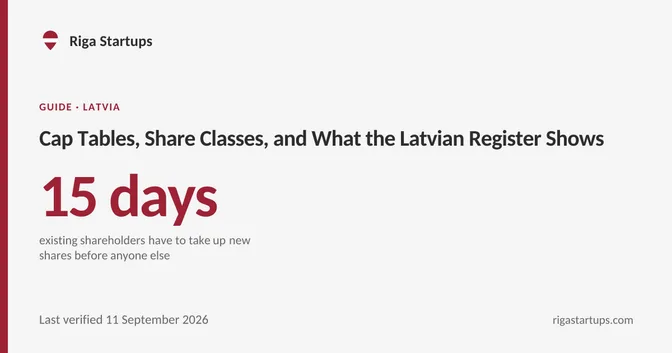
Many startups adopt templates such as the SAFE and the KISS. Existing shareholders have 15 days from the decision to take up new shares in proportion to their holdings, so collect their written waivers when the convertible is signed rather than at conversion. New shares must be paid within six months of the decision, and how the loan becomes paid-up share capital is a point to settle with a lawyer before signing. The Commercial Law's convertible bond rules are written for joint stock companies, not for an SIA.
What Does the Latvian Register Show About Your Ownership?
The Register of Enterprises publishes data on the shareholders of limited liability companies as open data, so a competitor, candidate, or journalist can see an SIA's shareholders and their holdings. The full register the company keeps, with personal codes and addresses, is open only to shareholders, board and supervisory board members, the auditor, and competent public authorities.
What the register does not show is ownership above the Latvian company. Of the 57 rounds our funding tracker could check against the register, 17 went to companies with a foreign parent, and those rounds carried 48.1% of the money. Only 36.8% of the checkable rounds appeared as a capital increase in the Latvian company.
Rights to acquire shares, such as options, are not on the public register, but the board must keep a record of the rights granted to acquire shares and who holds them, and people with a legal interest can ask to see it.
How Do Option Pools Work in a Latvian SIA?
Through shares the company holds for staff. An SIA may acquire its own shares to grant them to employees and board and supervisory board members. For the options to be tax-free, the plan needs at least 12 months before exercise, and the employer must file it with the State Revenue Service within 2 months.
The board must also keep a record of the rights granted to acquire shares and who holds them. A capital increase from the company's own equity can put new shares into the company for this purpose, but only if every voting shareholder approves. The stock options guide sets out all five tax conditions, including exercise within 6 months of leaving.
Why Do Latvian Startups End Up With a Foreign Parent?
Investors in larger rounds may prefer a holding company under a law they already use, so founders move the Latvian shares under a parent abroad. In our funding tracker, 17 of the 57 checkable rounds went to companies with a foreign parent, and they carried 48.1% of the money.
The move has costs. The Latvian company becomes a subsidiary, an option plan may need rebuilding over the parent's shares, and the tax on moving the shares needs checking before anything is signed. The stock options guide covers options over a foreign parent's shares.
How Do You Transfer Shares in a Latvian SIA?
A transfer must be in writing, other shareholders have pre-emption rights on a sale for one month from notice, unless the articles set a shorter period, and the register entry needs the notarised signatures of both the seller and the buyer. A gift or exchange instead needs a shareholders' decision, unless the articles say otherwise.
The new register section is filed with the Register of Enterprises, and the law protects a buyer who acquired in good faith from the shareholder shown in the register filed there. Most shareholders' agreements add drag-along and tag-along rights on top of the law's pre-emption rules. Selling the whole company runs on the same mechanics with more conditions attached, which the guide to selling a Latvian company sets out.
How Does a Down Round Work in a Latvian SIA?
Mechanically, like any other capital increase. New shares are issued at nominal value plus a smaller premium, or none, and since the nominal floor is one cent the price can fall a long way before the law objects. What bites is pre-emption, and the consent of any share category whose rights the round changes.
Latvia has no concept of issuing below par to worry about, because par is set so low. The price a new investor pays splits into nominal value, which enters share capital, and the premium, which is not counted in share capital. A down round simply shrinks or removes the second part. The company's registered share capital does not fall, and nothing in the register announces that the round was down.
Three things decide whether it goes smoothly.
- Pre-emption runs first, and it runs on a clock. Existing shareholders have 15 days days from the decision to take the new shares in proportion to their holdings, then a further fifteen for those who took theirs to take what the others left. Only after that may a third party subscribe. In a down round the existing holders usually decline, and the useful step is collecting written waivers rather than waiting the periods out.
- A protected category can block you. Where the articles give a category rights to dividends, a liquidation quota, or votes, changing, restricting, or cancelling those rights needs the consent of every holder of that category, unless the articles say otherwise. A seed investor holding preferred shares therefore has a veto over anything that reshapes the preference, which is what a down round usually has to do. That conversation happens before the shareholders' meeting, not at it.
- The money has to arrive. New shares must be fully paid within six months of the decision, and where the company's share capital is below the standard minimum they must be paid in cash. A round agreed in principle and funded late is a registration that fails.
What Latvia does not give you is the American machinery. There is no automatic conversion of preferred to ordinary, and no ratchet that recalculates a conversion price, because SIA shares do not convert. A full ratchet has to be built as an obligation on the other shareholders to permit a further issue, or as a transfer of existing shares, and both are contractual promises in the shareholders' agreement rather than features of the share. Draft them knowing that the remedy for breach is a claim, not an automatic adjustment.
How Do You Fix a Cap Table That Is Already Wrong?
Start from the section filed at the commercial register, because that is the version the law lets strangers rely on. Under the good faith rule, someone buying from a person recorded there as a shareholder acquires the share even if the record was wrong. Then file a fresh section showing the correct, complete position.
Most broken Latvian cap tables break the same way: a transfer that was signed and never filed, an option grant nobody recorded, or a founder who left with their shares still in their name. None of this shows up until a fund's lawyer reads the file.
- The filed section is the one that counts. Article 187 makes the shareholder register a file of sections, each one a snapshot of the complete current shareholder body, made in two copies, one kept and one filed with the Register of Enterprises. You do not amend a section. You make a new one.
- An unfiled transfer is worse than untidy. Article 188.1 treats an acquirer as being in good faith when they bought from someone recorded as a shareholder in the section held at the commercial register, unless they knew or were grossly negligent in not knowing the share was not that person's. A stale filing is therefore a route by which your shares can leave without you.
- You cannot tidy the history. Article 187 requires entries in chronological order and forbids erasing or crossing out. The fix is a correct new section, not a rewritten old one, and the trail of wrong sections stays in the file. That is the intended outcome: a buyer can see what happened and when.
- Missing transfers need the paperwork the transfer needed. A share transfer is in writing, and the register entry needs the notarised signatures of both the seller and the buyer. If the original sale was documented loosely, the repair is to re-paper it properly now and have both sides sign, which is a different conversation once one of them has left the company.
- Option grants have their own record. Rights to acquire shares never appear on the public register, but the board must keep a record of the rights granted to acquire shares and who holds them. A pool that exists only in a spreadsheet and some offer letters is the commonest gap, and the cheapest to close.
- Filing is not expensive. Registering a change in the commercial register costs EUR 20. The cost of a broken cap table is never the fee.
Ownership of what the company actually sells is the neighbouring question, and it is not settled by the cap table. The intellectual property guide covers who owns the code, the brand, and anything a contractor built.
Do this before you raise, not during. A board member who breaches the register rules is personally liable to the shareholder, the seller, or the buyer for the losses caused, under article 169.1 of the Commercial Law, and can face administrative liability for failing to make an entry or file a section in time. The registration guide sets out what a board member is answerable for more broadly.
What Does a Clean Cap Table Look Like at Each Round?
One a new investor can read in minutes: founders' shares documented, an option pool held by the company and recorded by the board, every convertible listed with its conversion terms, and pre-emption waivers signed. Ownership shifts at every round, and the example below shows how.
A hypothetical company, fully diluted, after each round. The percentages are an example of the shape, not a benchmark.
| After | Founders | Option pool | Angels | Seed fund | Series A fund |
|---|---|---|---|---|---|
| Pre-seed | 85% | 5% | 10% | ||
| Seed | 68% | 10% | 8% | 14% | |
| Series A | 51% | 12% | 6% | 11% | 20% |
- Pre-seed. Founders' shares in one category, any convertible documented with its conversion terms, and the articles ready to take a second category later.
- Seed. A preferred category written into the articles, a pool set aside and recorded by the board, and every existing shareholder's pre-emption waiver signed before the new shares are issued.
- Series A. Articles and shareholders' agreement drafted together, no convertible still outstanding, and a decision taken, not deferred, on whether the company stays Latvian or moves under a parent.
Frequently Asked Questions
Can a Latvian SIA Issue Preferred Shares?
Yes. The articles can give a category of shares different rights to dividends, a liquidation quota, and voting, so an SIA creates preferred shares by writing a category into its articles.
Is a SAFE Valid in Latvia?
Yes, as a contract. Convertible instruments are not regulated directly by Latvian law, and converting one still needs a capital increase with two thirds of the votes of the shareholders present, unless the articles require more.
Are SIA Shareholders Public in Latvia?
Yes. The Register of Enterprises publishes data on the shareholders of limited liability companies as open data, while the company's own register, with personal codes and addresses, is open only to shareholders, board and supervisory board members, the auditor, and competent public authorities.
Does a Share Transfer Need a Notary in Latvia?
The register entry does. It needs the notarised signatures of both the seller and the buyer, and the transfer itself must be in writing.
How Long Do Shareholders Have to Use Pre-Emption Rights?
On a sale, one month from notice, unless the articles set a shorter period. On new shares, existing shareholders have 15 days from the decision to take them up in proportion to their holdings.
Sources
- Komerclikums, the Commercial Law. Article 185 has the minimum capital, 186 and 186.1 shares and share categories, 187 the shareholder register, 188 and 189 transfers and pre-emption rights, 192 the company's own shares, 196 to 199 capital increases, and 244 convertible bonds.
- The Register of Enterprises' open data on SIA shareholders, on the Latvian open data portal.
- Lazdiņš Gavars, a Latvian law firm, on convertible loans and SAFEs in Latvian startups.
- Par iedzīvotāju ienākuma nodokli, the Personal Income Tax Act, for the stock option conditions, and the state fee regulation for filing an amendment.
- The funding round tracker, our own record of Latvian equity rounds, for the rounds checked against the register.
This page explains the law around a cap table. The articles, the shareholders' agreement, and any conversion need a lawyer who can see your company's documents.
Every Figure, and When It Was Checked
Each value links to the source it was taken from. The date is when that source was last read and matched. Where a source cannot be checked automatically, it says so.
| Figure | Value | Last checked |
|---|---|---|
| The lowest nominal value an SIA share may have | one cent | 11 September 2026 |
| Whether an SIA share may be split | cannot be divided | 11 September 2026 |
| The rights the articles may set differently for categories of SIA shares | dividends, a liquidation quota, and voting | 11 September 2026 |
| What the articles must state when an SIA has more than one category of shares | each category, the rights it carries, and its number of shares and nominal value | 11 September 2026 |
| Whose consent changing a category's rights needs | every holder of that category, unless the articles say otherwise | 11 September 2026 |
| How long a dissenting holder has to require a buyback after a category change | two months | 11 September 2026 |
| What a register entry for a share transfer needs | the notarised signatures of both the seller and the buyer | 11 September 2026 |
| Who may inspect an SIA's own shareholder register | shareholders, board and supervisory board members, the auditor, and competent public authorities | 11 September 2026 |
| What the board must keep when a company grants rights to acquire its shares | a record of the rights granted to acquire shares and who holds them | 11 September 2026 |
| The form a share transfer must take | in writing | 11 September 2026 |
| How long other shareholders have to use pre-emption rights on a sale | one month from notice, unless the articles set a shorter period | 11 September 2026 |
| What a gift or exchange of shares needs | a shareholders' decision, unless the articles say otherwise | 11 September 2026 |
| The majority a change in share capital needs | two thirds of the votes of the shareholders present, unless the articles require more | 11 September 2026 |
| How soon new shares must be fully paid | six months of the decision | 11 September 2026 |
| How long existing shareholders have to take up new shares in proportion to their holdings | 15 days | 11 September 2026 |
| One purpose for which an SIA may acquire its own shares | to grant them to employees and board and supervisory board members | 11 September 2026 |
| When a capital increase from equity may put the new shares into the company for staff | every voting shareholder approves | 11 September 2026 |
| The company type the Commercial Law's convertible bond rules are written for | joint stock companies | 11 September 2026 |
| What happens to the price paid above nominal value for new shares | is not counted in share capital | 11 September 2026 |
| What the Register of Enterprises publishes as open data | data on the shareholders of limited liability companies | 11 September 2026 |
| How widely convertible loans are used in Latvia, according to a Latvian law firm | the most common instrument for early-stage investment in Latvian startups | 11 September 2026 |
| The legal standing of convertible loans in Latvia | not regulated directly by Latvian law | 11 September 2026 |
| The early-stage templates Latvian startups often adopt | templates such as the SAFE and the KISS | 11 September 2026 |
| Minimum holding period between grant and the first day options may be exercised | 12 months | 8 September 2026 |
| Window to exercise after employment ends | 6 months | 8 September 2026 |
| Deadline to file the plan with the State Revenue Service | 2 months | 8 September 2026 |
| Minimum share capital for a standard SIA | EUR 2,800 | 8 September 2026 |
| State fee to register a change in the commercial register, such as a capital increase | EUR 20 | 10 September 2026 |